

The name Francis de Assisi resonates across centuries as one of Christianity's most beloved and influential saints. Born into wealth and privilege in medieval Italy, this remarkable man surrendered everything to follow Christ in radical poverty, forever changing how Christians understand compassion, creation, and service to the poor. His life story continues to inspire millions of faithful Catholics today, drawing pilgrims to Assisi and encouraging believers to live more authentically according to Gospel values. The legacy of Francis de Assisi extends far beyond his own era, shaping modern Catholicism and touching hearts across denominations and cultures.
Understanding the journey of this extraordinary saint offers profound insights into Christian discipleship and the transformative power of faith. His example challenges comfortable religiosity and calls believers to encounter Christ in the poor, the marginalized, and even in nature itself.
Early Life and Dramatic Conversion
Francis de Assisi was born Giovanni di Pietro di Bernardone in 1181 or 1182 in Assisi, a prosperous hill town in Umbria, Italy. His father, Pietro di Bernardone, was a wealthy cloth merchant who traded extensively in France, while his mother, Pica de Bourlemont, was reportedly of noble French descent. The young Francis enjoyed a privileged upbringing filled with fine clothes, entertainment, and the company of Assisi's youth.
Brought to you by Journeys of Faith, founded by Bob and Penny Lord. We are an Augustinian Secular Institute, Cyber Apostles, and our mission is evangelization through media.
During his youth, Francis dreamed of military glory and knighthood. He participated in the conflict between Assisi and neighboring Perugia, where he was captured and imprisoned for a year. This experience, along with a subsequent serious illness, began to shift his perspective on life's meaning and purpose.
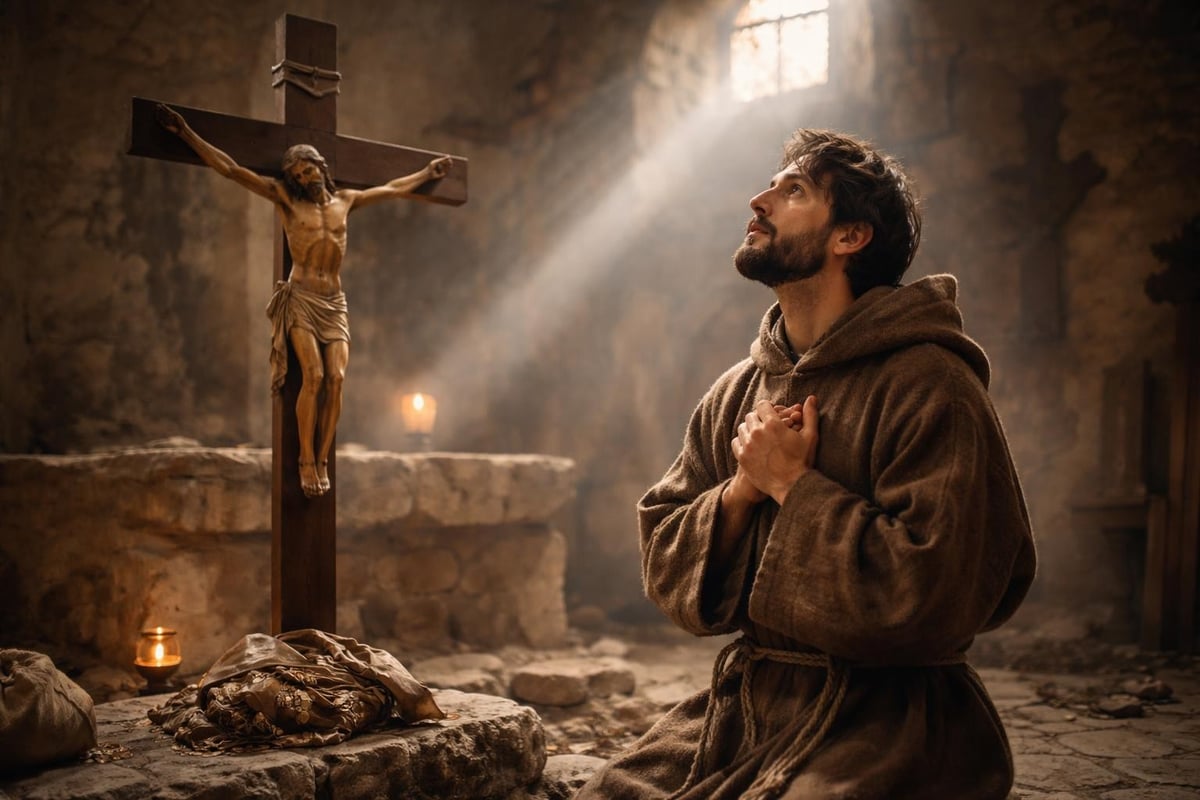
The Turning Point at San Damiano
The defining moment in Francis's conversion occurred around 1205 when he prayed before a crucifix in the dilapidated church of San Damiano. According to tradition, Francis heard Christ speak to him from the cross, saying, "Francis, go and repair my house, which as you see is falling into ruin." Initially interpreting this literally, Francis sold cloth from his father's warehouse to fund the church's repair.
This act led to a dramatic confrontation with his father before the Bishop of Assisi. In a powerful gesture of renunciation, Francis stripped off his fine clothes and returned them to his father, declaring his commitment to poverty and to "Father in Heaven" alone. This comprehensive biography provides extensive details about this transformative period in his life.
Founding the Franciscan Order
After his conversion, Francis de Assisi began living in absolute poverty, begging for food, caring for lepers, and repairing churches with his own hands. His radical lifestyle attracted followers who were equally captivated by his joyful embrace of Gospel poverty and his Christ-centered spirituality. By 1209, Francis had gathered eleven companions who shared his vision.
Francis composed a simple Rule of life for his followers, emphasizing:
- Absolute poverty - owning nothing individually or communally
- Obedience to the Gospel and to Church authority
- Preaching penance and peace
- Manual labor to support themselves
- Care for lepers and the marginalized
Pope Innocent III initially hesitated but eventually approved the Rule orally in 1209, giving birth to what would become the Order of Friars Minor (Franciscans). This approval marked a crucial moment for the Catholic Church, as it validated a new form of religious life focused on urban poverty and itinerant preaching.
Growth and Organization
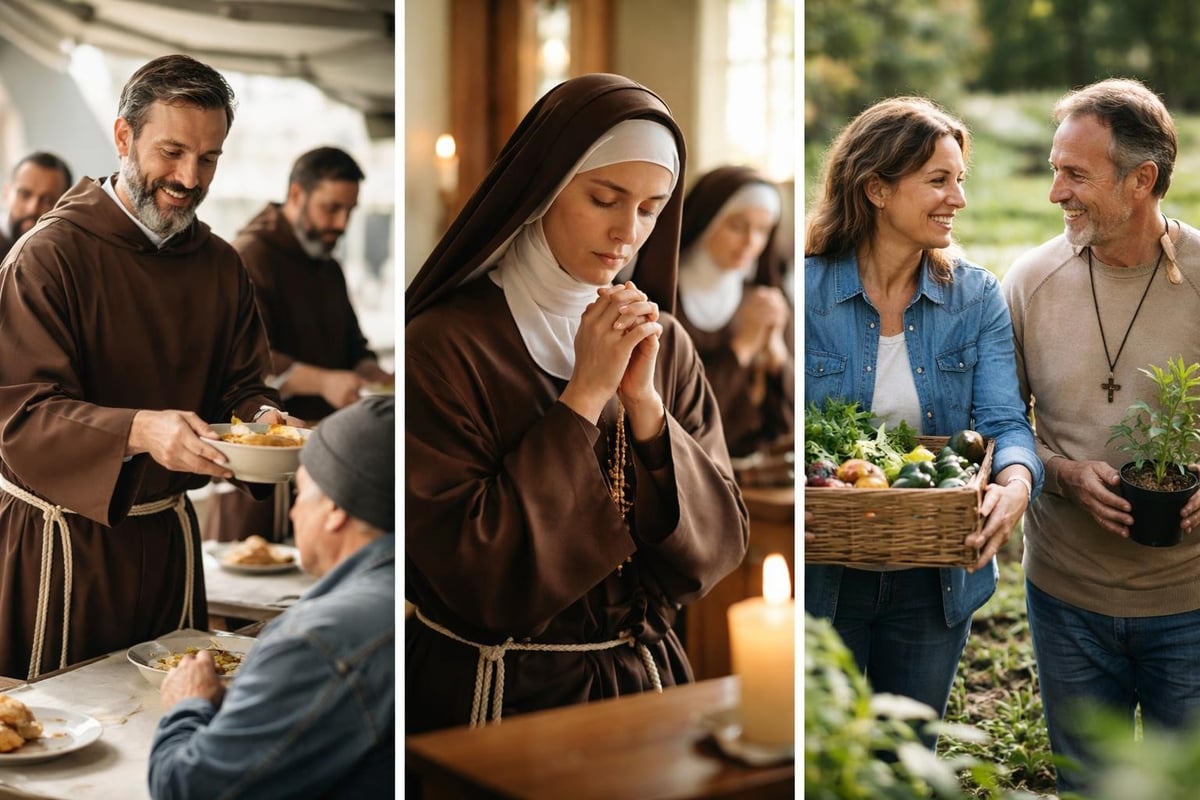
The Franciscan movement spread rapidly across Italy and beyond. Francis de Assisi, along with Saint Clare of Assisi, established the Second Order (Poor Clares) for women in 1212. Later, the Third Order was created for lay people who wished to live according to Franciscan spirituality while remaining in their secular vocations.
| Franciscan Orders | Founded | Purpose |
|---|---|---|
| First Order (Friars Minor) | 1209 | Men living in community under vows |
| Second Order (Poor Clares) | 1212 | Contemplative women religious |
| Third Order (Secular Franciscans) | 1221 | Lay people in the world |
The rapid expansion presented organizational challenges. Francis struggled with maintaining his original vision of radical poverty as the order grew more structured and institutionalized. These tensions reflect the perpetual challenge of balancing charismatic spirituality with practical governance.
Spirituality and Mystical Experiences
The spirituality of Francis de Assisi centered on imitating Christ through poverty, humility, and compassion. His approach to faith was deeply personal, emotional, and experiential rather than merely intellectual. Francis sought to live the Gospel literally, taking seriously Christ's commands to the disciples about abandoning possessions and trusting divine providence.
The Stigmata at La Verna
In September 1224, while praying on Mount La Verna, Francis de Assisi received the stigmata - the five wounds of Christ appeared on his body. This mystical experience, witnessed by his companions, marked him as uniquely conformed to the crucified Christ. The stigmata remained with Francis until his death, causing him considerable physical suffering but also filling him with spiritual consolation.
This extraordinary gift deepened Francis's already profound identification with Christ's passion. He bore these sacred wounds with humility, attempting to conceal them from others. The stigmata of Francis de Assisi represents the first documented case in Christian history, establishing a precedent for this rare mystical phenomenon.
Love for Creation and the Canticle of the Creatures
Francis possessed a distinctive reverence for all creation, viewing every creature as a brother or sister made by the same loving Creator. His famous "Canticle of the Creatures" (also called "Canticle of the Sun") praised God through "Brother Sun," "Sister Moon," "Brother Wind," "Sister Water," and even "Sister Death." This theological vision recognized the goodness of material creation and anticipated modern ecological consciousness.
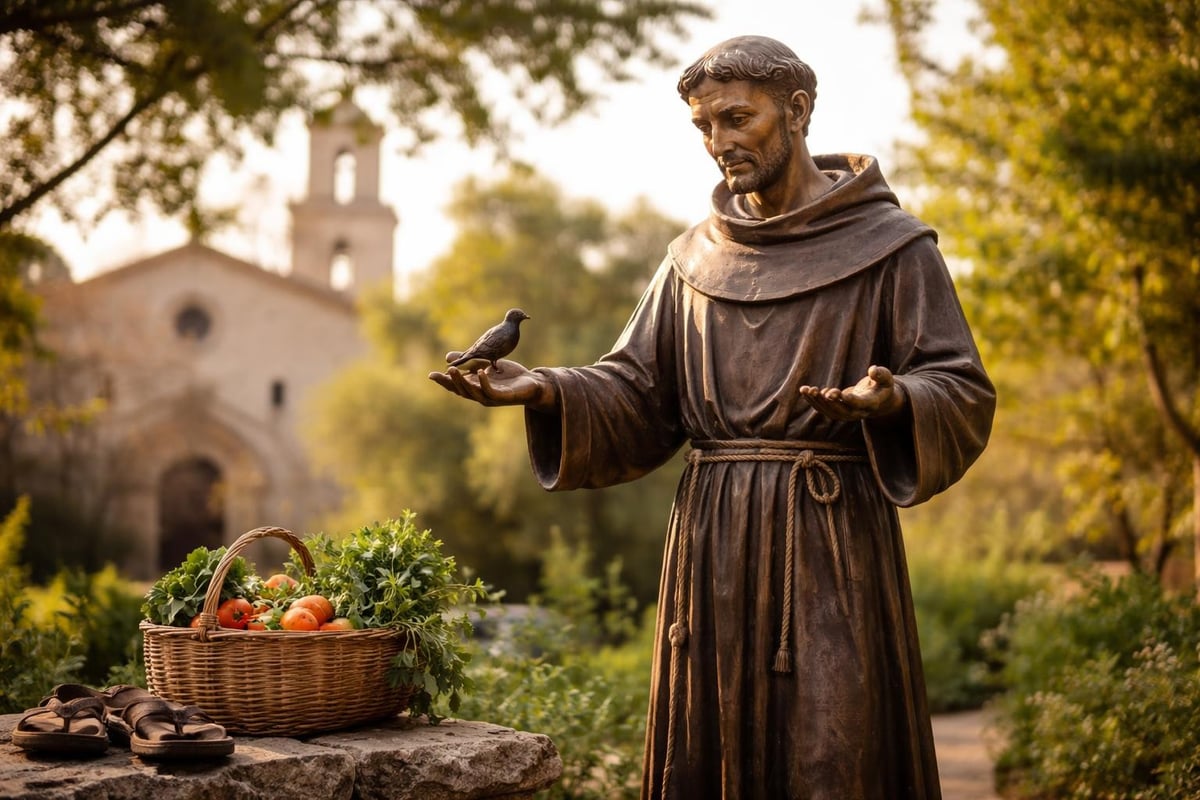
The famous legend of Francis preaching to the birds at Bevagna illustrates his kinship with all living things. Whether historical or symbolic, these stories communicate Francis's conviction that all creation glorifies God and deserves respect. For those seeking to understand Catholic saints and their unique charisms, Francis offers a beautiful example of holiness expressed through creation care.
Mission and Evangelization Efforts
Francis de Assisi was a passionate evangelist who traveled extensively to preach the Gospel. Unlike many medieval preachers who focused on theological debate, Francis emphasized simple, heartfelt conversion and peace. His preaching style was direct, emotional, and accessible to common people, often drawing large crowds in town squares.
In 1219, during the Fifth Crusade, Francis undertook a bold mission to Egypt. He crossed battle lines to meet with Sultan al-Kamil, seeking to convert him and end the conflict through peaceful dialogue. While the sultan did not convert, he received Francis with respect and safe passage. This encounter demonstrated Francis's commitment to peace and his willingness to engage with those of different faiths.
Francis's missionary vision extended the Franciscan presence to:
- Spain and Portugal - establishing communities in Iberian territories
- France and Germany - bringing the Franciscan charism to northern Europe
- The Holy Land - maintaining a Franciscan presence in Jerusalem that continues today
- North Africa - attempting evangelization despite dangers
- Eastern Europe - spreading to Hungary and beyond
His missionary efforts laid the groundwork for the Franciscans to become one of the Church's primary evangelizing forces. The order's emphasis on poverty and simplicity made Franciscan missionaries particularly effective in reaching the poor and marginalized.
The Nativity Scene and Popular Devotions
Francis de Assisi created the first nativity scene (presepio) in 1223 at Greccio, Italy. Desiring to make the mystery of Christ's birth more tangible and accessible to ordinary people, he arranged a living tableau with real animals and a manger. This innovation transformed Christmas celebrations and established a beloved Catholic tradition that continues worldwide.
The nativity scene at Greccio reflected Francis's genius for making abstract theological truths concrete and experiential. By recreating Bethlehem's stable, he invited believers to encounter the humble circumstances of the Incarnation. This devotional practice spread rapidly throughout Catholic Europe and remains a cherished Christmas tradition in homes and churches globally.
Many Catholics today deepen their faith through tangible devotions and prayer practices that Francis would have appreciated. The Surrender Novena Packages offer believers a way to pray with the same trust in divine providence that characterized Francis de Assisi's own spirituality, surrendering all concerns to God's loving care.
Final Years and Death
The later years of Francis de Assisi were marked by physical suffering and spiritual deepening. The stigmata caused ongoing pain, and he developed various ailments including an eye disease that gradually caused blindness. Despite his deteriorating health, Francis maintained his joyful spirit and continued to compose hymns of praise.
Francis spent his final days at the Porziuncola, the small chapel where the Franciscan movement began. He died on October 3, 1226, lying on bare ground in imitation of Christ's poverty. According to witnesses, he asked to be laid naked on the earth, singing Psalm 142 as he approached death.
Canonization and Veneration
Pope Gregory IX canonized Francis de Assisi on July 16, 1228, less than two years after his death. This rapid canonization reflected the widespread recognition of his holiness and the immediate popular devotion to him. The Basilica of Saint Francis was constructed in Assisi to house his remains, becoming one of Christianity's most important pilgrimage sites.
In 2026, St. Francis's bones were publicly displayed in Assisi, drawing thousands of pilgrims who venerated his relics. This event highlighted the enduring devotion to Francis de Assisi and the continued relevance of his witness. His feast day is celebrated on October 4, and he is recognized as the patron saint of animals, ecology, merchants, and Italy.
Influence on Modern Catholicism
The impact of Francis de Assisi extends powerfully into contemporary Catholic life and thought. When Cardinal Jorge Mario Bergoglio chose the papal name "Francis" in 2013, he became the first pope to take this name, signaling his commitment to poverty, simplicity, and care for the marginalized. Pope Francis's reform themes draw explicitly from the example of the medieval saint.
Pope Francis has emphasized themes central to the spirituality of Francis de Assisi:
- Preferential option for the poor and those on society's margins
- Environmental stewardship as expressed in the encyclical Laudato Si'
- Simplicity in Church governance and rejection of clericalism
- Interfaith dialogue and peace-making
- Joy in the Gospel rather than rigid moralism
The papal namesake demonstrates how St. Francis's love for the poor, creation, and peace continues to shape Catholic priorities in the 21st century. This connection between medieval saint and modern pope illustrates the timeless relevance of Franciscan spirituality.
Lessons for Contemporary Disciples
Francis de Assisi offers contemporary Catholics a compelling model of radical Christian living. His example challenges the materialism, consumerism, and individualism that characterize modern culture. Several key lessons emerge from studying his life:
Simplicity and Detachment
Francis's embrace of poverty was not merely material but spiritual. He demonstrated freedom from attachment to possessions, status, and security. This detachment liberated him to love God and neighbor more fully. Modern disciples can apply this principle by examining their own attachments and practicing simplicity in lifestyle choices.
Encountering Christ in the Poor
For Francis de Assisi, serving lepers and beggars was not charity work but encountering Christ himself in disguised form. This theological vision transforms social ministry from optional good works to essential Christian practice. Catholics today are challenged to recognize Christ's presence in refugees, the homeless, prisoners, and other marginalized populations.
Creation as Sacramental
Francis's vision of creation as revelatory of God's goodness offers resources for contemporary environmental theology. His Canticle of the Creatures presents nature not as mere resource for human use but as a community of praise to the Creator. This perspective supports Catholic environmental advocacy and creation care initiatives.
| Franciscan Value | Medieval Expression | Contemporary Application |
|---|---|---|
| Poverty | Owning nothing | Simplicity, generosity, anti-consumerism |
| Obedience | Submission to Church | Listening, humility, discernment |
| Preaching | Town square sermons | New evangelization, witness |
| Peace | Meeting the Sultan | Interfaith dialogue, conflict resolution |
| Joy | Singing despite suffering | Gratitude, hope, celebration |
The Franciscan Legacy Today
The Franciscan order remains one of the Catholic Church's largest and most active religious communities. The three Franciscan orders collectively include tens of thousands of members worldwide, serving in education, healthcare, social services, missions, and parish ministry. Franciscan universities, hospitals, and charitable organizations carry forward Francis's commitment to serving the poor and marginalized.
Beyond formal Franciscan communities, Francis de Assisi's spirituality influences millions of Catholics and other Christians. His emphasis on simplicity, peace, and creation care resonates across denominational boundaries. Environmental activists, peace workers, and those committed to voluntary simplicity often cite Francis as inspiration, even when not Catholic.
The Franciscan saints and their spiritual heritage continue to enrich Catholic devotional life and provide models of holiness across diverse contexts. From Saint Clare to Saint Anthony of Padua to Blessed Junípero Serra, the Franciscan family includes numerous canonized saints who embodied Francis's charism in unique ways.
For those seeking to deepen their understanding of the Catholic saints and their wisdom, resources exploring the lives of holy men and women offer valuable insights into how saints like Francis de Assisi discovered and lived holiness in their particular circumstances.
Resources and Further Exploration
-
Explore Journeys of Faith Online store with thousands of Catholic items at https://journeysoffaith.com/collections - discover books, prayer cards, and devotional materials that help you grow closer to the saints.
-
Our Unique Mega Search Engine at https://journeysoffaith.com/search is linked to hundreds of Catholic shops and stores, making it easy to find exactly what you need for your spiritual journey.
-
Get the Journeys of Faith NEW App for iPhone or Android. Search for Journeys of Faith or go to https://journeysoffaith.com/pages/download-our-app to access Catholic resources on the go.
-
Chat with us anytime at https://chatting.page/mjxs9aerrtgm3lmpndlcepmbyosntrjn - we're here to help with questions about saints, prayer, and Catholic faith.
-
We need your help to reach more souls. Please make a donation at https://journeysoffaith.com/pages/donate to support our mission of evangelization through media.
Those interested in learning more about Francis de Assisi can explore various resources. Detailed video biographies provide visual presentations of his life and legacy. Additionally, narrated accounts of his work and spirituality offer accessible introductions to Franciscan spirituality.
Reading about the saints provides inspiration and practical guidance for living Christian faith more authentically. The example of Francis de Assisi demonstrates that holiness is not reserved for extraordinary people but is accessible to anyone willing to surrender completely to God's will. His radical trust, joyful poverty, and compassionate service continue to challenge and inspire believers across generations.
The witness of Francis de Assisi invites contemporary Catholics to examine their own lives and ask how they might more faithfully follow Christ. Whether through simplifying possessions, serving the poor, caring for creation, or cultivating peace, his example offers concrete pathways for deepening discipleship. His life proves that one person fully committed to the Gospel can indeed change the world.
The life of Francis de Assisi demonstrates the transformative power of radical Gospel living and continues to challenge Christians to authentic discipleship centered on poverty, peace, and compassion. His witness reminds us that encountering Christ in prayer, the poor, and creation leads to joy even amid suffering. At Journeys of Faith, we're committed to sharing the stories of saints like Francis through books, media, and resources that inspire deeper faith and more faithful witness to Christ in today's world.