

The Catholic Church has been blessed with countless male saints who have shaped the course of Christian history through their extraordinary faith, courage, and devotion. These holy men, ranging from apostles and martyrs to scholars and missionaries, offer timeless examples of how ordinary individuals can achieve extraordinary sanctity. Their lives demonstrate that holiness is not reserved for a select few but is accessible to every person who surrenders to God's will. By studying the journeys of male saints, Catholics discover practical wisdom, spiritual encouragement, and proven pathways to deeper relationship with Christ.
The Foundation of Male Sanctity in Scripture
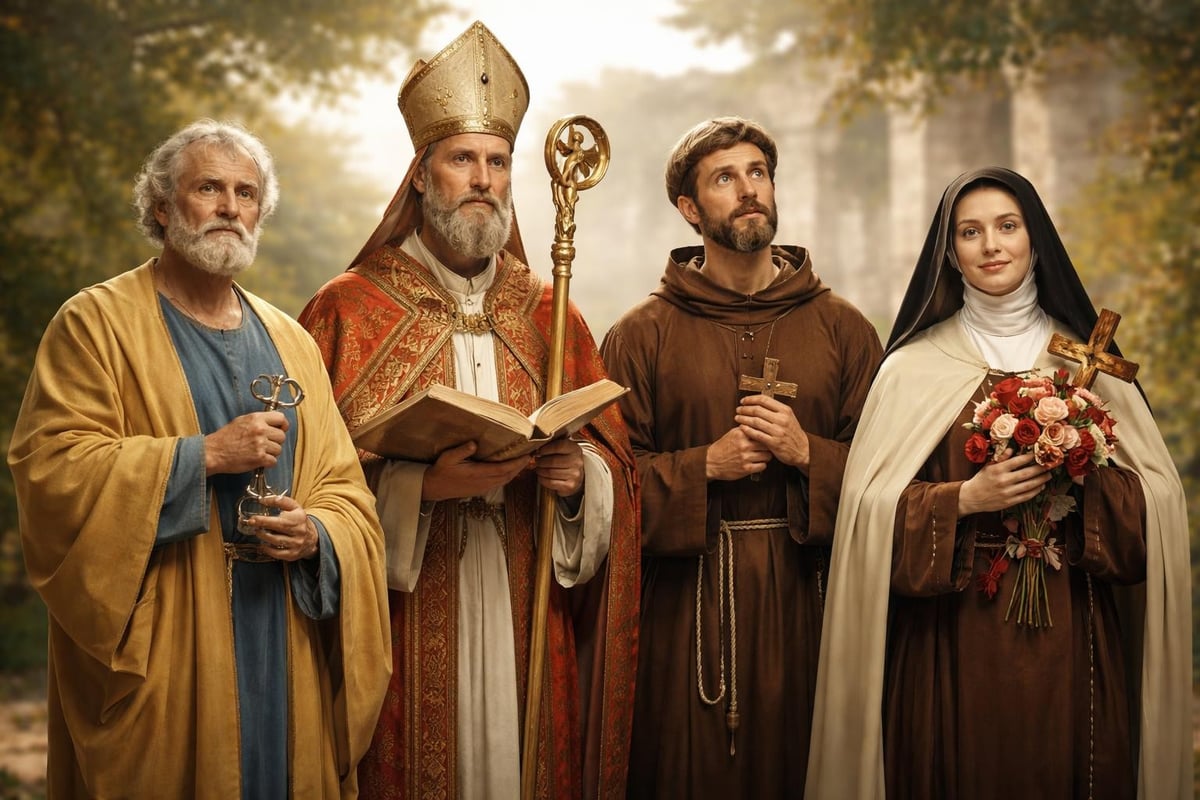
The foundation for understanding male saints begins with the twelve apostles chosen by Christ himself. These men, despite their human weaknesses and doubts, became the pillars upon which the Church was built. Saint Peter, the first pope, exemplifies how humility and repentance transform failure into leadership. His denial of Christ followed by his tearful conversion reveals the profound mercy available to all believers.
Saint Paul represents a dramatic conversion that redirected a persecutor into the greatest missionary the early Church ever knew. His letters form a substantial portion of the New Testament, providing theological depth and pastoral guidance that continues to nourish the faithful. The Catholic Encyclopedia's exploration of patron saints details how these early male saints established patterns of intercession that persist throughout Church tradition.
Saint John the Evangelist, known as the beloved disciple, offers a model of contemplative devotion combined with theological insight. His Gospel emphasizes the identity of Christ as the Word made flesh, while his epistles stress the centrality of love in Christian life. These apostolic witnesses established the essential characteristics that define male sanctity: courage in proclaiming truth, willingness to suffer for faith, and unwavering commitment to Christ's mission.
Brought to you by Journeys of Faith, founded by Bob and Penny Lord. We are an Augustinian Secular Institute and Cyber Apostles. Our mission is evangelization through media.
Early Church Fathers and Martyrs
The post-apostolic era produced remarkable male saints who defended orthodoxy and willingly sacrificed their lives for the faith. Saint Ignatius of Antioch, martyred around 107 AD, wrote letters en route to his execution that reveal profound theological understanding and passionate love for Christ. His famous words about being "wheat of Christ, ground by the teeth of beasts" illustrate the transformative power of martyrdom.
Saint Polycarp of Smyrna, a direct disciple of Saint John the Apostle, bridges the apostolic age with the early Church. His martyrdom at age 86 demonstrates that sanctity strengthens rather than diminishes with age. When offered the chance to deny Christ and save his life, he responded: "Eighty-six years I have served Him, and He has done me no wrong. How can I blaspheme my King and Savior?"
The Internet Medieval Sourcebook's collection of hagiographies preserves these powerful testimonies for modern readers. These early male saints established crucial theological foundations while their blood became, as Tertullian noted, the seed of the Church. Their witness proved that no earthly threat could extinguish the fire of Christian conviction.
Theological Giants of the Patristic Period
Saint Augustine of Hippo stands as perhaps the most influential theologian in Western Christianity after Saint Paul. His "Confessions" remains a masterpiece of spiritual autobiography, chronicling his journey from worldly pursuits to complete surrender to God. Augustine's intellectual rigor combined with pastoral sensitivity created a template for theological reflection that serves the Church today.
Saint Athanasius defended the divinity of Christ against the Arian heresy, enduring five exiles for his steadfast commitment to orthodox truth. His biography of Saint Anthony the Great introduced monasticism to the wider Christian world, inspiring countless men to pursue holiness through solitude, prayer, and asceticism. These patristic fathers demonstrated that male sanctity requires both intellectual depth and courageous action.
Medieval Saints: Monasticism and Mission
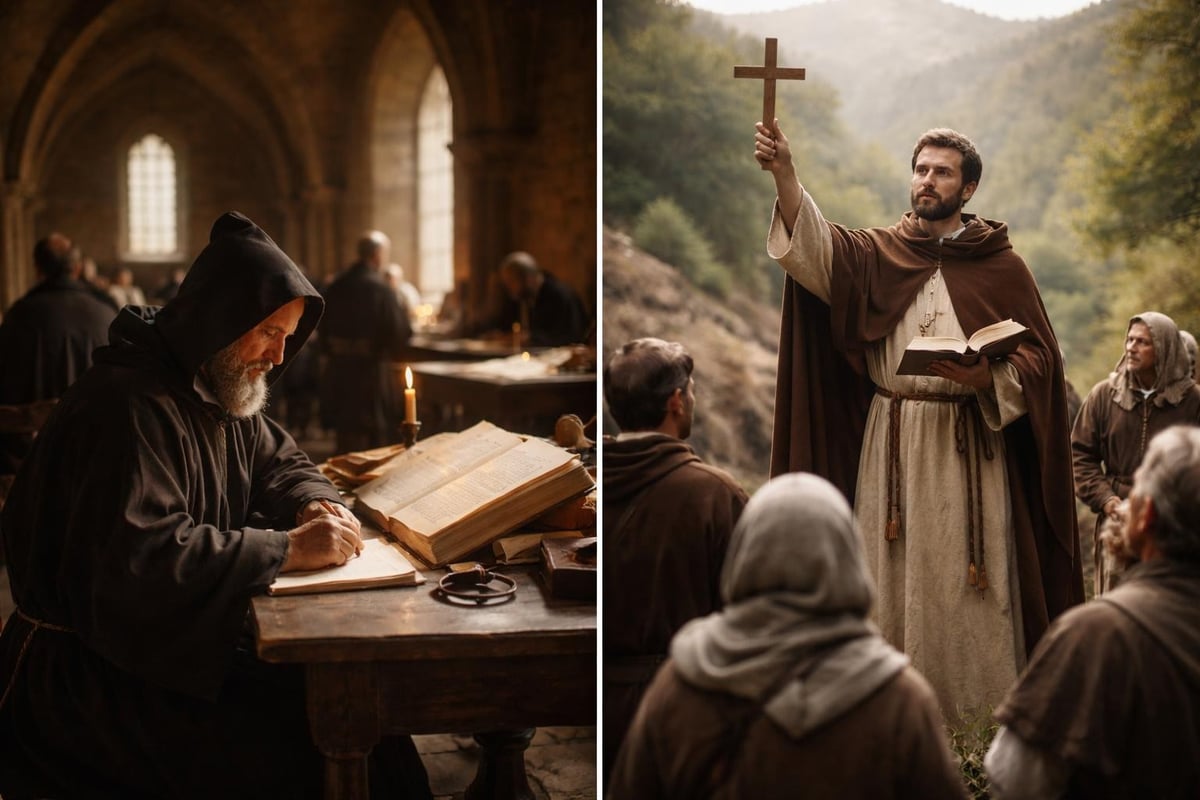
The medieval period witnessed an explosion of male sanctity through monastic reform and missionary expansion. Saint Benedict of Nursia, the father of Western monasticism, created a rule that balanced prayer, work, and study. His motto "ora et labora" (pray and work) established rhythms that continue to shape Catholic spirituality. Benedictine monasteries became centers of learning, agriculture, and hospitality throughout Europe.
Saint Francis of Assisi revolutionized Christian spirituality through his radical embrace of poverty and creation. His cheerful simplicity and stigmata (bearing the wounds of Christ) inspired millions to see Christ in the poor and marginalized. The Franciscan movement he founded brought evangelical fervor to city streets and university halls alike.
Saint Dominic de Guzman responded to heresy not with violence but with preaching and education. The Dominican Order he established produced some of Christianity's greatest theologians, including Saint Thomas Aquinas. These mendicant movements demonstrated how male saints could renew the Church through return to Gospel simplicity.
Missionary Saints Who Transformed Cultures
Saint Patrick brought Christianity to Ireland through patient evangelization that respected local culture while challenging pagan practices. His effective missionary strategy combined bold proclamation with genuine love for the Irish people. The Celtic Christianity that emerged became a powerhouse of learning and missionary zeal.
Saint Boniface evangelized Germany and reformed the Frankish church, ultimately dying as a martyr. His organizational skills and theological clarity established structures that supported lasting conversion. These missionary male saints prove that authentic evangelization requires both courage and cultural sensitivity. The detailed biographies at Roman Catholic Saints provide extensive documentation of these remarkable evangelizers.
| Saint | Era | Primary Contribution | Feast Day |
|---|---|---|---|
| Saint Patrick | 5th Century | Evangelization of Ireland | March 17 |
| Saint Boniface | 8th Century | Conversion of Germany | June 5 |
| Saint Cyril & Methodius | 9th Century | Slavic Evangelization | February 14 |
| Saint Francis Xavier | 16th Century | Asian Missions | December 3 |
Counter-Reformation Saints and Spiritual Renewal
The Protestant Reformation prompted the Catholic Church to produce male saints who combined reform with orthodoxy. Saint Ignatius of Loyola founded the Society of Jesus after a dramatic conversion from military ambition to spiritual warfare. His "Spiritual Exercises" provide a systematic method for discernment and prayer that transforms countless lives. The Jesuits became the Church's intellectual and missionary vanguard.
Saint Charles Borromeo implemented the reforms of the Council of Trent as Archbishop of Milan, demonstrating that renewal begins with personal holiness and episcopal leadership. His pastoral visits, catechetical programs, and care for the poor set standards for effective Church governance. He proved that administrative skill and mystical prayer complement rather than contradict each other.
Saint Philip Neri brought joy and accessibility to sanctity through his Congregation of the Oratory. His cheerful spirituality and emphasis on frequent confession and communion made holiness attractive to laypeople. These counter-reformation male saints show that authentic reform preserves tradition while addressing contemporary needs. For those seeking to deepen their understanding of saints' lives, Catholic Saints Books offers resources that reveal the secrets to holiness discovered by studying these holy men.
Carmelite Reform and Mystical Theology
Saint John of the Cross partnered with Saint Teresa of Avila to reform the Carmelite Order, returning it to contemplative roots. His mystical writings, particularly "Dark Night of the Soul," chart the soul's journey through purgation to union with God. These profound works demonstrate that male saints contribute not only through action but through articulating the spiritual life's deepest mysteries.
Saint Peter of Alcantara practiced extreme asceticism while maintaining profound simplicity. His guidance to Saint Teresa proved instrumental in her own reform efforts. These Carmelite male saints reveal that holiness often requires embracing the cross through voluntary suffering and radical trust.
Modern Male Saints: Holiness in Contemporary Context
The modern era demonstrates that sanctity adapts to changing circumstances without compromising eternal truths. Saint John Vianney, the Curé of Ars, transformed a spiritually indifferent parish through unwavering dedication to the confessional and Eucharist. Despite limited education, his profound spiritual wisdom attracted pilgrims from across Europe. He proves that pastoral effectiveness flows from prayer rather than mere technique.
Saint Maximilian Kolbe volunteered to die in place of a stranger at Auschwitz, embodying Christ's teaching that greater love has no one than to lay down his life for his friends. His Marian devotion and use of media for evangelization anticipated the Second Vatican Council's emphasis on modern communication methods. These twentieth-century male saints faced unprecedented challenges with traditional virtues.
Saint John Paul II's pontificate spanned critical decades of Church history, addressing atheistic communism, moral relativism, and secularization. His philosophical depth, pastoral warmth, and dramatic witness to suffering in old age created a multifaceted model of contemporary sanctity. His emphasis on the universal call to holiness inspired millions to pursue serious spiritual life regardless of vocation.
Saints of Social Justice and Mercy
Saint Vincent de Paul revolutionized charitable work through organized systems that addressed root causes of poverty. His Vincentian spirituality combines practical assistance with spiritual formation, recognizing the dignity of every person. The Vincentian family he inspired continues serving the marginalized worldwide.
Saint John Bosco developed innovative educational methods that combined academic excellence with moral formation and joy. His Salesian approach to youth ministry emphasized prevention rather than punishment, reason over force. These male saints of mercy demonstrate that authentic holiness includes concrete service to the least among us. Resources like Journeys of Faith's streaming channels make the stories of these powerful witnesses accessible to modern audiences.
Diverse Vocations Among Male Saints
Male saints represent every possible vocation and social position, proving holiness transcends circumstance. Kings like Saint Louis IX balanced political power with personal humility and justice. Scholars like Saint Thomas Aquinas integrated faith and reason, creating theological syntheses that guide the Church centuries later. Laymen like Saint Joseph Moscati practiced medicine as a form of prayer and service.
Working-class saints like Saint Joseph the Worker and Saint Isidore the Farmer sanctified ordinary labor through extraordinary love. Their example encourages contemporary Catholics to view daily work as collaboration with God's creative activity. Military saints like Saint Joan of Arc's companion Saint Jean de Brébeuf show that even warriors can pursue holiness through just defense of the innocent.
Key Categories of Male Saints:
- Apostles and Evangelists: Foundation of Church teaching and Scripture
- Martyrs: Witnessed faith through blood sacrifice
- Bishops and Popes: Guided the Church through leadership and teaching
- Monks and Hermits: Explored depths of contemplative prayer
- Missionaries: Carried Gospel to unreached peoples
- Scholars and Doctors: Articulated theological truth
- Social Reformers: Addressed injustice and poverty
- Laymen: Sanctified secular professions and family life
The comprehensive directory at Saintly Ways catalogs this remarkable diversity, demonstrating the Church's universal character. Each vocation offers unique opportunities for holiness when pursued with genuine love for God and neighbor.
Common Characteristics of Male Saints
Despite their diversity, male saints share identifiable characteristics that mark authentic holiness. Deep Eucharistic devotion appears consistently throughout their lives, whether as priests celebrating Mass or laymen receiving communion with reverence. The Eucharist sustained them through persecution, doubt, and spiritual darkness. This sacramental foundation proves essential for supernatural transformation.
Intense prayer lives distinguished these holy men from their contemporaries. Whether through liturgical prayer, contemplative silence, or devotional practices, they prioritized communion with God. Saint Alphonsus Liguori famously stated that a day without prayer is a day without grace. Male saints took this principle seriously, carving out time for prayer despite demanding schedules.
Heroic virtue manifested in their willingness to sacrifice comfort, reputation, and life itself for truth. This supernatural courage flowed not from natural temperament but from grace perfecting nature. They faced opposition from civil authorities, ecclesiastical politics, and their own weaknesses with persistent faith. Their witness proves that grace empowers ordinary men to accomplish extraordinary deeds.
Marian Devotion and Male Sanctity
Profound devotion to Mary characterizes most male saints across all eras. Saint Louis de Montfort's "True Devotion to Mary" articulated how Marian consecration accelerates spiritual growth. Saint Maximilian Kolbe's Militia Immaculata mobilized thousands in service to the Immaculate Heart. These holy men recognized that Christ gave His mother to all believers at Calvary. Their masculine strength complemented rather than contradicted filial trust in Mary's maternal intercession.
| Characteristic | Description | Biblical Foundation |
|---|---|---|
| Eucharistic Devotion | Central focus on Real Presence | John 6:53-56 |
| Prayer Life | Consistent communion with God | Luke 18:1 |
| Heroic Virtue | Supernatural courage in adversity | Matthew 10:22 |
| Marian Devotion | Filial trust in Mary's intercession | John 19:26-27 |
| Missionary Zeal | Passion for spreading Gospel | Matthew 28:19-20 |
Patron Saints and Practical Intercession
The Church recognizes certain male saints as patron saints for specific professions, causes, or situations. Saint Joseph serves as patron of workers, fathers, and the universal Church. His silent strength and faithful obedience provide models for contemporary men navigating family and work responsibilities. Invoking his intercession connects believers with his powerful advocacy before God.
Saint Michael the Archangel protects against spiritual warfare and leads heavenly armies against evil. His masculine strength and unwavering loyalty to God inspire men facing temptation or persecution. Military personnel, police officers, and others in protective professions find particular resonance with his example.
Professional patronages reflect how male saints sanctified specific occupations. Saint Luke guides physicians, Saint Matthew assists accountants, and Saint Genesius protects actors. These patronages remind Catholics that every legitimate profession offers opportunities for holiness when pursued with proper intention. The intercession of these male saints provides practical spiritual support for daily challenges.
Learning from Male Saints Today
Contemporary Catholics access male saints' wisdom through multiple channels. Reading their biographies reveals how they navigated challenges remarkably similar to modern struggles. Saint Augustine's battle with lust, Saint Ignatius's discernment of spirits, and Saint John Vianney's pastoral fatigue resonate with current experiences. Their solutions, rooted in grace rather than mere willpower, offer proven strategies for spiritual growth.
Praying with their writings deepens understanding of contemplative life. Saint Francis de Sales' "Introduction to the Devout Life" provides accessible guidance for laypeople seeking holiness. Saint John of the Cross's mystical works chart advanced stages of prayer for those called to deeper union. These spiritual classics remain perpetually relevant because they address the human soul's fundamental dynamics. The Journeys of Faith blog regularly explores these timeless teachings in contemporary context.
Practical Ways to Connect with Male Saints:
- Choose a patron saint for your profession or situation
- Read one biography monthly to study their virtues
- Pray their written prayers or novenas regularly
- Visit shrines or churches dedicated to specific saints
- Celebrate their feast days with special devotions
- Study their approach to challenges you currently face
- Join confraternities or associations under their patronage
Implementing Saints' Wisdom in Daily Life
Male saints demonstrate that holiness emerges through small daily choices rather than dramatic gestures alone. Saint Josemaría Escrivá taught that ordinary work becomes prayer when offered to God. His spirituality of Opus Dei (Work of God) encourages sanctifying professional life through excellence and charity. This accessible approach makes sanctity achievable for everyone.
Saint John Bosco's preventive system in education emphasizes creating environments where virtue flourishes naturally. His principles apply to parenting, management, and mentorship. By studying how male saints addressed practical challenges, contemporary Catholics gain wisdom that transforms everyday situations into opportunities for grace.
The Communion of Male Saints
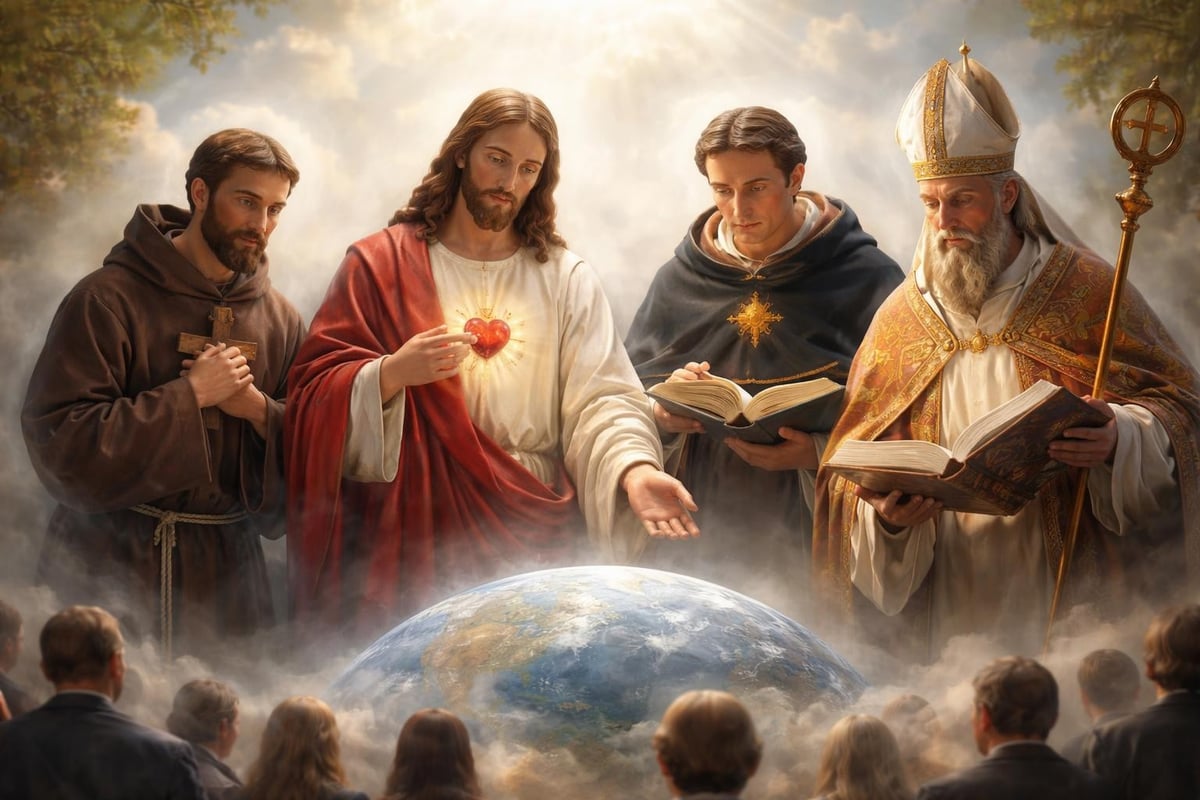
The Church's teaching on the communion of saints affirms that these holy men remain actively engaged in believers' spiritual welfare. They intercede before God's throne, presenting petitions and offering encouragement. This supernatural reality means Catholics never walk alone but journey alongside countless witnesses who have successfully completed the race.
Devotion to male saints strengthens during difficult times when their example provides hope and their intercession brings consolation. During persecution, remembering martyrs like Saint Thomas More or Saint Miguel Pro inspires courage. In intellectual doubt, recalling Saint Augustine's journey from skepticism to faith reassures seekers. This communion transcends time and space, uniting the Church Militant, Suffering, and Triumphant.
The legends and traditions surrounding saints sometimes blend historical fact with pious embellishment, yet these narratives serve important catechetical purposes. They communicate theological truths through memorable stories that inspire imitation. Discerning the historical core while appreciating the spiritual message enriches understanding of male saints' continued relevance.
Canonization Process and Recognition
The Church's formal canonization process ensures that declared male saints authentically lived heroic virtue and can be safely proposed for universal veneration. This rigorous investigation examines their lives, writings, and reputation for holiness. Required miracles demonstrate God's confirmation of their sanctity through supernatural intervention.
Understanding this process helps Catholics distinguish between genuine holiness and mere popularity or sentimentality. Not every good person becomes a canonized saint, yet the Church recognizes many more holy individuals than those formally declared. The canonized male saints represent proven examples whose intercession and imitation the Church confidently recommends.
Recent canonizations like Saint John Paul II and Saint Oscar Romero demonstrate the Church's continued production of male saints. These modern witnesses prove that sanctity remains achievable in contemporary circumstances. Their lives address current challenges while embodying timeless virtues, creating bridges between tradition and modernity.
Male Saints in Family and Education
Parents wisely introduce children to male saints as role models superior to secular celebrities. Stories of Saint Tarcisius, the boy martyr who protected the Eucharist, inspire young people to courage. Tales of Saint Dominic Savio's purity and devotion encourage adolescents toward virtue. These age-appropriate examples plant seeds that may flourish throughout life. Educational resources like home school materials from Journeys of Faith incorporate saints' lives into comprehensive Catholic formation.
Catholic schools benefit from highlighting male saints in curriculum and culture. Naming houses or teams after saints creates friendly competition while teaching their virtues. Celebrating feast days with special activities makes Church calendar personally meaningful. This integration forms Catholic identity and provides practical models for Christian living.
Fathers particularly need male saints as models of authentic masculinity. Saint Joseph's silent strength, Saint Thomas More's principled integrity, and Saint John Paul II's tender strength demonstrate that holiness enhances rather than diminishes masculinity. These examples counter cultural confusion about male identity by presenting men fully alive in Christ.
Resources for Studying Male Saints
Numerous resources support deeper engagement with male saints' lives and teachings. The Journeys of Faith online store offers thousands of Catholic items including books, DVDs, and prayer cards featuring male saints. Their unique mega search engine links to hundreds of Catholic shops, making comprehensive research convenient and accessible.
Digital resources expand access to saints' wisdom. The Journeys of Faith app for iPhone or Android provides portable access to saints' stories and prayers. Their streaming services make documentaries and teachings about male saints available anywhere. These modern media fulfill the evangelization mission while honoring timeless content.
Personal interaction enhances learning. Chatting with Journeys of Faith provides opportunities to ask questions and receive guidance. Their conferences and retreats offer immersive experiences that deepen appreciation for male saints. Supporting this mission through donations helps reach more souls with these transformative stories.
Recommended Starting Points:
- Begin with New Testament apostles for foundational understanding
- Explore patron saints related to your profession or needs
- Read one comprehensive biography to understand depth
- Study a saint from your ethnic or cultural background
- Investigate saints who faced challenges similar to yours
- Follow the liturgical calendar, learning about daily feast commemorations
Male saints throughout Catholic history demonstrate that holiness remains accessible to every man willing to surrender to God's transforming grace. Their diverse lives, spanning continents and centuries, prove that authentic sanctity adapts to changing circumstances while maintaining eternal truths. Whether you seek inspiration, intercession, or practical wisdom, these holy men offer powerful witness to Christ's redemptive power. Journeys of Faith provides comprehensive resources to help you discover and learn from these remarkable witnesses through books, media, and educational materials that make their timeless wisdom accessible for contemporary application.