

Saint Turibius of Mongrovejo stands as one of the most remarkable missionary bishops in Catholic history, transforming the spiritual landscape of colonial Peru through unwavering dedication to evangelization and social justice. Born in 1538 in Mayorga, Spain, this learned lawyer unexpectedly became the Archbishop of Lima, where he spent 25 years traveling the vast territories of South America, baptizing hundreds of thousands of indigenous people, and defending their rights against colonial exploitation. His legacy of pastoral care, administrative reform, and tireless evangelization continues to inspire Catholics worldwide, particularly those engaged in missionary work and social justice advocacy. Understanding the life and mission of saint turibius of mongrovejo offers profound insights into authentic Christian leadership and the Church's role in promoting human dignity.
Early Life and Unexpected Call to Episcopal Service
Turibius Alfonso de Mogrovejo grew up in a distinguished family in Castile, receiving an exceptional education that prepared him for a legal career. He studied at the University of Salamanca, one of Europe's most prestigious institutions, where he earned doctorates in both civil and canon law. His academic brilliance and moral integrity caught the attention of King Philip II of Spain, who appointed him as chief judge of the Inquisition at Granada in 1573.
Despite his success in the legal profession, saint turibius of mongrovejo never imagined ecclesiastical leadership. He was not even ordained when King Philip II nominated him for the prestigious position of Archbishop of Lima in 1579. The appointment shocked everyone, including Turibius himself, who protested that he lacked the necessary qualifications. However, Pope Gregory XIII confirmed the appointment, recognizing in this layman the qualities needed to reform the struggling Church in Peru.
Within months, Turibius underwent rapid theological preparation, received ordination as a priest, and was consecrated as a bishop before departing for the New World. His legal background and commitment to justice would prove invaluable in his new role. This unexpected journey from courtroom to cathedral demonstrated divine providence working through human institutions.

Brought to you by Journeys of Faith, founded by Bob and Penny Lord. We are an Augustinian Secular Institute and Cyber Apostles. Our mission is evangelization through media.
Reforming the Church in Colonial Peru
When saint turibius of mongrovejo arrived in Lima in 1581, he encountered a Church plagued by corruption, neglect, and exploitation. Many clergy had traveled to the New World seeking wealth rather than souls, treating their positions as opportunities for personal enrichment. The indigenous population suffered under brutal colonial systems, and the Church had failed to adequately defend their rights or provide proper pastoral care.
Archbishop Turibius immediately began implementing comprehensive reforms. He convened three provincial councils and thirteen diocesan synods to establish proper ecclesiastical discipline and create guidelines for missionary work. These gatherings produced the first catechism written specifically for indigenous peoples in the Americas, translated into several native languages including Quechua and Aymara.
Administrative and Pastoral Excellence
The reforms introduced by saint turibius of mongrovejo addressed multiple dimensions of Church life:
- Clergy discipline: Enforcement of celibacy, residency requirements, and proper liturgical practices
- Seminary establishment: Foundation of the first seminary in the Americas to ensure proper priestly formation
- Sacramental accessibility: Requirements that all parishes offer regular sacraments to indigenous communities
- Language requirements: Mandates that priests learn native languages to communicate effectively with their flocks
- Financial accountability: Elimination of simony and corruption in ecclesiastical appointments
His relentless dedication to reform often brought him into conflict with colonial authorities and even members of his own clergy. However, Turibius remained firm in his convictions, prioritizing the spiritual welfare of all people over political convenience or personal comfort.
Extraordinary Missionary Journeys Across Peru
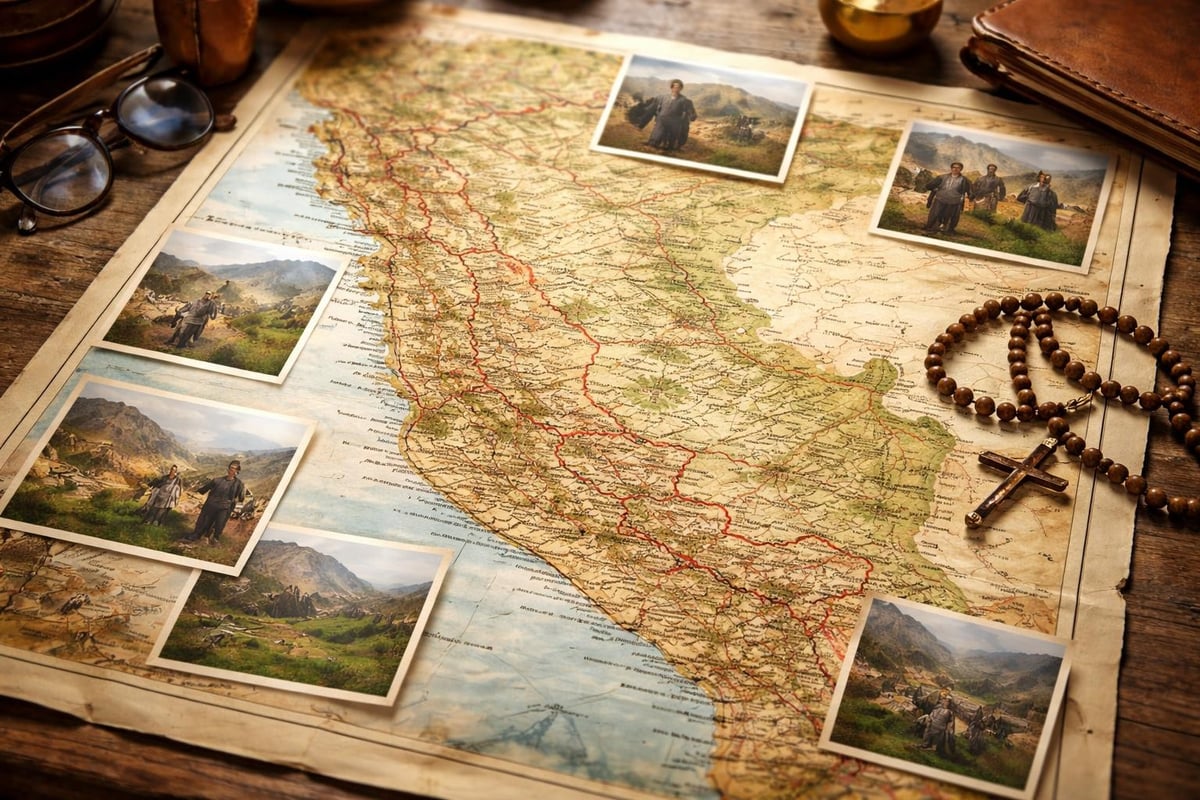
The defining characteristic of saint turibius of mongrovejo's episcopate was his commitment to personally visiting every corner of his vast archdiocese. The Archdiocese of Lima covered an enormous territory extending across modern-day Peru, Ecuador, Bolivia, and parts of Chile and Argentina. Rather than governing from the comfort of his cathedral, Archbishop Turibius spent most of his 25 years in office traveling to remote villages, mountain communities, and jungle settlements.
These missionary journeys were physically demanding and often dangerous. Turibius traveled on foot and horseback through the Andes Mountains, crossing treacherous passes at altitudes exceeding 15,000 feet. He endured extreme weather, primitive accommodations, and the constant threat of illness. Despite these hardships, he completed three extensive visitations of his entire archdiocese, each taking several years to complete.
| Journey Aspect | Details |
|---|---|
| Total Distance | Estimated 18,000 miles over 25 years |
| Terrain Covered | Coastal deserts, Andean highlands, Amazon jungle |
| Mode of Travel | Primarily on foot and horseback |
| Duration per Visit | 3-7 years for complete archdiocese tour |
| People Reached | Hundreds of thousands of indigenous people |
During these visitations, saint turibius of mongrovejo personally administered confirmation to nearly half a million people, including Saint Rose of Lima, Saint Martin de Porres, and Blessed John Macías. He baptized countless indigenous people, blessed marriages, heard confessions, and celebrated Mass in the most remote locations. His pastoral care extended to establishing schools, hospitals, and charitable institutions throughout the region.
Champion of Indigenous Rights and Social Justice
One of the most admirable aspects of saint turibius of mongrovejo's ministry was his fierce defense of indigenous peoples against colonial exploitation. The Spanish encomienda system subjected native populations to forced labor and brutal treatment, often with the complicity or silence of Church officials seeking to maintain good relations with civil authorities.
Archbishop Turibius courageously challenged this system, publicly condemning the mistreatment of indigenous people and using his authority to protect them. He insisted that native peoples possessed the same human dignity as Europeans and deserved respect, fair treatment, and access to the Gospel presented in ways they could understand. His commitment to the rights of native peoples reflected the teachings of earlier advocates like Bartolomé de las Casas.
Practical Measures for Justice
Saint turibius of mongrovejo implemented concrete policies to protect indigenous communities:
- Required fair wages for indigenous workers employed by the Church
- Prohibited forced labor in ecclesiastical construction projects
- Established legal protections against exploitation by colonial officials
- Created indigenous parishes with native-language worship
- Trained indigenous catechists to serve their own communities
- Defended land rights of native communities against encroachment
These measures often brought Turibius into direct conflict with wealthy landowners and colonial administrators. He faced threats, slander, and attempts to undermine his authority. Yet he never wavered, understanding that authentic evangelization required defending human dignity and promoting justice. His example demonstrates that Catholic social teaching is not a modern innovation but flows from the Gospel's fundamental message.
Those seeking to deepen their understanding of saints who combined evangelization with social justice can explore the Catholic Saints books offered by Journeys of Faith, which illuminate how holy men and women throughout history have lived these principles.
Spiritual Life and Personal Holiness
Beyond his administrative skills and pastoral zeal, saint turibius of mongrovejo was recognized for his deep personal holiness. Despite his heavy responsibilities, he maintained a rigorous prayer life, spending hours in contemplation before the Blessed Sacrament. His spirituality centered on the Eucharist, which he promoted as the source and summit of Christian life.
Contemporaries noted his extreme asceticism and self-denial. Turibius fasted frequently, slept on a hard wooden plank, and devoted much of his personal income to the poor rather than maintaining an episcopal lifestyle. He wore simple clothing beneath his liturgical vestments and avoided the luxuries common among Church officials of his era. This personal austerity gave credibility to his calls for reform among the clergy.
The archbishop's holiness was also manifest in his patience and gentleness despite frequent opposition. His perseverance in the face of obstacles revealed a soul deeply united to Christ. When conflicts arose, Turibius responded with prayer and charitable persistence rather than anger or vindictiveness.
Miracles and Signs of Grace
Even during his lifetime, people attributed miraculous healings to saint turibius of mongrovejo's intercession. Reports circulated of the sick recovering after his blessing, of violent storms calming when he prayed, and of his presence bringing peace to troubled communities. These signs confirmed for many that God worked powerfully through this humble servant.
His death in 1606 occurred while he was on yet another pastoral visitation, fulfilling his episcopal duties to the very end. He fell ill at Saña and died at age 68, having spent himself completely in service to the Church and the people of Peru. His final words reportedly were prayers for his flock and expressions of gratitude for the privilege of serving as their shepherd.
Legacy and Canonization
The impact of saint turibius of mongrovejo on the Church in Latin America cannot be overstated. The reforms he implemented, the institutions he founded, and the example he set shaped Catholicism throughout South America for generations. The seminary he established in Lima became a model for priestly formation across the continent. The catechetical materials he commissioned remained in use for centuries.
Perhaps most significantly, the three saints he confirmed-Rose, Martin, and John-became the first canonized saints of the Americas, their holiness nurtured in the spiritual climate Turibius helped create. This fact alone testifies to the fruitfulness of his ministry. The Catholic Church in Peru that emerged from his labors was more authentic, more just, and more deeply rooted in the Gospel than what he had inherited.
The process of recognizing saint turibius of mongrovejo's sanctity began shortly after his death. Pope Innocent XI beatified him in 1679, and Pope Benedict XIII canonized him in 1726. His feast day is celebrated on March 23, though in some regions it is observed on different dates. In 2000, Pope John Paul II declared him the patron saint of Latin American bishops, recognizing his model of episcopal leadership.
Lessons for Contemporary Evangelization
The example of saint turibius of mongrovejo offers valuable lessons for the Church today, particularly for those engaged in evangelization and missionary work. His life demonstrates that authentic Christian witness requires both spiritual depth and practical action, both personal holiness and institutional reform, both love for tradition and adaptation to new contexts.
Modern Applications of His Ministry
Inculturation: Turibius understood that the Gospel must be presented in ways that respect and engage local cultures. His insistence on native-language catechisms and indigenous clergy anticipated modern missiological principles by centuries.
Social Justice: His defense of the oppressed shows that evangelization cannot be separated from the pursuit of justice. Proclaiming Christ means defending human dignity and challenging systems of exploitation.
Pastoral Presence: In an age of administrative distance and bureaucratic management, Turibius's personal visits to every corner of his diocese remind Church leaders of the irreplaceable value of face-to-face pastoral care.
Perseverance: His 25 years of patient reform work demonstrate that authentic change requires sustained commitment rather than dramatic gestures or quick fixes.
His stewardship of time and resources also provides a model for contemporary Catholics seeking to use their gifts responsibly in service to God's kingdom.
The Importance of Studying Saints' Lives
The Catholic tradition has always emphasized learning from the saints who have gone before us. When we study figures like saint turibius of mongrovejo, we encounter concrete examples of Gospel living that inspire and challenge us. Saints are not museum pieces to be admired from a distance but companions on the journey who show us what faith looks like in practice.
Understanding the historical context in which saints lived enriches our appreciation of their witness. Turibius faced challenges specific to 16th-century colonial Peru, yet his responses illuminate timeless principles applicable across eras and cultures. His combination of intellectual rigor, pastoral compassion, prophetic courage, and mystical depth represents a holistic Christian discipleship that remains relevant today.
For families, parishes, and individuals seeking to deepen their faith, the lives of saints provide an invaluable resource. They demonstrate that holiness is possible in every state of life and every circumstance. They show us that God works through ordinary people who respond generously to divine grace. For additional resources on studying the lives of saints and growing in faith, explore the many offerings available at Journeys of Faith.
Resources for Further Learning
Those wishing to learn more about saint turibius of mongrovejo have access to numerous resources. Historical documents from the councils and synods he convened provide primary source material about his reforms. Biographies in multiple languages detail his life and ministry. Academic studies examine his influence on the development of the Latin American Church.
Visual materials also help bring his story to life. Images and artistic representations from various periods show how different generations have understood and honored this saint. These artistic works often depict him in episcopal vestments, sometimes holding a Bible or crucifix, occasionally shown blessing indigenous people or traveling through mountainous terrain.
Modern pilgrims can visit sites associated with saint turibius of mongrovejo in Peru. His relics are venerated in the Cathedral of Lima, where his tomb attracts visitors from around the world. Churches dedicated to him exist throughout Latin America and in other regions with significant Hispanic Catholic populations. These sacred spaces provide opportunities for prayer and reflection on his witness.
Practical Resources for Deepening Devotion
- Explore Journeys of Faith's extensive collection of Catholic items including prayer cards, books, and devotional materials
- Utilize the Mega Search Engine to find resources from hundreds of Catholic shops and stores
- Download the Journeys of Faith app for iPhone or Android to access spiritual content on the go
- Chat with us anytime for questions about Catholic resources and materials
- Make a donation to help reach more souls through Catholic media and evangelization
The mission of evangelization that consumed saint turibius of mongrovejo's life continues today through various apostolates and organizations. Those inspired by his example can support missionary work, advocate for social justice, deepen their sacramental life, and share the Gospel in their own contexts. His witness reminds us that every baptized Catholic shares responsibility for spreading the faith and building God's kingdom.
Saint Turibius of Mongrovejo's extraordinary life of pastoral dedication, social justice advocacy, and missionary zeal continues to inspire Catholics more than four centuries after his death. His example of combining deep personal holiness with tireless service to the most vulnerable demonstrates authentic Christian discipleship. Whether you're seeking to deepen your knowledge of the saints, find inspiration for your own spiritual journey, or access quality Catholic resources for evangelization, Journeys of Faith offers a wealth of books, media, and materials to support your faith and help share the Gospel message with others.
