

St Francis of Assisi stands as one of the most beloved figures in Catholic history, renowned not only for his radical commitment to poverty and service but also for his profound love of God's creation. Understanding st francis patron saint designations reveals the breadth of his spiritual influence, which extends from animals and the environment to merchants and peacemakers. His life journey from a wealthy merchant's son to the founder of three religious orders demonstrates the transformative power of encountering Christ. For those seeking deeper knowledge of the saints who shaped Catholic tradition, Francis offers a compelling example of living the Gospel with joy, simplicity, and unwavering faith.
The Life and Conversion of St Francis
Giovanni di Pietro di Bernardone, known to history as St Francis of Assisi, was born in 1181 or 1182 in the Italian town of Assisi. His father, a prosperous cloth merchant, provided him with a comfortable upbringing filled with worldly pleasures and aspirations for success in business. Young Francis enjoyed the privileges of his social class, participating in local military campaigns and entertaining dreams of knightly glory.
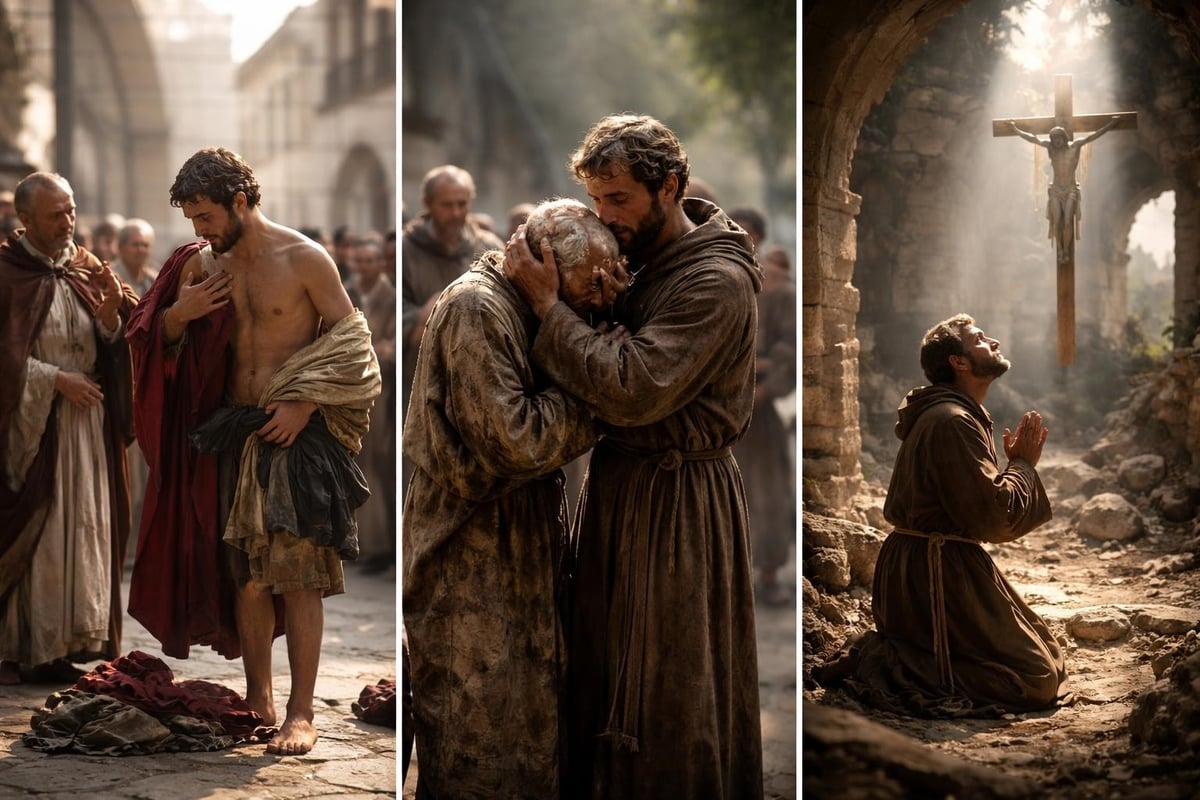
The turning point came during his imprisonment following a military defeat at Perugia. During this period and a subsequent illness, Francis began questioning his life's direction and purpose. A pivotal moment occurred when he encountered a leper on the road, traditionally an encounter he would have avoided. Instead, Francis dismounted his horse, embraced the leper, and kissed his hand. This act of radical compassion marked the beginning of his conversion.
The Call to Rebuild the Church
While praying in the dilapidated church of San Damiano around 1205, Francis heard Christ speak to him from the crucifix: "Francis, go and repair my house, which as you see is falling into ruin." Initially interpreting this literally, he began physically rebuilding San Damiano and other chapels. Only later did he understand the deeper meaning-he was called to rebuild the spiritual life of the Church itself.
Key moments in Francis's conversion included:
- His public renunciation of his inheritance before the Bishop of Assisi
- Removing his fine clothing and embracing absolute poverty
- Beginning to preach repentance and peace throughout the countryside
- Attracting followers who shared his vision of Gospel poverty
Brought to by Journeys of Faith Founded by Bob and Penny Lord - We are an Augustinian Secular Institute - Cyber Apostles - Our Mission is Evangelization through Media.
Founding the Franciscan Order
By 1209, Francis had gathered twelve companions who shared his commitment to living according to the Gospel. He composed a simple Rule based on Christ's instructions to the apostles, emphasizing poverty, preaching, and manual labor. The establishment of the Franciscan order required papal approval, which Francis sought from Pope Innocent III.
According to tradition, the Pope initially hesitated but experienced a dream showing Francis holding up the crumbling Lateran Basilica. This vision convinced him to give verbal approval to the new order. The Franciscans grew rapidly, attracting men from all walks of life who were inspired by their joyful witness to poverty and evangelical simplicity.
The Three Orders of St Francis
Francis established three distinct orders to accommodate different vocations:
| Order | Name | Members | Purpose |
|---|---|---|---|
| First Order | Order of Friars Minor | Men living in community | Preaching, service, poverty |
| Second Order | Poor Clares | Women religious | Contemplative prayer, enclosure |
| Third Order | Secular Franciscans | Lay men and women | Living Gospel values in the world |
The Second Order was founded with St Clare of Assisi, who became Francis's spiritual companion and established a community of women dedicated to the same radical poverty. The Third Order enabled married couples and laypeople to participate in Franciscan spirituality while maintaining their secular responsibilities.
St Francis Patron Saint Designations
The designation of st francis patron saint extends to numerous causes, reflecting the diverse aspects of his life and spirituality. The Church has officially recognized him as patron of several important areas, each connected to his life example and spiritual legacy.
Animals and Ecology
Perhaps the most widely known patronage is St Francis patron saint of animals and ecology. This designation stems from his profound respect for all creation, viewing every creature as a brother or sister made by the same loving Creator. Francis's devotion to nature is immortalized in his "Canticle of the Creatures," where he praised God through Brother Sun, Sister Moon, and all elements of creation.
Famous stories demonstrating his love for animals include:
- Preaching to the birds near Bevagna
- Taming the wolf of Gubbio through negotiation and prayer
- Releasing captured animals and fish back to freedom
- Caring for wounded creatures during his travels
In 1979, Pope John Paul II officially declared St Francis patron saint of ecology, recognizing the contemporary relevance of his creation spirituality as environmental concerns grew worldwide.
Merchants and Commerce
Given his background as the son of a prosperous cloth merchant, st francis patron saint of merchants carries particular significance. Though Francis ultimately rejected his father's business and wealth, his understanding of commercial life made him an appropriate intercessor for those engaged in trade and business. His patronage reminds merchants to conduct business ethically, use wealth generously, and never let material success overshadow spiritual values.
Italy and San Francisco
St Francis serves as patron saint of Italy, sharing this honor with St Catherine of Siena. His influence on Italian culture, spirituality, and religious life cannot be overstated. Additionally, the city of San Francisco, California, bears his name and claims him as patron, reflecting the missionary expansion of Franciscan spirituality to the Americas.

The Spirituality of St Francis
The spiritual legacy of st francis patron saint rests on several foundational principles that continue to inspire Catholics worldwide. His approach to faith emphasized direct experience of God through creation, poverty, and service rather than abstract theological speculation.
Evangelical Poverty
Francis understood poverty not merely as lack of possessions but as spiritual freedom. By owning nothing, he became free to serve everyone. This radical trust in divine providence challenged both the wealthy clergy of his time and the emerging merchant class. His poverty was joyful rather than austere, expressing confidence in a generous Father who provides for all needs.
Love of the Eucharist
Despite his simple approach to faith, Francis maintained profound reverence for the Eucharist. He insisted that churches be clean and altars beautifully maintained. His writings frequently reference the Real Presence of Christ in the consecrated elements, demonstrating that evangelical simplicity and liturgical reverence complement rather than contradict each other.
Devotion to Mary
Francis's love for the Blessed Virgin Mary permeated his spirituality. He established his first chapel at St Mary of the Angels (Portiuncula), where he would eventually die. Francis saw Mary as the perfect example of humility and obedience to God's will, qualities he sought to emulate in his own life.
Those seeking to deepen their understanding of Catholic saints like Francis will find valuable resources in Catholic Saints Books, which offer insights into how studying the lives of saints can inspire greater holiness in our own spiritual journeys.
The Stigmata and Final Years
In September 1224, while praying on Mount La Verna, Francis received the stigmata-the five wounds of Christ appearing on his own body. This mystical experience, occurring two years before his death, marked him as uniquely configured to the suffering Christ. He attempted to hide the wounds, but companions noticed blood on his habit and his difficulty walking due to the wound in his foot.
Declining Health and Death
The final years of Francis's life were marked by increasing physical suffering:
- Near-blindness from an eye disease
- Chronic stomach ailments
- Pain from the stigmata
- General weakness from years of austere living
Despite his suffering, Francis composed his joyful "Canticle of the Creatures" during this period, adding verses praising God through Sister Death. He died on October 3, 1226, at the Portiuncula, lying on bare ground in a final act of embracing poverty. His death marked the end of a remarkable spiritual journey that had transformed countless lives.
Canonization and Feast Days
Pope Gregory IX canonized Francis on July 16, 1228, less than two years after his death-a remarkably swift process reflecting widespread recognition of his holiness. The Church celebrates his feast day on October 4, and many parishes hold animal blessings on or near this date, honoring his patronage of creatures.
Basilica of St Francis
The magnificent Basilica of St Francis in Assisi was constructed shortly after his canonization, ironically creating the kind of grand structure Francis himself would have avoided. Yet it serves as a testament to the Church's recognition of his significance and houses beautiful frescoes depicting scenes from his life, created by masters like Giotto.

Contemporary Relevance of St Francis Patron Saint
The designation of st francis patron saint in various areas speaks to his enduring relevance for contemporary Catholic life. His emphasis on creation care resonates powerfully in an age of environmental crisis. Pope Francis chose his papal name deliberately, signaling commitment to the poor and to ecological responsibility that Francis of Assisi embodied.
Environmental Stewardship
As patron saint of ecology, Francis provides a theological foundation for Catholic environmental action. His view of creation as a community of creatures sharing a common Creator challenges exploitative attitudes toward nature. Understanding Francis's creation spirituality helps Catholics integrate environmental concern with traditional devotional life.
Simplicity in Consumer Culture
Francis's radical poverty challenges contemporary consumer culture. While few are called to his extreme renunciation, his example invites reflection on how material possessions can impede spiritual freedom. His patronage of merchants reminds business people to conduct commerce ethically and use wealth for the common good.
Peace and Reconciliation
St Francis patron saint of peace attempted to end the Fifth Crusade through dialogue, even traveling to Egypt to meet Sultan al-Kamil. His approach to the wolf of Gubbio-seeking understanding and negotiated peace rather than violent elimination-offers a model for conflict resolution. Catholic peacemaking efforts frequently invoke Francis as inspiration and intercessor.
Franciscan Spirituality Today
The three orders Francis established continue active ministry worldwide. The Order of Friars Minor, Conventual Franciscans, and Capuchins serve in parishes, schools, missions, and social service agencies. The Poor Clares maintain contemplative communities offering prayer support for the Church's mission. Secular Franciscans number in the hundreds of thousands, bringing Franciscan values into family life, workplaces, and civic engagement.
Living the Franciscan Charism
Modern Franciscans emphasize several key aspects of their founder's spirituality:
- Minority: Living humbly among people, especially the poor
- Fraternity: Building genuine community across social divisions
- Contemplation: Finding God in creation and everyday experiences
- Mission: Sharing the Gospel through word and example
These principles shape Franciscan schools, hospitals, retreat centers, and justice initiatives. Organizations like Franciscan Mission Service send lay missionaries to serve in developing nations, extending Francis's missionary spirit to contemporary contexts.
St Francis in Art and Popular Culture
Artistic representations of st francis patron saint typically show him in his simple brown habit, often with animals nearby or receiving the stigmata. Garden statues of Francis are ubiquitous in Catholic yards and parishes, frequently serving as the focal point for animal blessings. His image communicates accessibility and gentleness, making him one of the most recognizable saints even to non-Catholics.
Literary and Film Portrayals
Numerous biographies, novels, and films have explored Francis's life. Brother Sun, Sister Moon (1972) introduced his story to popular audiences, while scholarly works continue examining his theological contributions. The first biography, written by Thomas of Celano shortly after Francis's death, remains a primary source for understanding his life and spirituality.
Prayers and Devotions to St Francis
Catholics invoke st francis patron saint through various prayers and devotions. The Prayer of St Francis ("Lord, make me an instrument of your peace") is perhaps the most famous, though scholars debate whether Francis actually composed it. Regardless of authorship, it perfectly captures his spirit of peacemaking and service.
The Tau Cross
Francis used the Tau cross (T-shaped) as his signature and encouraged its use among his followers. This ancient Christian symbol represents the cross of Christ and appears frequently in Franciscan spirituality. Many Franciscans wear a Tau cross as a reminder of their commitment to following Christ in the way of Francis.
| Prayer/Devotion | Purpose | Occasion |
|---|---|---|
| Prayer of St Francis | Peace and service | Daily prayer |
| Canticle of Creatures | Praise through creation | Feast day, environmental events |
| Transitus Service | Commemorate Francis's death | Evening of October 3 |
| Tau Cross Blessing | Franciscan commitment | Investiture, profession |
St Francis and Other Saints
Francis's relationships with other saints reveal important aspects of his spirituality. His partnership with St Clare created a parallel women's movement of radical Gospel poverty. His meeting with St Dominic in Rome established mutual respect between the two great mendicant founders. His reverence for the Blessed Virgin Mary connected him to centuries of Marian devotion.
The Catholic tradition of saints studying other saints before them is well documented. For those interested in exploring this pattern across Church history, the extensive collection at Journeys of Faith provides resources on countless holy men and women who followed similar paths of conversion and service.
Teaching St Francis to Young Catholics
Introducing children to st francis patron saint offers an accessible entry point into Catholic spirituality. His love for animals immediately captures children's imagination, while his joyful simplicity provides an alternative to consumer culture's messages. Religious education programs frequently feature Francis when teaching about creation care, vocational discernment, and living Gospel values.
Educational Resources
Many schools and parishes use the feast of St Francis as an opportunity for service projects and environmental education. Animal blessings become teaching moments about God's love for all creation. Nature walks can incorporate Francis's "Canticle of the Creatures," helping children see creation as revelation of the Creator's glory.
St Francis of Assisi's enduring influence as patron saint of animals, ecology, merchants, and peace demonstrates how authentic Gospel living transcends time and culture. His radical poverty, creation spirituality, and joyful witness continue inspiring Catholics to deeper faith and service. For those seeking to deepen their knowledge of St Francis and the countless other saints who have shaped our faith, Journeys of Faith offers extensive resources including books, videos, and prayer materials that bring the lives of the saints into vivid focus for contemporary seekers.
Resources:
- Explore Journeys of Faith Online store with thousands of Catholic Items at https://journeysoffaith.com/collections
- Our Unique Mega Search Engine https://journeysoffaith.com/search is linked to hundreds of Catholic Shops and Stores
- Get the Journeys of Faith NEW App for IPhone or Android Search for Journeys of Faith or go to https://journeysoffaith.com/pages/download-our-app
- Chat with us anytime https://chatting.page/mjxs9aerrtgm3lmpndlcepmbyosntrjn
- We need your help to reach more souls. Please Make a Donation https://journeysoffaith.com/pages/donate