

The foundation of Catholic family life rests on prayer-the intimate conversation between believers and God that transforms households into vibrant domestic churches. In 2026, as families navigate increasingly complex schedules and digital distractions, the practice of catholic family prayer serves as an anchor, grounding children and parents alike in the timeless traditions of the faith. When families pray together, they don't merely recite words; they participate in a sacred dialogue that shapes values, builds resilience, and creates spiritual memories that endure for generations.
The Domestic Church and Its Prayer Foundation
The Second Vatican Council's recognition of the family as the ecclesia domestica-the domestic church-elevated household prayer from a pious practice to an essential element of Catholic identity. Catholic family prayer becomes the heartbeat of this domestic church, creating a sacred space where faith is first learned, lived, and transmitted.
Parents serve as the first catechists of their children, and prayer provides the natural curriculum for this formation. Through consistent prayer rhythms, children internalize the vocabulary of faith, learn to recognize God's presence in daily life, and develop the habit of turning to Christ in both joy and struggle. The United States Conference of Catholic Bishops emphasizes prayers for families across all stages of life, from birth through death, acknowledging that prayer adapts to each season.
Creating Sustainable Prayer Rhythms
Establishing catholic family prayer requires intentionality without perfectionism. Families succeed when they start small, remain consistent, and adapt to their unique circumstances.
Morning offerings provide an excellent starting point:
- Brief consecration of the day to God (30 seconds)
- Intentions for family members' activities
- Simple Sign of the Cross together
Mealtime grace anchors prayer in daily routines:
- Traditional Catholic blessings before meals
- Spontaneous thanksgiving for specific blessings
- Rotation of family members leading prayer
Evening prayers close the day with reflection:
- Examination of conscience appropriate to children's ages
- Prayers of gratitude and petition
- Night prayers from Catholic tradition
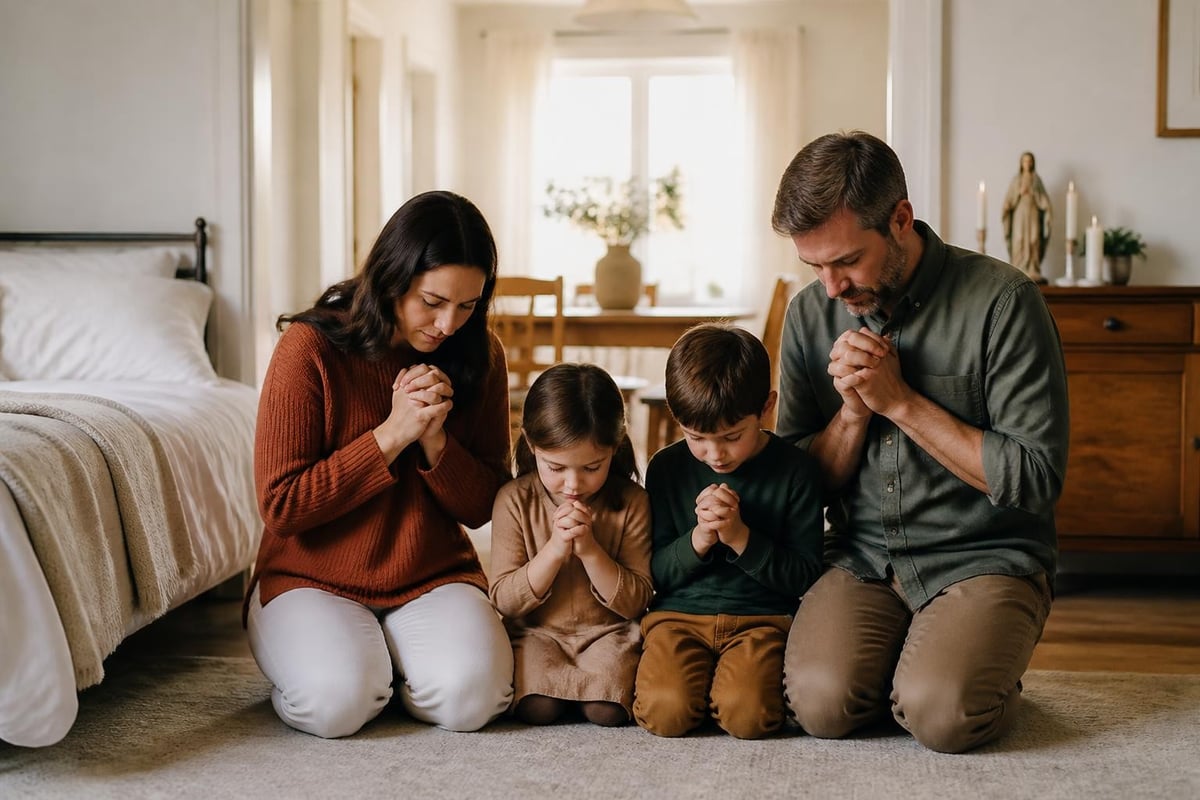
Research demonstrates measurable benefits of shared religious practices. Studies show that family prayer functions as a bonding ritual that strengthens relationships and creates emotional support networks. Families who pray together report higher levels of cohesion and more effective communication during challenging times.
Brought to you by Journeys of Faith. Founded by Bob and Penny Lord. We are an Augustinian Secular Institute – Cyber Apostles. Our Mission is Evangelization through Media.
Traditional Catholic Devotions for Families
The Catholic tradition offers a treasury of devotions perfectly suited for family prayer. These time-tested practices connect contemporary families with centuries of faithful believers while providing structure and variety.
| Devotion | Duration | Best For | Frequency |
|---|---|---|---|
| Family Rosary | 15-20 minutes | Evening prayer | Daily or weekly |
| Divine Mercy Chaplet | 10 minutes | Afternoon (3 PM ideal) | Daily during Lent |
| Angelus | 2 minutes | Noon or 6 PM | Daily |
| Stations of the Cross | 20-30 minutes | Friday evenings | Weekly during Lent |
| Liturgy of the Hours | Varies | Morning or evening | Daily |
The Family Rosary Tradition
The Rosary remains the premier devotion for catholic family prayer, adaptable to children of all ages. Father Patrick Peyton's famous declaration-"The family that prays together stays together"-speaks to the Rosary's unifying power.
For younger children, families might pray a single decade while older children can participate in the full five decades. Visual aids, such as Rosary guides or meditation cards, help maintain focus. Some families assign each member a specific decade to lead, fostering ownership and engagement.
The repetitive nature of the Rosary creates a contemplative atmosphere that allows even busy minds to settle into prayer. Parents often find that children who initially resist eventually request the Rosary during stressful periods, having internalized its calming rhythm.
Novenas as Family Formation Tools
Nine-day novenas provide focused opportunities for catholic family prayer around specific intentions or feast days. These extended prayers teach perseverance and demonstrate that some petitions require sustained attention.
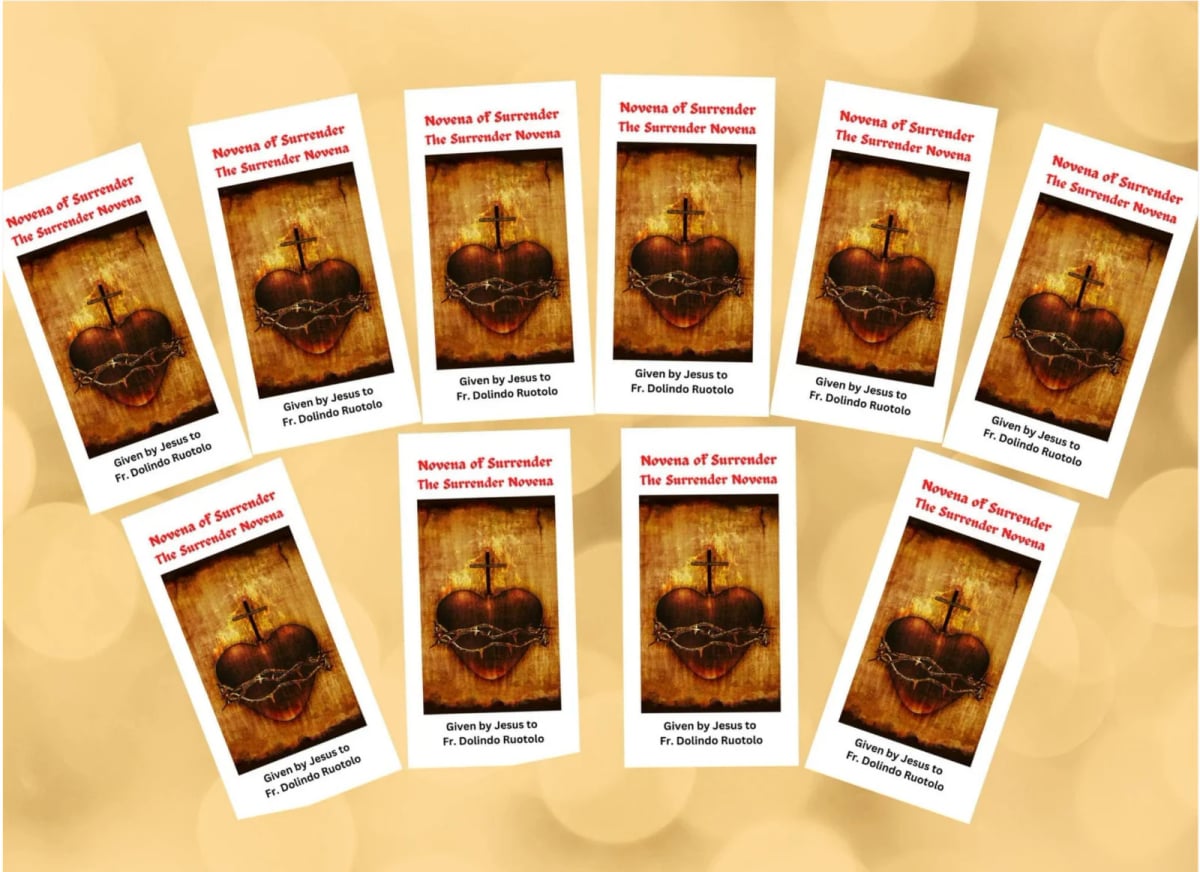
Families preparing for First Communion might pray a Eucharistic novena together, deepening the child's understanding while involving siblings in the preparation. Similarly, novenas to patron saints create teachable moments about virtuous living and the communion of saints. For families seeking powerful intercessory prayers, the Surrender Novena offers a beautiful practice of abandoning concerns to divine providence-a valuable lesson for children and adults alike.
Scripture-based family devotions complement traditional prayers:
- Lectio Divina adapted for children
- Gospel reflections tied to Sunday readings
- Psalm praying before bedtime
Pope John Paul II's Letter to Families emphasizes that family prayer flows from the sacramental grace of marriage and becomes a participation in the Church's prayer. When families pray, they exercise their baptismal priesthood, offering spiritual sacrifices that sanctify ordinary moments.
Age-Appropriate Approaches to Catholic Family Prayer
Effective catholic family prayer recognizes developmental stages and adapts accordingly. A prayer practice that resonates with teenagers will differ significantly from what captures a toddler's attention, yet both can participate meaningfully in shared family devotions.
Praying with Young Children (Ages 2-7)
Young children thrive on sensory experiences and repetition. Their prayer formation focuses on creating positive associations with Catholic practice.
Effective strategies include:
- Visual prayer corners with candles, icons, and statues
- Simple repetitive prayers (Hail Mary, Guardian Angel prayer)
- Action prayers (Sign of the Cross with deliberate movements)
- Song-based prayers that combine melody with doctrine
Children at this age benefit from witnessing parental prayer. When a mother pauses to thank God for finding lost keys or a father asks St. Anthony's intercession for a work challenge, children learn that prayer addresses real-life concerns.
Middle Childhood Prayer Formation (Ages 8-12)
As children develop abstract thinking, catholic family prayer can incorporate more complex concepts while maintaining engagement through participation.
| Prayer Element | Implementation | Formation Goal |
|---|---|---|
| Scripture reading | Child-friendly Bible, one passage | Biblical literacy |
| Intercessory prayer | Each family member names intentions | Concern for others |
| Prayer journaling | Personal notebooks for older children | Reflection skills |
| Liturgical year awareness | Prayers tied to seasons/feasts | Church calendar understanding |
This age group responds well to responsibility. Allowing children to lead certain prayers, select Scripture passages, or prepare the prayer space cultivates ownership. They're also old enough to understand prayer as conversation, not just recitation, opening opportunities for spontaneous prayer alongside formal devotions.
Adolescent Prayer Engagement (Ages 13-18)
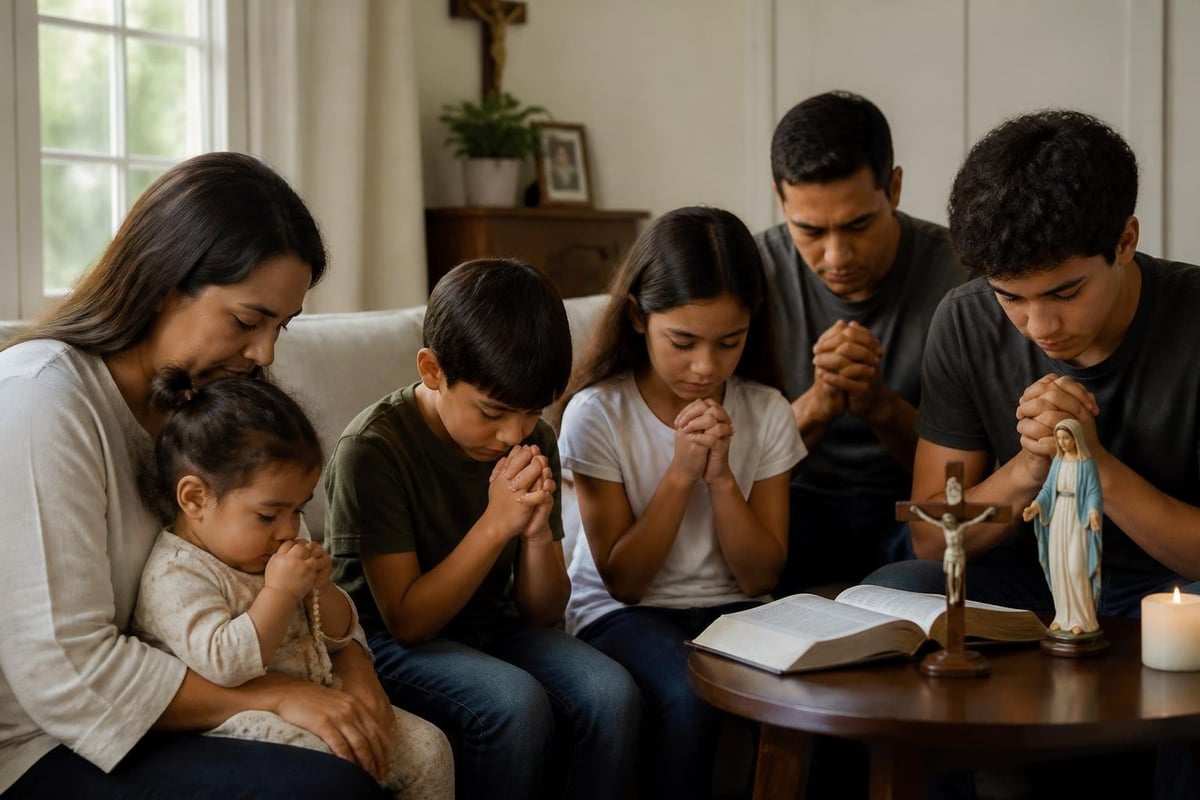
Teenagers present unique challenges and opportunities for catholic family prayer. While resistance to mandatory participation sometimes emerges, this stage also allows for deeper theological discussion and authentic prayer expression.
Successful approaches honor teenagers' growing autonomy while maintaining non-negotiable family prayer commitments. Rather than requiring attendance at all prayer times, families might identify one daily prayer (perhaps evening meal grace) as obligatory while offering optional participation in Rosary or other devotions.
Adolescents engage more authentically when:
- Asked to lead prayer occasionally
- Invited to articulate prayer intentions for friends and concerns
- Given space to question and discuss faith during prayer time
- Connected to wider Catholic community through youth group prayer experiences
- Challenged to develop personal prayer lives alongside family prayer
Many Catholic families find that Loyola Press's family prayer resources offer age-specific guidance that helps bridge generational gaps in prayer styles and preferences.
Liturgical Seasons and Family Prayer Adaptation
The Church's liturgical calendar provides a natural framework for varying and enriching catholic family prayer throughout the year. Each season offers distinct opportunities for deepening family faith through adapted prayer practices.
Advent: Waiting in Prayer
Advent transforms family prayer through anticipation and preparation. The Advent wreath becomes a focal point, with weekly candle lighting accompanied by appropriate prayers and Scripture readings.
Advent family prayer practices:
- Daily countdown prayers to Christmas
- Jesse Tree readings and ornament placement
- O Antiphons during final week
- Advent calendar with prayer prompts
- Increased focus on Mary's "yes" through Magnificat
Families might add brief penitential practices, appropriate to children's ages, creating space for spiritual preparation alongside cultural Christmas activities. This season teaches children that catholic family prayer adapts to the Church's rhythms, not just personal preferences.
Lent: Intensified Family Devotion
Lent calls families to deeper prayer, fasting, and almsgiving. Catholic family prayer during these forty days incorporates practices that might be too intensive for year-round observance.
The Stations of the Cross become a weekly family devotion, helping children understand Christ's passion through visual and narrative elements. Many families combine this with simple Friday fasts, connecting prayer to sacrifice.
Divine Mercy devotions intensify during Lent, preparing for the celebration of Divine Mercy Sunday. The Divine Mercy Chaplet, prayed at 3 PM when possible, focuses family attention on Christ's passion and mercy.
Easter Season: Resurrection Joy in Prayer
The fifty days from Easter to Pentecost transform family prayer with resurrection themes. The Regina Caeli replaces the Angelus, introducing children to seasonal prayer variations.
Easter season prayer enhancements:
- Frequent Alleluias reintroduced to prayers
- Focus on appearances of Risen Christ
- Preparation for Pentecost through Holy Spirit prayers
- Celebration of First Communions with family novenas
Ordinary Time: Sustainable Daily Prayer
The longest liturgical season provides opportunity for establishing sustainable catholic family prayer rhythms without seasonal intensity. This becomes the testing ground for practices that will endure through all seasons.
Overcoming Common Obstacles to Catholic Family Prayer
Even committed Catholic families encounter resistance, schedule conflicts, and motivation challenges. Acknowledging these obstacles honestly allows for practical solutions rather than guilt-driven abandonment of family prayer.
Time Scarcity and Overscheduling
Contemporary family schedules strain even the most intentional prayer practices. Sports, activities, work demands, and school commitments fragment family time.
Practical responses include:
- Protecting one meal daily for family prayer and connection
- Car time prayers during drives to activities
- Shorter, more frequent prayer moments rather than lengthy sessions
- Weekend intensification when weekday prayer proves difficult
- Seasonal flexibility allowing for busier and calmer periods
Recent Pew Research data on religion and family life shows that families successfully maintaining religious practices often adapt rather than abandon when faced with schedule pressures.
Age-Gap Challenges in Mixed-Age Families
Families with children spanning multiple developmental stages struggle to find prayer approaches that engage everyone. A prayer practice perfect for teenagers bores preschoolers; activities that captivate young children seem juvenile to older siblings.
Solutions emphasize layered participation where the same prayer practice includes multiple entry points. During family Rosary, younger children might hold beads and respond to "Hail Mary" while older children lead decades and meditate on mysteries. Parents narrate mysteries at various complexity levels, addressing different comprehension abilities simultaneously.
Some families separate for age-specific prayer formation while maintaining one daily shared prayer time that accommodates all ages, typically a brief mealtime grace or bedtime blessing.
Resistance and Reluctance
Catholic family prayer sometimes meets outright resistance, particularly from teenagers or children experiencing faith questions. Forced participation often backfires, creating negative associations.
| Resistance Type | Possible Causes | Constructive Responses |
|---|---|---|
| Active refusal | Peer pressure, doubt, rebellion | Maintain minimum requirements, dialogue about concerns |
| Passive disengagement | Boredom, distraction | Vary prayer forms, increase participation |
| Embarrassment | Adolescent self-consciousness | Respect privacy, offer alternatives to vocal prayer |
| Theological questions | Intellectual development | Welcome questions, discuss during prayer time |
Experts in family religious practice note that children who participate in family prayer, even reluctantly, develop prayer habits they often return to in adulthood. Consistency matters more than enthusiasm.
Parents also face their own resistance-exhaustion, spiritual dryness, or distraction. Modeling imperfect but persistent prayer teaches children that catholic family prayer continues through difficult seasons, not just when it feels easy. Just as fathers develop discipline and consistency through programs like The Father Forge, which builds mental resilience and leadership capacity, families build spiritual muscle through consistent prayer practice even when motivation wanes.
Incorporating Sacramental Life into Family Prayer
The sacraments provide the source and summit of Catholic life, and catholic family prayer both prepares for and flows from sacramental grace. Families who connect daily prayer to liturgical participation develop a more integrated faith life.
Sunday Mass as Family Prayer Centerpiece
The Sunday Eucharist remains the most important prayer gathering for Catholic families. Home prayer throughout the week should orient toward and flow from Mass participation.
Before Sunday Mass:
- Review upcoming Sunday readings together
- Discuss Gospel themes at Saturday dinner
- Prepare specific Mass intentions as a family
- Pray for openness to the Word and Eucharist
After Sunday Mass:
- Discuss homily points and readings during Sunday meal
- Apply Gospel message to coming week
- Express gratitude for Eucharistic encounter
- Connect weekday prayers to Sunday themes
Many families keep liturgical calendars visible, marking feast days and seasons, helping children understand that catholic family prayer participates in the Church's universal prayer. Resources like Journeys of Faith's Catholic media and materials help families deepen their understanding of the Eucharist, Mary, and the saints, enriching both Mass participation and home prayer.
Preparation for Sacramental Milestones
Significant sacramental moments-First Reconciliation, First Communion, Confirmation-provide opportunities for intensified family prayer. Rather than treating these as individual achievements, families can embrace them as shared spiritual milestones.
A family might pray a novena together before a child's First Communion, attend additional Mass, or incorporate Eucharistic adoration into their routine. These practices demonstrate that catholic family prayer adapts to important moments while teaching the theology underlying the sacrament.
Daily Connection to Sacramental Grace
Between Sunday celebrations, families maintain sacramental awareness through daily prayer. Morning offerings frequently consecrate the day "through Christ, with Christ, and in Christ," echoing Mass language. Evening examinations of conscience prepare children for eventual regular Confession.
Some families incorporate brief spiritual Communion prayers, teaching children to desire the Eucharist and unite themselves to Christ's presence even outside Mass. These practices form Catholic imagination, helping children recognize that all prayer connects to sacramental life.
Creating Sacred Space for Catholic Family Prayer
Physical environment significantly impacts prayer quality and consistency. While catholic family prayer can occur anywhere, designated sacred spaces within the home facilitate regular devotion and signal prayer's importance.
Home Prayer Corners and Altars
Even small homes can accommodate a prayer corner-a dedicated space that visually communicates the family's faith priorities. These spaces need not be elaborate; simplicity often proves more sustainable than complex arrangements.
Essential elements include:
- Crucifix or cross as focal point
- Images of Mary and family patron saints
- Bible or children's Scripture book
- Rosary and other prayer aids
- Candles for feast days and special intentions
- Prayer intention book or basket
Children respond to spaces they help create. Allowing them to select images, arrange items, or add personal touches increases engagement. Some families rotate seasonal items, incorporating Advent wreaths, Nativity scenes, or Easter symbols as the liturgical year progresses.
Bedroom Blessings and Nighttime Prayer Spaces
Individual bedrooms offer opportunities for personal prayer formation alongside family devotions. Parents who bless children's rooms, establish bedside prayer routines, and encourage personal devotional practices cultivate lifelong prayer habits.
A simple bedside setup might include:
- Small crucifix or holy card
- Guardian angel image
- Age-appropriate prayer book
- Rosary or prayer bracelet
- Night light with religious imagery
These spaces support the transition from parent-led prayer to independent spiritual life, particularly important during adolescence when children develop more private faith expressions.
Mealtime Prayer Spaces
The family table represents a natural prayer gathering place. Whether at dinner or breakfast, designating one meal for consistent family prayer creates rhythm without requiring special space preparation.
Brief mealtime prayers teach gratitude, petition, and awareness of God's providence. Families might keep a small prayer card basket on the table, rotating through various blessings, or maintain a family intention journal where members write prayer requests throughout the week.
Seasonal and Cultural Catholic Family Prayer Traditions
Beyond liturgical seasons, Catholic families enrich their prayer life through cultural traditions and seasonal practices that connect faith to daily rhythms and heritage.
Feast Day Celebrations
Saints' feast days provide natural opportunities for themed catholic family prayer and celebration. Families honor patron saints with special meals, prayers, and activities that teach about virtuous living.
A family with a child named Therese might celebrate St. Therese of Lisieux's feast day (October 1) with rose petals scattered during prayer, readings from The Story of a Soul, and acts of small sacrifices throughout the day. These celebrations make faith tangible and memorable.
Popular family feast day observances:
- St. Nicholas Day (December 6) with shoes and surprises
- St. Joseph's Day (March 19) with special foods and father blessing
- All Saints' Day (November 1) with saint costume celebrations
- Assumption (August 15) with Marian processions and flowers
- Guardian Angels (October 2) with angel-themed prayers and stories
Many families maintain prayer cards and novenas specific to their patron saints, incorporating these into daily family prayer while intensifying devotion around feast days.
Cultural Heritage and Prayer
Catholic families from various ethnic backgrounds carry rich prayer traditions from their cultural heritage. Irish families might emphasize St. Patrick devotions; Italian families often maintain strong connections to local patron saints; Polish families frequently practice special Marian devotions.
Incorporating cultural prayer traditions teaches children that Catholicism embraces diverse expressions while maintaining doctrinal unity. Bilingual prayers, traditional hymns, and ethnic feast celebrations enrich family faith formation.
Seasonal Nature Prayers
The rhythm of seasons-spring planting, summer growth, autumn harvest, winter dormancy-provides natural prayer themes. Families with gardens might pray blessings over seeds in spring, offer gratitude for produce in summer, and thank God for harvest in autumn.
These practices connect catholic family prayer to creation, teaching stewardship and recognizing God's providence in natural cycles. Even urban families can mark seasonal transitions through window gardens, nature walks with prayer, or seasonal food celebrations.
Technology and Modern Catholic Family Prayer
Contemporary families navigate technology's role in prayer life-a tool offering resources and connection while also presenting distraction and fragmentation. Wise integration of technology enhances rather than replaces traditional catholic family prayer practices.
Digital Resources for Family Prayer
Numerous apps, podcasts, and online resources support catholic family prayer formation. Daily Scripture readings, guided meditations, saint biographies, and liturgical year trackers help families maintain consistent prayer even during travel or disrupted routines.
Valuable digital tools include:
- Laudate app for prayers, Mass readings, and devotions
- Hallow app for guided family prayers and meditations
- Formed.org for saint videos and family catechesis
- YouTube channels featuring family Rosary and chaplet prayers
- Podcasts explaining Church teaching and spirituality
However, families must balance digital convenience with the formation that occurs through memorized prayer, printed Scripture, and technology-free contemplation. Over-reliance on devices can undermine the personal, relational dimension essential to prayer.
Managing Digital Distraction
Technology's greatest threat to catholic family prayer comes through constant connectivity and notification interruptions. Families serious about prayer establish clear boundaries around device usage during prayer times.
Simple rules prove most sustainable:
- All phones placed in basket during family prayer
- No screens during mealtime prayer
- Technology-free Sundays or holy days
- Airplane mode during evening prayer routines
Parents model appropriate priorities when they prioritize prayer over responding to messages or checking updates. Children internalize these values through observation more than instruction.
Social Media and Prayer Witness
Some families choose to share their prayer life through social media, offering witness to others while creating accountability for consistency. Photos of home altars, brief videos of children leading prayer, or sharing favorite devotions can inspire other Catholic families.
This practice requires discernment, balancing authentic witness against performative religiosity or privacy concerns. Prayer remains primarily intimate conversation with God, not content creation.
Catholic family prayer forms the spiritual foundation that transforms houses into domestic churches, creating spaces where faith is lived, learned, and transmitted across generations. Through consistent daily rhythms, liturgical season adaptations, sacramental connections, and age-appropriate practices, families build prayer traditions that sustain faith through all life circumstances. Whether through morning offerings, evening Rosaries, feast day celebrations, or spontaneous thanksgiving, these shared moments of prayer form children's Catholic imagination and strengthen family bonds in Christ.
Explore More Resources:
-
Explore Journeys of Faith Online store with thousands of Catholic Items at https://journeysoffaith.com/collections
-
Journeys of Faith is blessed to provide Catholic media, including podcasts and inspirational content, free of charge across multiple media platforms for viewers and listeners around the world. While access to this content remains free, there are significant and continually increasing costs associated with producing, hosting, and distributing these programs. Your support helps us continue sharing the beauty of the Catholic faith with souls. Please Make a Donation https://journeysoffaith.com/pages/donate
As you strengthen your family's prayer life in 2026, Journeys of Faith offers extensive resources to support your journey-from books and DVDs about the Eucharist, Mary, and the Saints to prayer cards, devotional materials, and inspiring testimonies that enrich your domestic church. Founded by Bob and Penny Lord, our mission centers on evangelization through media, providing families the tools they need to grow in faith together.
