

A church gift shop serves as far more than a simple retail space. It represents a point of connection between your faith community and the tools they need for deeper spiritual growth, evangelization, and daily devotion. Whether you're planning to launch a new church gift shop or refine an existing operation, understanding how mission-driven retail differs from conventional commerce helps you create a space that truly serves your congregation while supporting your ministry's financial sustainability.
Understanding the Mission of a Church Gift Shop
The fundamental difference between a church gift shop and a typical retail store lies in its purpose. Your primary goal isn't profit maximization but rather providing access to sacramentals, devotional materials, and educational resources that strengthen faith formation. This mission-first approach shapes every decision, from product selection to pricing strategy to customer service standards.
Mission-based retail in a church setting means aligning your inventory with your parish's spiritual priorities. If your community emphasizes Eucharistic devotion, you'll want to stock materials that deepen understanding of the Real Presence. If your evangelization efforts focus on reaching young families, children's catechesis materials become essential. The American Alliance of Museums provides practical guidance for mission-based retail operations that applies directly to church environments.
Defining Your Scope and Audience
Start by identifying who you serve. Your primary customers include regular parishioners seeking prayer resources, parents preparing children for sacraments, visitors needing Mass cards or gifts, and community members exploring Catholicism. Each group has distinct needs that your church gift shop should address through thoughtful product curation.
Consider these audience segments:
- Active parishioners requiring rosaries, prayer books, and devotional items for personal use
- Families seeking baptism gifts, First Communion items, and age-appropriate catechetical materials
- RCIA candidates needing Catholic Bibles, introductory theology books, and saint resources
- Visitors and tourists looking for parish-specific items, local patron saint materials, or meaningful souvenirs
- Ministry volunteers requiring supplies for religious education, youth ministry, or parish events
Your inventory strategy should reflect the relative size and needs of each segment within your specific community context.
Planning Your Church Gift Shop Layout and Operations
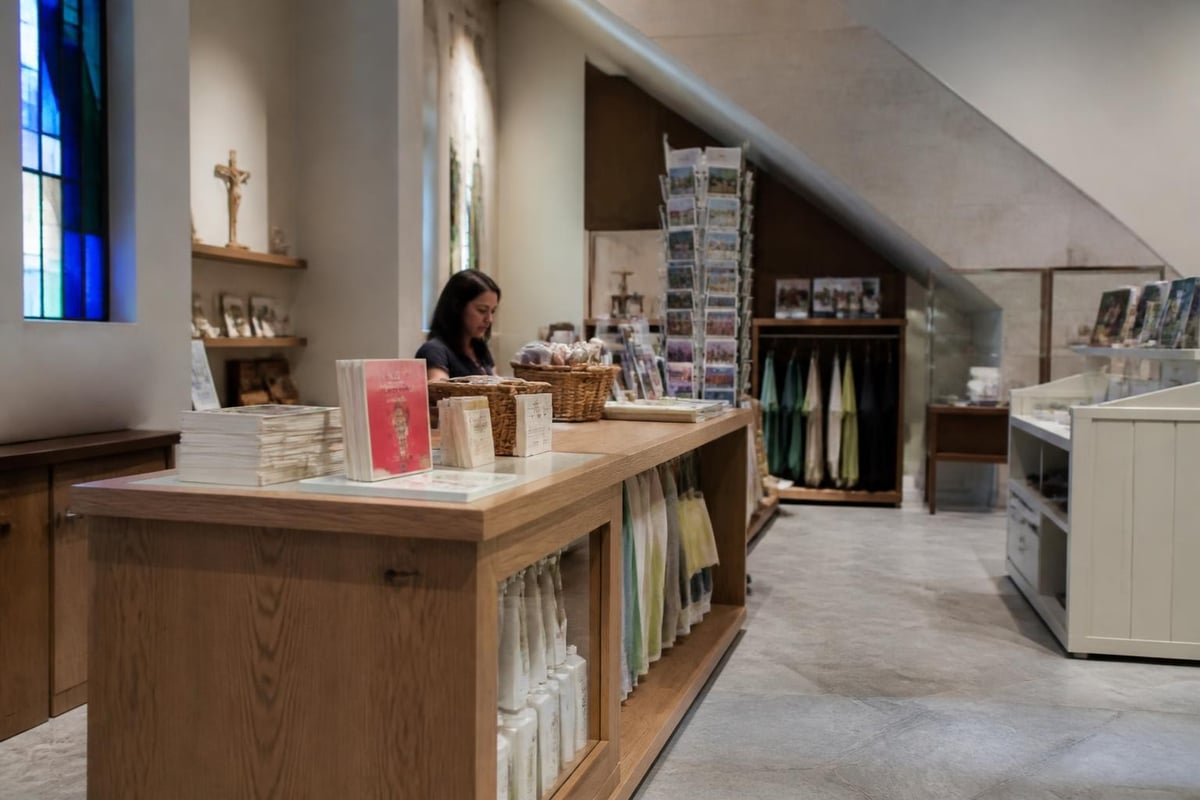
Physical space constraints often dictate what's possible in a church gift shop environment. Many parishes operate from converted closets, repurposed offices, or small corner areas in narthexes. Making the most of limited square footage requires strategic planning and creative merchandising.
Brought to you by Journeys of Faith, founded by Bob and Penny Lord. We are an Augustinian Secular Institute – Cyber Apostles – our mission is evangelization through media.
| Space Type | Square Footage | Typical Capacity | Best Use Cases |
|---|---|---|---|
| Display Cabinet | 12-20 sq ft | 50-100 items | Jewelry, medals, small devotionals |
| Wall Shelving Unit | 15-30 sq ft | 200-300 items | Books, DVDs, prayer cards |
| Freestanding Rack | 4-9 sq ft | 100-150 items | Greeting cards, pamphlets, booklets |
| Counter Display | 6-12 sq ft | 30-60 items | Impulse purchases, seasonal items |
Staffing Models That Work
Most church gift shops operate primarily with volunteers, which creates both opportunities and challenges. Volunteer-driven retail requires structured training, clear policies, and recognition systems that sustain engagement. The Charity Retail Association offers safeguarding and volunteer management guidance that helps churches implement professional standards while honoring the spirit of service.
Effective volunteer scheduling balances coverage needs with individual availability. Consider recruiting team leaders who can handle opening/closing procedures, cash management, and inventory replenishment. These coordinators provide continuity even as other volunteers rotate through shifts.
Training should cover product knowledge (especially sacramentals that require explanation), point-of-sale procedures, customer service expectations, and how to handle sensitive pastoral situations. A volunteer encountering someone shopping for funeral Mass cards needs different skills than one helping a child select a First Communion gift.
Curating Products for Your Church Gift Shop
Product selection directly reflects your evangelization priorities and community needs. A thoughtful church gift shop carries items across multiple categories, each serving specific spiritual purposes and customer occasions.
Core Inventory Categories
Your foundation inventory should include:
Sacramentals and Devotional Items
- Rosaries in various materials, sizes, and price points
- Crucifixes for home display
- Holy water fonts and bottles
- Scapulars and medals
- Blessed candles and incense
Prayer Resources
- Mass missals and daily prayer books
- Novena booklets and prayer cards
- Liturgy of the Hours volumes
- Spiritual reading collections
- Scripture resources
Prayer cards remain among the most accessible and popular items in any church gift shop. They provide portable devotional content at minimal cost, making them ideal for bulk parish distribution or individual purchase. Catholic prayer cards serve as tangible connections to favorite saints and provide quick access to traditional prayers that deepen daily spiritual practice.
Educational Materials
- Catechisms and theology books
- Saint biographies and stories
- Church history resources
- Age-specific faith formation materials
- RCIA and adult education tools
Seasonal and Liturgical Planning
The Church calendar should drive your merchandising calendar. Your church gift shop needs to anticipate and stock for major liturgical seasons and sacramental milestones well in advance.
Plan your purchasing and display rotation around these key periods:
- Advent and Christmas (mid-October setup): Nativity sets, Advent wreaths and candles, Christmas cards, seasonal devotional books
- Lent and Easter (early February setup): Stations of the Cross materials, Lenten devotionals, Easter gifts, paschal candle accessories
- First Communion season (January ordering): White accessories, prayer books, keepsake items, parent resources
- Confirmation (varies by diocese): Gifts for confirmands, Holy Spirit devotionals, sponsor resources
- Marian months (May and October): Rosaries, Mary statues and images, Marian consecration books
- All Saints and All Souls (September setup): Saint resources, memorial cards, cemetery items

Financial Management and Tax Considerations
Operating a church gift shop involves navigating unique financial and tax situations that don't apply to typical parish operations. Understanding these requirements protects your organization's tax-exempt status while ensuring proper stewardship of resources.
Unrelated Business Income Tax (UBIT)
The IRS distinguishes between activities substantially related to your exempt purpose and those that constitute unrelated business income. Most church gift shop sales quality as related income when they support religious practice, education, and worship. However, certain product categories or selling methods might trigger UBIT concerns.
IRS Publication 598 explains when exempt organizations face tax on unrelated business income. Generally, your church gift shop avoids UBIT when it:
- Sells items directly supporting religious observance and education
- Operates primarily for members and regular participants
- Prices items reasonably without excessive markup
- Integrates sales with your overall religious mission
Consult with qualified tax professionals familiar with religious organization regulations, and review IRS Publication 557 for comprehensive guidance on maintaining tax-exempt status while conducting ancillary commercial activities.
Pricing Strategy for Mission Retail
Your church gift shop pricing should balance three factors: covering wholesale costs, funding operations, and maintaining accessibility. Unlike commercial retail that targets 50-100% markups, many church stores operate on slimmer margins to keep items affordable for parishioners.
| Pricing Approach | Markup Range | Best For | Considerations |
|---|---|---|---|
| Cost Recovery | 10-25% | Prayer cards, pamphlets | Minimal revenue; maximum access |
| Sustainable Operations | 30-45% | Books, devotional items | Covers staff time and overhead |
| Revenue Generation | 50-75% | Gift items, specialty products | Supports broader ministries |
| Consignment | 20-35% commission | Local artisan items | No inventory risk |
Some items might be sold at cost or even subsidized to ensure availability. A parish prioritizing evangelization might price introductory Catholic materials very low while maintaining standard markups on gift items.
Marketing Your Church Gift Shop Effectively
Even within your own parish community, your church gift shop needs consistent visibility and promotion. Many parishioners simply don't know what's available or when the shop is open unless you communicate regularly and strategically.
Visibility Strategies
Maximize awareness through multiple touchpoints:
- Bulletin announcements: Weekly hours, new arrivals, seasonal highlights, special sales
- Pulpit announcements: Brief mentions before/after Mass for major seasons or new resources
- Social media: Photo posts of featured items, ministry testimonials, behind-the-scenes volunteer stories
- Website integration: Product highlights, online shopping (if applicable), volunteer opportunities
- Physical signage: Clear directional signs from church entrances, attractive window or case displays
- Parish events: Pop-up displays at festivals, coffee hours, ministry fairs
The Museum Store Association explores how mission-based retail spaces enhance visitor engagement and institutional connection, offering insights applicable to church environments seeking to deepen community participation through their gift shops.
Digital Presence and E-Commerce Options
While traditional in-person shopping remains central to church gift shop operations, digital components extend your reach and service hours. Even a simple online catalog with email ordering capability helps parishioners browse and plan purchases.
Full e-commerce platforms require significant setup and ongoing management but offer substantial benefits:
- Access for homebound or distant parishioners
- Extended "shopping hours" beyond volunteer availability
- Detailed product descriptions and educational content
- Integration with broader parish communications
- Order tracking and customer service documentation
Consider starting small with a curated selection online before expanding to full inventory. Partner with reliable Catholic suppliers who may offer dropshipping arrangements that eliminate storage and fulfillment burden.
Building Supplier Relationships and Sourcing Products
Your church gift shop depends on reliable wholesale sources for Catholic merchandise. Building strong supplier relationships ensures consistent product quality, favorable pricing, and access to new releases and seasonal items.
Vetting Catholic Suppliers
Not all religious goods suppliers maintain equal standards for theological accuracy, product quality, or ethical business practices. Evaluate potential vendors across multiple dimensions:
Theological Integrity: Do products reflect authentic Catholic teaching? Are prayer texts accurate and properly attributed? Do images and statuary follow traditional iconography?
Quality Standards: Are materials durable and well-constructed? Do items meet safety standards (especially for children's products)? Is printing clear and professional?
Business Practices: Does the company offer reasonable terms, fair pricing, and responsive customer service? Are return policies clear and reasonable? Do they support mission-based retail operations?
Mission Alignment: Does the supplier demonstrate commitment to Catholic evangelization? Do they support church and ministry customers? Are sustainability and ethical sourcing priorities?
The Museum Store Association's guidance on sustainability and inclusivity in retail purchasing helps church shops adopt responsible sourcing practices that reflect Catholic social teaching.
Managing Inventory and Reordering
Effective inventory management in a church gift shop requires tracking what sells, what sits, and what seasonal patterns emerge. Even basic systems help you avoid overstocking slow items or running out of popular products.
Implement these inventory practices:
- Categorize clearly: Organize by product type, price point, and turn rate
- Track sales patterns: Note weekly or monthly movement by category
- Set par levels: Establish minimum quantities for core items and reorder triggers
- Review quarterly: Assess what's working, what's not, and adjust accordingly
- Plan seasonally: Order liturgical and sacramental items well before peak demand
Small church gift shops often operate without sophisticated POS systems, but simple spreadsheets or even notebook tracking provides valuable data for better purchasing decisions over time.

Enhancing Customer Experience and Pastoral Care
Every interaction in your church gift shop represents a ministry opportunity. The volunteer helping a grieving widow select Mass remembrance cards, the staff member guiding an RCIA candidate toward solid catechetical resources, or the coordinator assisting a nervous teen preparing for Confirmation all participate in the parish's pastoral mission.
Training for Ministry Moments
Equip your volunteers to recognize and respond to pastoral needs that arise during retail interactions. Someone shopping for baptism gifts might need gentle direction toward preparation resources. A customer asking about particular saints could be dealing with specific life challenges where that saint's intercession brings comfort.
Create reference materials that help volunteers:
- Recommend appropriate sacramental preparation resources
- Explain the significance of various sacramentals
- Suggest devotions for common needs (healing, discernment, protection, thanksgiving)
- Know when to refer customers to pastoral staff for deeper spiritual guidance
- Handle sensitive situations (grief, family crisis, faith struggles) with compassion
Your church gift shop becomes an extension of pastoral care when staff understand its evangelizing potential beyond simple transactions.
Creating Welcoming Environments
The physical and relational atmosphere of your church gift shop matters enormously. Organized displays, clean spaces, clear pricing, and friendly service communicate that you value customers and respect the sacred items you offer.
Design your space for browsing and discovery:
- Logical organization: Group related items together (all rosaries in one area, all saint resources together, all sacramental preparation by sacrament)
- Clear labeling: Use shelf tags, category signs, and product descriptions
- Accessible pricing: Display prices prominently; avoid making customers ask
- Comfortable browsing: Allow space to look without crowding
- Helpful signage: Explain less-familiar items, suggest uses, note special features
Leveraging Resources and Best Practices
Church gift shop operators don't need to reinvent every system. Abundant resources exist for small-scale, mission-based retail that translate directly to church environments.
The National Retail Federation provides retail fundamentals applicable to any small store, covering merchandising, inventory management, loss prevention, and seasonal planning. Their "Five to Thrive" framework offers practical implementation guidance for church volunteers without retail backgrounds.
For operational checklists and merchandising strategies specifically designed for smaller mission-based stores, the Retail Success Guide provides downloadable templates and planning tools that church gift shop coordinators can adapt immediately.
Connecting with Other Church Retail Operators
Networking with other church gift shop managers provides invaluable peer support, product recommendations, and operational ideas. Many dioceses host annual gatherings for parish business managers where retail operations are discussed. Consider joining broader associations like the Museum Store Association, which welcomes mission-based retail members and offers conferences, publications, and online resources.
Online communities and social media groups dedicated to Catholic ministry also connect church gift shop operators for informal advice sharing, vendor reviews, and problem-solving support.
Measuring Success in Mission-Driven Terms
Traditional retail success metrics (revenue per square foot, inventory turns, gross margin) matter for your church gift shop, but they don't capture the full picture. Mission impact should drive your primary success measures.
Consider tracking:
Evangelization Indicators
- How many catechetical resources distributed to RCIA participants
- Prayer cards placed for parish devotions and evangelization efforts
- Children's faith formation materials sold to families
- Testimonials about how products deepened someone's spiritual life
Community Service Metrics
- Percentage of parishioners who have visited the shop
- Diverse demographic participation (age groups, families, individuals)
- Accessibility accommodations implemented
- Volunteer satisfaction and retention rates
Operational Sustainability
- Cost recovery percentage (are you covering expenses?)
- Inventory turnover rates (nothing gathering dust?)
- Seasonal preparation success (adequate stock for peak periods?)
- Volunteer hours contributed and valued
Financial Contribution
- Net revenue returned to parish operations
- Percentage allocated to specific ministries
- In-kind product donations to outreach programs
- Scholarship or need-based assistance funded
Balanced scorecards that combine mission, service, operational, and financial measures provide the most complete picture of your church gift shop's health and impact.
Expanding Your Impact Through Partnerships
Your church gift shop can extend its evangelization reach through strategic partnerships with ministries, schools, and community organizations. These collaborations amplify mission impact while potentially increasing revenue and service.
Ministry Integration Opportunities
Work closely with parish ministries to support their specific needs:
- Religious Education: Bulk purchase arrangements for classroom supplies, sacramental preparation materials, family resources
- RCIA: Curated new-Catholic kits, introductory resource bundles, sponsor gift suggestions
- Youth Ministry: Age-appropriate devotionals, Confirmation preparation, retreat materials
- Outreach: Donation programs where shop sales fund gifts to those in need
- Prayer Groups: Devotional resources aligned with group focus (Divine Mercy, Marian consecration, etc.)
Collaborative planning ensures your church gift shop directly serves broader parish priorities rather than operating in isolation.
School and Organization Relationships
Catholic schools, homeschool cooperatives, and faith-based community organizations represent potential partnership opportunities. Your church gift shop might:
- Provide required or recommended materials for religious education curricula
- Host seasonal shopping events for students and families
- Offer bulk pricing for group orders
- Create custom product bundles for specific programs
- Support fundraising through affiliate or commission arrangements
These partnerships expand your customer base while serving the broader Catholic community's formation needs. Strong connections with organizations like Journeys of Faith ensure access to quality Catholic media, books, and resources that support evangelization across multiple platforms and communities.
Successfully operating a church gift shop requires balancing retail fundamentals with pastoral sensitivity, ensuring that every product decision and customer interaction advances your evangelization mission while serving community needs with excellence and care. Whether you're launching a new shop or refining existing operations, staying focused on making authentic Catholic resources accessible helps your retail ministry thrive.
Explore the Journeys of Faith online store with thousands of Catholic items supporting every aspect of faith formation and devotional practice. Journeys of Faith is blessed to provide Catholic media, including podcasts and inspirational content, free of charge across multiple platforms for viewers and listeners around the world. While access to this content remains free, there are significant and continually increasing costs associated with producing, hosting, and distributing these programs. Your support helps us continue sharing the beauty of the Catholic faith with souls. Please make a donation and explore the resources available through our mission of evangelization through media.
