

Learning about Catholicism begins with a few core foundations: the Creed, the seven sacraments, Sacred Scripture, and a regular life of prayer. From there, most people grow in understanding through the lives of the saints, the Church's teaching on Mary, and a close look at the Eucharist, which the Church calls the source and summit of Christian life. You do not need to master everything at once. A steady, prayerful pace works better than a crash course, and the Catholic tradition offers a clear order in which to take things up.
This guide gives beginners a practical path, with attention to the devotional side of the faith: the rosary, novenas, holy cards, and the stories of the saints and Marian apparitions that draw many Catholics deeper.
Where to Start With Learning About Catholicism
The best starting point is the Church's own summary of the faith, followed by regular attendance at Mass and a conversation with a priest or parish catechist. The Vatican's Compendium of the Catechism presents Catholic teaching in a concise question-and-answer format, which makes it far more approachable than the full Catechism for a first read.
A simple sequence works well for most beginners:
- Read a short summary of the faith, such as the Compendium, a few pages at a time.
- Attend Mass and simply observe before worrying about every response and posture.
- Begin reading one Gospel slowly, starting with Mark or Luke.
- Learn two or three basic prayers: the Our Father, the Hail Mary, and the Sign of the Cross.
- Speak with a parish priest, deacon, or the person who leads religious education.
Sit with each step before adding the next. Catholicism is lived as much as studied, and the prayers and rhythms of the liturgy teach things that reading alone cannot.
The Seven Sacraments Explained
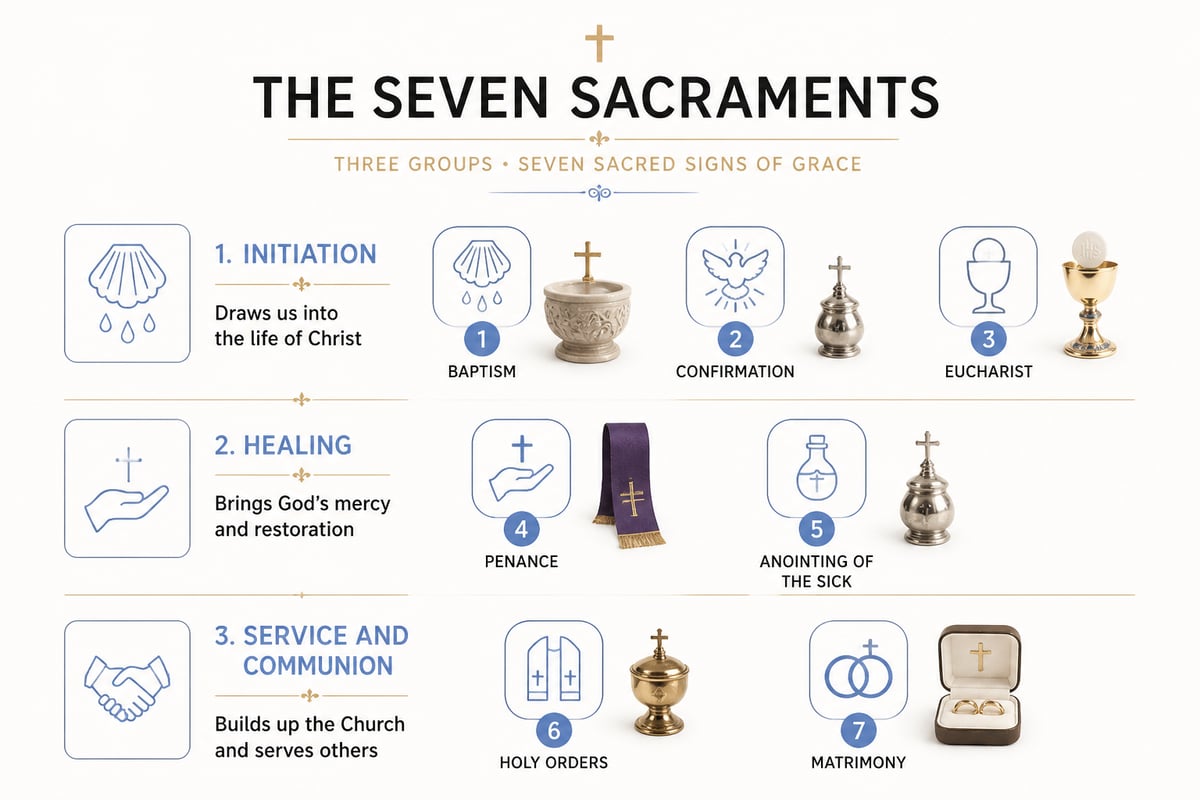
The Catholic Church recognizes seven sacraments: Baptism, Confirmation, Eucharist, Penance, Anointing of the Sick, Holy Orders, and Matrimony. Catholics understand these as visible signs through which Christ gives grace, and they mark the major moments of a believer's life.
The sacraments fall into three groups:
- Sacraments of initiation: Baptism, Confirmation, and the Eucharist. The Catechism identifies these as the three sacraments of Christian initiation.
- Sacraments of healing: Penance (Confession) and Anointing of the Sick.
- Sacraments of service and communion: Holy Orders and Matrimony.
Everyone is baptized once, confirmed once, and invited to receive the Eucharist often. Confession is available whenever a Catholic needs to be reconciled with God and the Church. Holy Orders and Matrimony are lived out as vocations. For a gentle way to introduce children to the idea that God calls each person to a particular path, So Many Ways to Be Holy: A Child's Book About Vocations makes a fitting gift for a godchild.
How Adults Join the Church
Adults who wish to become Catholic enter through a period of formation that culminates in the sacraments of initiation. The Catechism describes adult Christian initiation as beginning with entry into the catechumenate and culminating in Baptism, Confirmation, and the Eucharist, typically celebrated together at the Easter Vigil.
In most parishes this process is called the Rite of Christian Initiation of Adults, or RCIA. It usually runs for several months, with weekly sessions on Scripture, doctrine, prayer, and Catholic life. Those who are already baptized Christians follow a similar path but are received into full communion rather than baptized again.
Questions about your own situation, such as a previous baptism or an earlier marriage, are best raised early with your parish priest. He can explain what applies to you and what documents, if any, are needed.
Core Beliefs Every Beginner Should Know
Catholic belief is summarized in the Creed, which professes faith in one God in three Persons, the Incarnation of Jesus Christ, His death and Resurrection, the Holy Spirit, the Church, and the life of the world to come. Everything else in Catholic teaching grows from these truths.
A few distinctive emphases help beginners orient themselves:
- Scripture and Tradition together. Catholics receive the Bible within the living Tradition of the Church, which guards and interprets it.
- The Eucharist as the real presence. Catholics believe that the bread and wine become the Body and Blood of Christ at Mass.
- The communion of saints. The faithful on earth, those being purified, and the saints in heaven are united in prayer for one another.
- The role of Mary. She is honored as the Mother of God and the first disciple, and she always points to her Son.
- The Church's teaching authority. Catholics hold that Christ entrusted His teaching to the apostles and their successors.
The Church is also far larger than most newcomers realize. The latest figures in the 2024 statistics dossier, for December 31, 2022, put the number of Catholics worldwide at 1,389,573,000, about 17.7% of the world population. In the United States, Pew Research Center found that 20% of adults identified as Catholic in 2024, roughly 53 million people, down from 24% in 2007. Joining the faith means joining an enormously varied family.
Building a Prayer Life as a Beginner
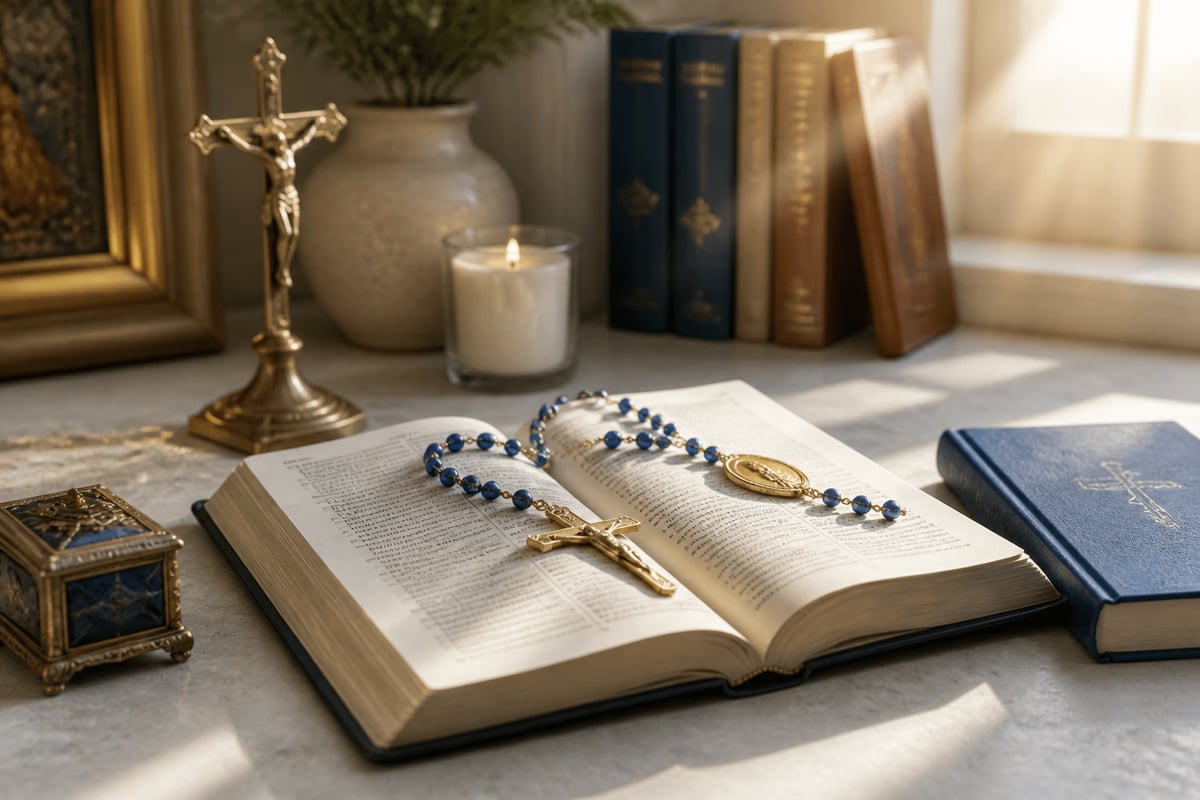
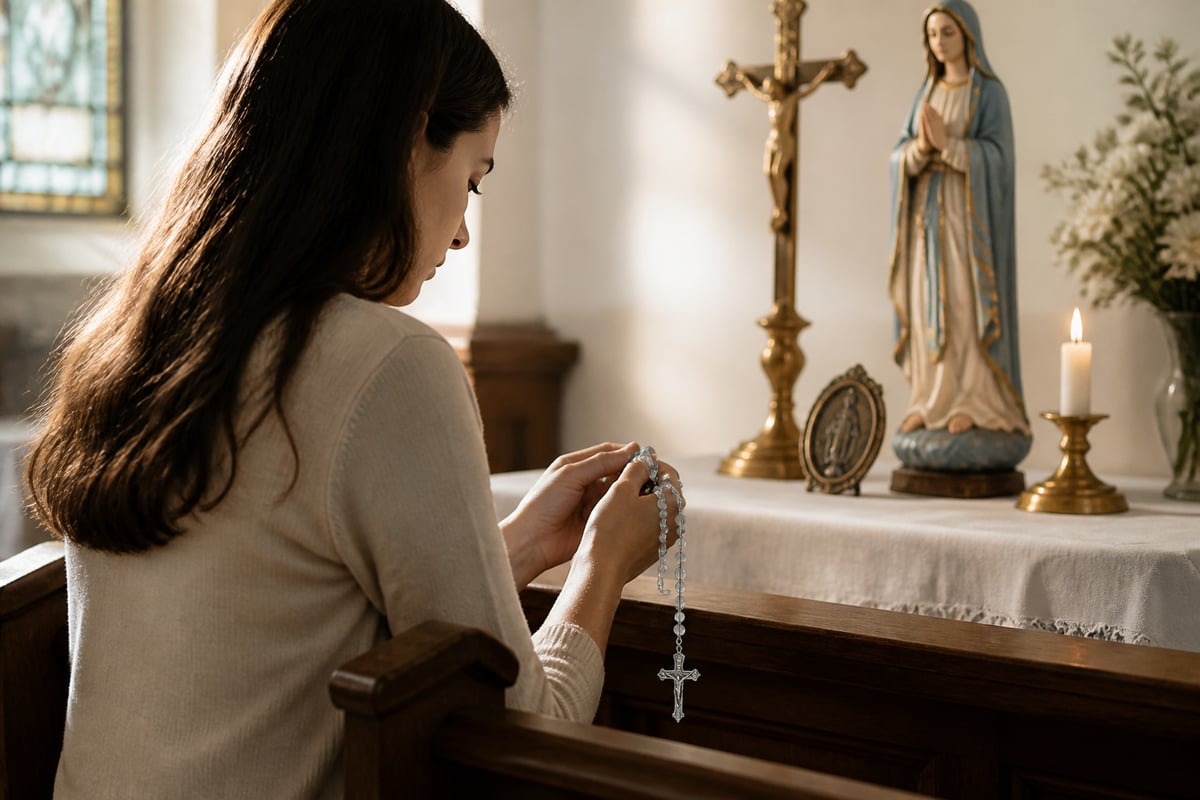
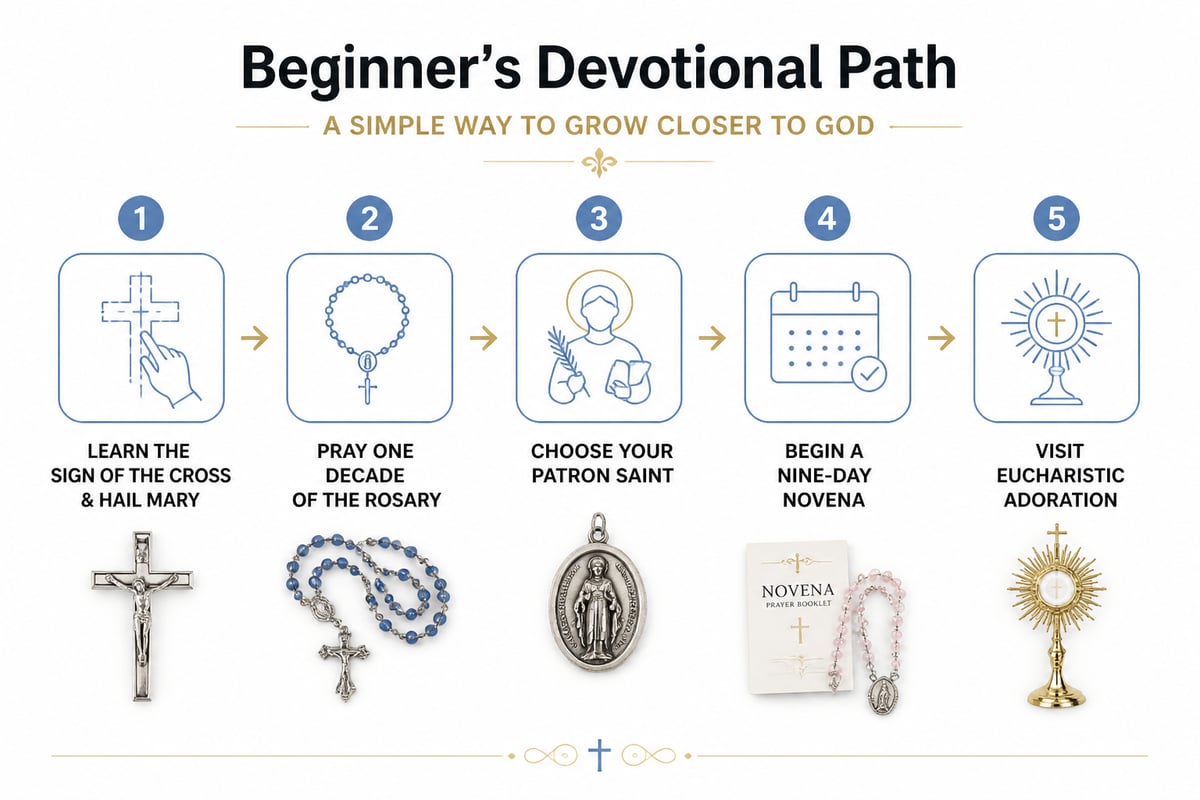
A Catholic prayer life grows through small, repeated practices, and the rosary is the most beloved of them. Prayed with a set of beads, it guides you through the mysteries of Christ's life while repeating the Hail Mary, and it takes about twenty minutes. Many beginners start with a single decade and add more over time.
Other devotions beginners often adopt include:
- Novenas, nine consecutive days of prayer for a particular intention, often to a saint.
- The Divine Mercy Chaplet, prayed on rosary beads.
- Morning and evening prayer, even if only a few minutes long.
- Eucharistic adoration, quiet time before the Blessed Sacrament.
- Prayer cards and short booklets, which keep a prayer close at hand in a purse, car, or bedside drawer.
The Church treats these practices as sacramentals and popular devotions, which prepare the heart for the sacraments and extend their grace into daily life. The Catechism's section on sacramentals and popular piety explains why blessed objects and devotions have a legitimate and cherished place in Catholic life.
A rosary or crucifix can be a helpful physical anchor for a new habit. Journeys of Faith offers a wide selection of crucifixes, rosaries, and medals, including rosaries from around the world, Miraculous Medals, and medals of the saints, so a beginner can choose one connected to a devotion that speaks to them.
Brought to you by Journeys of Faith, founded by Bob and Penny Lord. We are an Augustinian Secular Institute, Cyber Apostles, and our mission is evangelization through media.
Learning About Catholicism Through the Saints
The saints are among the most accessible teachers of the faith, because they show Catholic teaching lived out in real lives. Reading a saint's story often explains a doctrine better than a textbook does. A martyr illustrates courage in faith, a mystic illustrates prayer, and a reformed sinner illustrates mercy.
A few places to begin:
- Saint Marcellinus and Saint Peter on walking in courage under persecution.
- Saint Maria Goretti on forgiving our enemies.
- Saint Alphonsus Liguori on learning to pray and deepening the spiritual life.
Many Catholics choose a patron saint or a saint connected to their name, profession, or struggle, and ask for that saint's intercession in daily prayer. Prayer cards and medals make this practice tangible, especially when you give one to a child at Baptism or First Communion.
Marian Apparitions and Eucharistic Miracles
Marian apparitions and Eucharistic miracles are a rich part of Catholic devotion, though they hold a different place than the core teachings of the faith. The Church may approve certain apparitions as worthy of belief for the faithful, but no Catholic is required to accept private revelation, and the deposit of faith is complete in Christ and the apostles.
That distinction matters for beginners. Public revelation, found in Scripture and Tradition, is binding. Approved apparitions, such as Our Lady of Guadalupe, are understood as aids that call people back to the Gospel, to prayer, and to the sacraments.
Eucharistic miracles are reported cases in which the consecrated host or wine has shown extraordinary signs. They are meant to strengthen belief in the real presence, not to replace it. The long-recorded liquefaction of the blood of Saint Januarius in Naples is one example, explored in what the blood of Saint Januarius teaches us about faith.
Catholics who enjoy this side of the faith often learn best through books, documentaries, and audio. Journeys of Faith carries Catholic books, DVDs, ebooks, and audio on the saints, Marian apparitions, and Eucharistic miracles, including works by founders Bob and Penny Lord.
Resources for Learning More
A short, well-chosen library serves a beginner better than a large one. Aim for one reference, one devotional, and one book of saints' lives, then add more as your questions develop.
| Need | What to look for |
|---|---|
| Doctrine reference | The Compendium or Catechism of the Catholic Church |
| Scripture | A Catholic edition of the Bible with notes |
| Prayer | A rosary, a prayer booklet, and prayer cards |
| Inspiration | Lives of the saints, Marian apparitions, Eucharistic miracles |
| Community | RCIA, a parish Bible study, or a Eucharistic adoration hour |
For a curated starting point, the Journeys of Faith guide to books about the Catholic Church lays out essential reading for 2026.
A free app is also available to download, which keeps Catholic content within reach on your phone. Orders over $50 qualify for free shipping, which helps when you are gathering a few books, a rosary, and some prayer cards at once.
Practical Tips for the First Year
The first year is about forming habits, not collecting information. Attend Sunday Mass consistently, pray a little every day, and read the Gospels slowly. Write down questions as they arise and bring them to a priest or a trusted, well-formed Catholic friend.
A few cautions help:
- Be patient with parts of the faith that feel unfamiliar. Understanding often comes after practice.
- Prefer sources faithful to the Church's teaching over online commentary of uncertain origin.
- Avoid comparing your pace to anyone else's. Some people take a year, some take many.
- Keep your devotional life simple. One rosary, one prayer card, and one saint to know well is a full beginning.
Learning about Catholicism is a lifelong pursuit, and no one finishes it. The goal is a closer relationship with Christ, and each prayer, Mass, and saint's story moves you a step in that direction.
Your next step is simple: choose one habit, such as praying a decade of the rosary tonight, and begin it before you read anything else. When you are ready for books, DVDs, and devotional items to support it, explore the Crucifixes, Rosaries and Medals collection and the wider catalogue from Journeys of Faith, founded by Bob and Penny Lord. You can explore the Journeys of Faith online store, with thousands of Catholic items, at journeysoffaith.com/collections. Journeys of Faith is blessed to provide Catholic media, including podcasts and inspirational content, free of charge across multiple media platforms for viewers and listeners around the world. While access to this content remains free, there are significant and continually increasing costs associated with producing, hosting, and distributing these programs, and your support helps us continue sharing the beauty of the Catholic faith with souls, so please make a donation. To gather your first rosary, prayer cards, and books in one place, Shop now at Journeys of Faith.
