

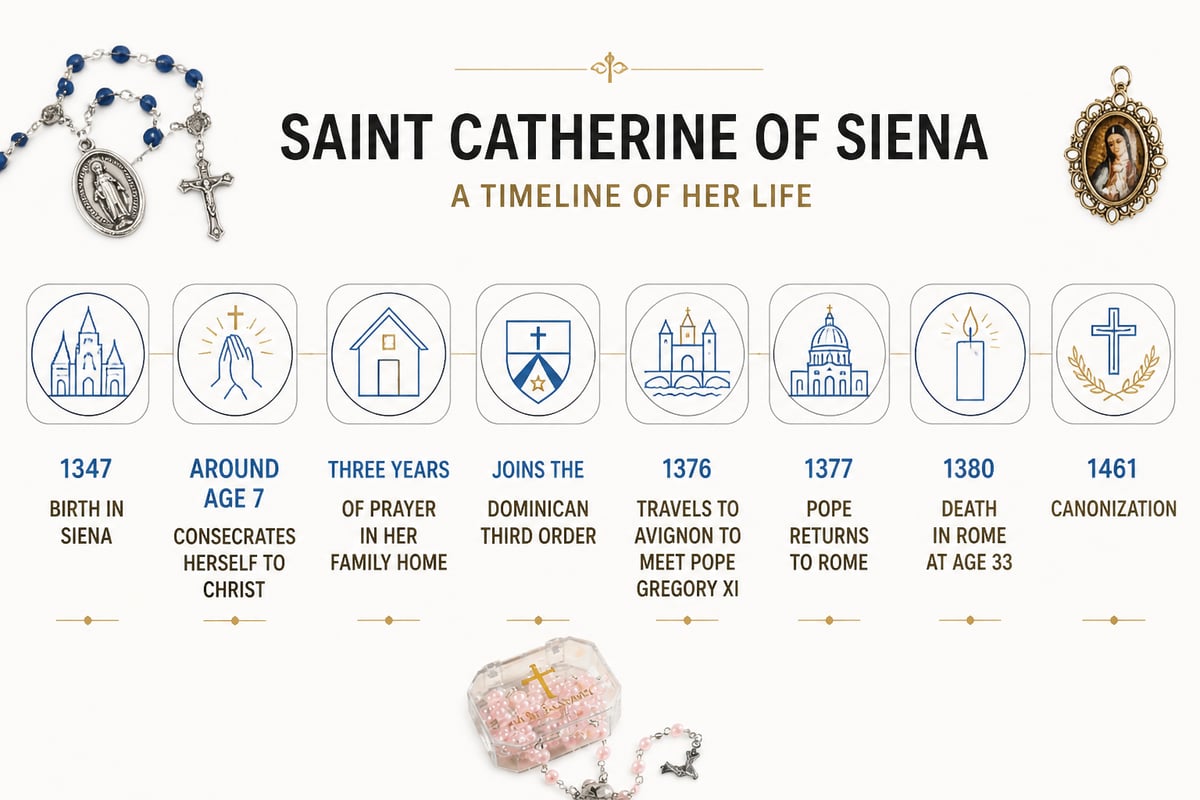
Saint Catherine of Siena was a fourteenth-century Dominican tertiary, mystic, writer and peacemaker who counseled popes, helped bring the papacy back to Rome and was later named a Doctor of the Church. Born in Siena in 1347 to a large family of a wool dyer, she lived only 33 years, yet her letters and her spiritual treatise, the Dialogue, continue to shape Catholic prayer today. This guide covers her life, her fasting, her visions, her writings, her best-known sayings and the ways devotion to her can enter your own prayer life.
Catherine's story rewards slow reading. It touches on the Eucharist, the Cross, the unity of the Church and the call of every layperson to holiness.
Brought to by Journeys of Faith Founded and Bob and Penny Lord - We are an Augustinian Secular Institute - Cyber Apostles - Our Mission is Evangelization through Media.
Can You Tell Me the Story of St. Catherine of Siena?
Catherine was born on March 25, 1347, in Siena, and died on April 29, 1380, in Rome, according to Encyclopaedia Britannica. Between those dates lies one of the most remarkable lives in Church history.
She was born into a large family, the child of Giacomo and Lapa Benincasa. From early childhood she experienced visions, and at about age seven she consecrated her virginity to Christ. Her family had other plans. When her parents pressed her toward marriage, she cut her hair short as a sign of refusal and endured months of domestic hardship before her father relented and permitted her to live as she wished.
For about three years she lived in near silence and prayer in a small room in her family home, a period she called her "interior cell." She then entered the Dominican Third Order, joining the Mantellate, women who wore the habit and lived in the world.
Her inner life soon turned outward. She nursed the sick, including plague victims and prisoners, and gathered a circle of followers, men and women, clergy and laity, who called her "Mamma." She wrote to rulers, cardinals and popes, urging reform of the clergy, peace among warring Italian cities and the return of the pope from Avignon to Rome. In 1376 she traveled to Avignon and pressed Pope Gregory XI to go home. He returned to Rome in 1377.
After Gregory's death, the Western Schism divided Christendom. Catherine spent her last years in Rome, praying and offering herself for the Church's unity. She died there at age 33.
Why Did St. Catherine of Siena Starve Herself?
Catherine's severe fasting was a form of penance and union with Christ, not a pursuit of death, though modern readers rightly find it difficult. Her confessor and biographer, Blessed Raymond of Capua, is traditionally cited as describing her very limited eating and her devotion to the Eucharist.
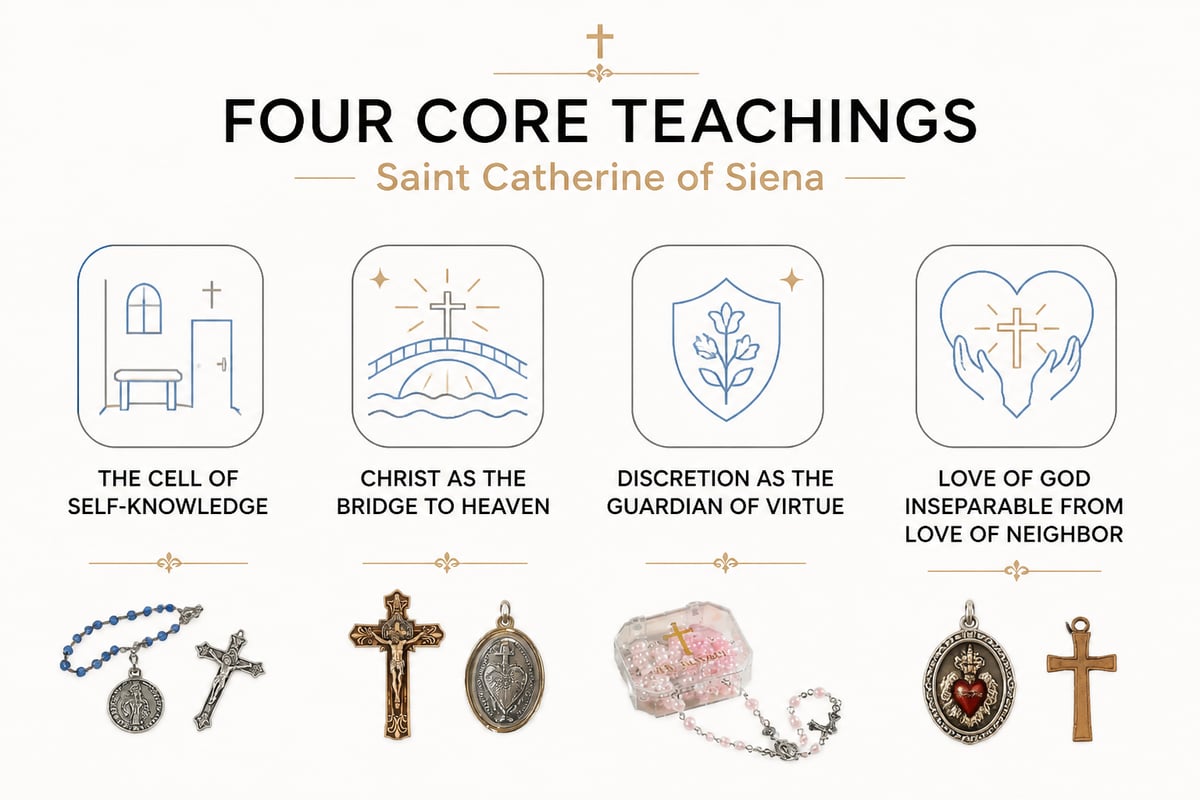
Her motives were spiritual. She offered her sufferings for sinners, for the reform of the Church and for the souls of those she loved. She also told her followers plainly that bodily penance was never the goal. In the Dialogue, she presents discretion as the guardian of every virtue and teaches that charity, not austerity, is the measure of holiness.
A few points help place her practice in context:
- Fourteenth-century piety. Severe fasting was an accepted ascetical practice among medieval mystics, and many saints of that era practiced it.
- Eucharistic hunger. Raymond of Capua describes her longing for Holy Communion as the center of her inner life.
- Her own warnings. She repeatedly counseled moderation to others and told them not to harm their health in pursuit of penance.
- Later struggles. Her fasting did damage her health, and she suffered greatly in her final years.
The Church canonizes Catherine for her heroic charity and her teaching, not as a model for extreme fasting. Anyone drawn to penance today should seek the guidance of a confessor or spiritual director.
What Visions and Mystical Experiences Defined Her Life?
Catherine's mystical life centered on Christ crucified, the Eucharist and her union with Him, and several experiences became famous in Catholic tradition. Each is rooted in her own accounts and those of her early biographers.
The best known is her mystical marriage to Christ, which tradition places it in the 1360s. He describes Our Lord placing a ring on her finger, visible to her alone. You can read more about this episode in Journeys of Faith's reflection on Saint Catherine of Siena and her mystical marriage.
Other experiences include:
- The exchange of hearts. Tradition holds that Christ took her heart and gave her His own.
- The stigmata. Catherine is said to have received the wounds of Christ, invisible during her life, according to her early biographers.
- Visions of heaven and the soul's journey. Her writings describe the soul's ascent and the glory of the saints. Journeys of Faith explores these in its article on visions of heaven by Saint Catherine of Siena.
- Eucharistic graces. Biographers report that Communion sustained her through long periods without ordinary food.
A recent overview from EWTN News highlights how her spiritual experiences and her work for Church reform belonged together. For Catherine, mystical union was never an escape. It sent her into the streets, the prisons and the papal court.
What Did Saint Catherine of Siena Write?
Catherine left behind three bodies of work: the Dialogue, her letters and her prayers. She dictated much of it, and scholars debate how much she could write herself, but her authorship and voice are unmistakable.
The Dialogue (also called The Book of Divine Providence). Catherine's Dialogue is widely regarded as her spiritual testament. It records a conversation between the soul and God the Father, covering discretion, prayer, obedience and divine providence. Its most memorable image is Christ as a bridge spanning the gap between earth and heaven, with the soul climbing by the stairs of His feet, side and mouth.
The letters. Many of her letters survive. She wrote to popes, kings, queens, soldiers, prisoners, friends and her own mother. They are direct, affectionate and sometimes startlingly bold. She addressed the pope as "Papa" and urged him to act with courage.
The prayers. A number of prayers attributed to her survive, many recorded by her disciples. They are short enough to pray slowly and rich enough to return to again and again.
Readers who want to meet her in her own words can start with the Dialogue of St. Catherine of Siena leather-bound classic, a sturdy edition suited to long-term spiritual reading.

What Did Saint Catherine of Siena Say?
Catherine's sayings endure because they compress her teaching into a few sentences that can be carried through an ordinary day. These are among the most frequently quoted words attributed to her:
Popular collections attribute many short sayings to her, and their wording varies between sources.
Some of these appear in popular collections in varying wording, and scholars note that not every popular quotation can be traced word for word to her letters or the Dialogue. What can be traced is the theme behind them: self-knowledge before God, courage in truth, and love that acts.
Two ideas run through her authentic writings. The first is the "cell of self-knowledge," the inner room where a person sees both their sinfulness and God's mercy. The second is the insistence that love of God and love of neighbor cannot be separated. Her counsel is practical: pray, examine yourself honestly, then go and serve.
For a gathering of her wisdom in one place, Journeys of Faith offers an article on the heavenly wisdom of Saint Catherine of Siena.
How Did Catherine Influence the Church and Italy?
Catherine changed the course of Church history through persuasion rather than power, and the Church formally honored her influence in several steps. She was canonized in 1461, and her feast day is April 29, as Encyclopaedia Britannica records. She is honored as a patron saint of Italy.
Her titles continued to grow:
- Doctor of the Church. She is recognized as a Doctor of the Church.
- Co-patroness of Europe. She is honored as a co-patroness of Europe.
- Patroness of nurses, the sick and the Dominican Third Order. These patronages grew from her care for the plague-stricken and her life as a tertiary.
Her political influence rested on moral authority. She mediated between Florence and the papacy, urged crusading leaders toward peace and refused to flatter the powerful. Her insistence that the pope return to Rome came from a conviction that the Church's visible head belonged at the tomb of Peter.
What Are Some Interesting Facts About Saint Catherine?
Several details about Catherine's life surprise readers who know her only from statues and holy cards.
- She dictated much of her work. Many of her writings were dictated to secretaries.
- She was a layperson. As a Dominican tertiary, she never took cloistered vows, yet she counseled bishops and cardinals.
- Her relics are venerated in more than one city. Her body rests in Rome, and her head is venerated in Siena.
- She worked among plague victims. Her care for the sick made her a patron of nurses.
- She died young. At 33, she died offering her life for the Church amid the Western Schism.
A single, practical point sets Catherine apart as a model for lay Catholics today. She never waited for a perfect state in life before serving. She lived in her family's home, as a tertiary in her city and on diplomatic missions, and in each season she acted from the same interior prayer. That pattern, prayer first and then action wherever you are, is the part of her life that carries over most easily to a busy household or parish.
How Can You Grow in Devotion to Saint Catherine of Siena?
Devotion to Saint Catherine of Siena grows best through three habits: reading her, praying with her and keeping her image or relic-style devotional items close at hand.
Read. Begin with a short biography, then move to the Dialogue and a selection of letters. Journeys of Faith carries a Saint Catherine of Siena booklet and an audiobook, useful if you pray in the car or while working. For the Catholic reader who wants her spiritual teaching in the company of other great guides, the Classic Spiritual Direction Books collection is a natural place to browse.
Pray. Catherine's feast on April 29 is a fitting day for a short novena, a rosary offered for the Church and the pope, and a prayer for peace. Her patronage of the sick makes her a natural intercessor when praying for nurses and caregivers.
Keep her near. A laminated bio card or a small statue prayer card fits easily in a Bible, missal or wallet.
Watch. Journeys of Faith's Saint Catherine of Siena video download tells her story on screen. Families who keep older Catholic programming on videotape can find equipment support through VCR Supply, which rents and repairs professional videotape decks for digitization.
FAQ
Was Saint Catherine of Siena a nun?
No. Catherine was a Dominican tertiary, a lay member of the Third Order who wore the habit but lived in the world. This allowed her to serve the sick, travel on diplomatic missions and counsel Church leaders without the restrictions of a cloister.
When is the feast day of Saint Catherine of Siena?
Her feast day is April 29, the date of her death in 1380. Catholics often mark it with a novena or a rosary offered for the Church and the pope.
Why is Saint Catherine of Siena a Doctor of the Church?
The Church recognizes her as a Doctor of the Church for the depth of her teaching.
A simple next step is to choose one short Catherine reading, such as the booklet or her prayers, and pray with it daily until her feast day on April 29. Journeys of Faith can supply that reading and more, including the Classic Spiritual Direction Books collection, along with rosaries, medals, holy cards and Catholic media on the saints, Marian apparitions and Eucharistic miracles. 1. Explore the Journeys of Faith online store with thousands of Catholic items at journeysoffaith.com/collections. 2. Journeys of Faith is blessed to provide Catholic media, including podcasts and inspirational content, free of charge across multiple media platforms for viewers and listeners around the world. While access to this content remains free, there are significant and continually increasing costs associated with producing, hosting and distributing these programs. Your support helps us continue sharing the beauty of the Catholic faith with souls, and you can make a donation here. Shop now and enjoy free shipping on all orders over $50.
