

The story of saint perpetua and felicity stands as one of the most compelling narratives of Christian martyrdom in the early Church. These two women, separated by social class but united in faith, faced persecution with extraordinary courage in third-century North Africa. Their witness continues to inspire Catholics worldwide, reminding us that authentic discipleship often requires profound sacrifice. Through their documented visions, unwavering commitment to Christ, and ultimate martyrdom, saint perpetua and felicity demonstrate how the Holy Spirit strengthens believers in their darkest moments.
Historical Context of Early Christian Persecution
The persecution under Emperor Septimius Severus in 203 AD created a dangerous environment for Christian converts throughout the Roman Empire. The emperor issued an edict prohibiting conversions to Christianity and Judaism, targeting catechumens-those preparing for baptism-with particular severity. This political climate set the stage for the arrest of saint perpetua and felicity in Carthage, located in modern-day Tunisia.
The Passion of Saints Perpetua and Felicity provides one of the earliest and most authentic accounts of Christian martyrdom. Unlike many hagiographical texts written generations after events occurred, this document contains firsthand testimony. The narrative's immediacy and personal details offer unique insights into the spiritual lives of early Christians facing death for their faith.
Social Status and Personal Backgrounds
Perpetua came from a wealthy, educated Roman family. She was approximately 22 years old, recently married, and nursing an infant son when authorities arrested her. Her classical education enabled her to document her experiences in Latin, making her one of the first Christian women whose writings survive.
Felicity occupied a different social position entirely. She served as a slave, likely in Perpetua's household, and was eight months pregnant at the time of her arrest. Despite their contrasting circumstances, these women formed a spiritual bond that transcended Roman social hierarchies.
Brought to you by Journeys of Faith Founded by Bob and Penny Lord - We are an Augustinian Secular Institute - Cyber Apostles - Our Mission is Evangelization through Media.
The group arrested with saint perpetua and felicity included three other catechumens: Saturninus, Secundulus, and Revocatus. Their teacher, Saturus, voluntarily joined them in prison, choosing solidarity over safety. This Christian community supported one another through imprisonment, torture, and execution.
The Prison Experience and Baptism
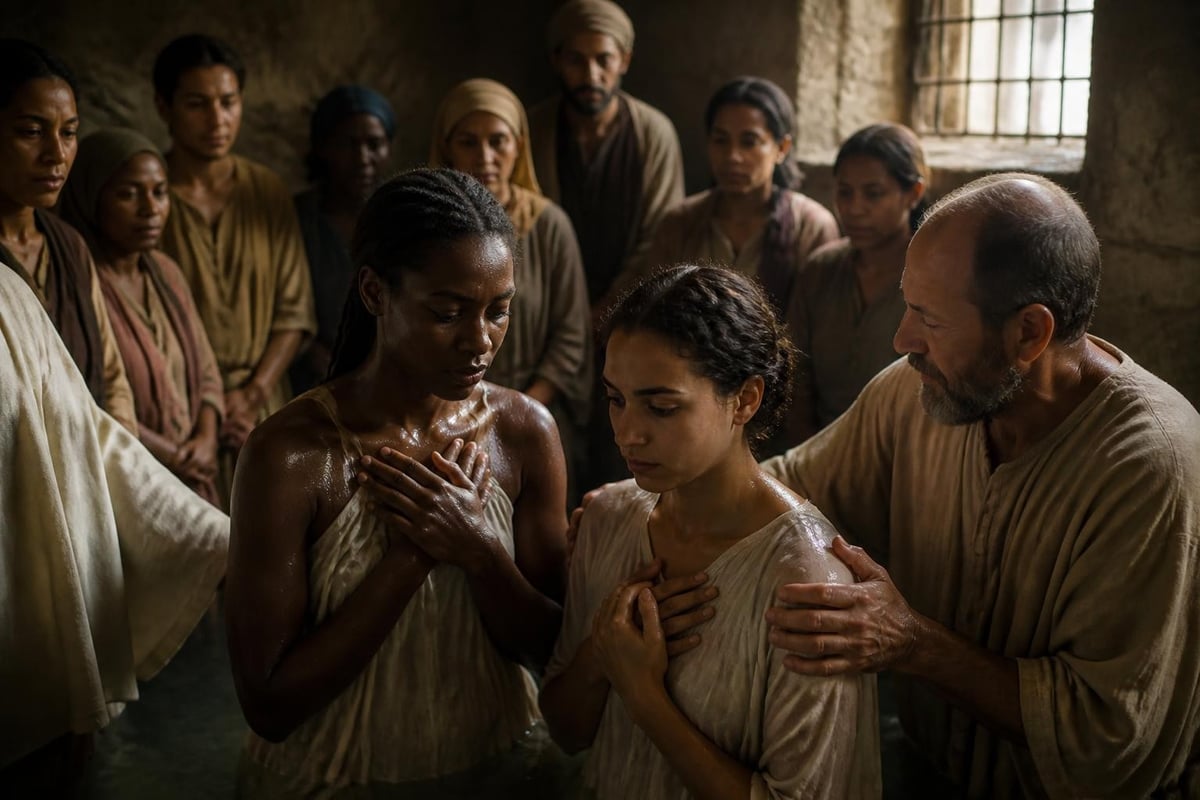
Prison conditions in Roman Carthage were notoriously harsh. Perpetua described the dungeon as terrifyingly dark and overcrowded. The heat, combined with rough treatment from guards, created almost unbearable circumstances. Yet within these brutal conditions, the prisoners experienced profound spiritual moments.
The group received baptism while imprisoned, fulfilling their catechumenate journey under extraordinary circumstances. This sacramental moment strengthened their resolve and prepared them spiritually for martyrdom. Perpetua later wrote that after baptism, the Holy Spirit instructed her to pray only for endurance in her coming suffering.
Family Pressures and Maternal Struggles
Perpetua's father repeatedly visited the prison, begging his daughter to renounce Christianity. According to historical accounts, he threw himself at her feet, kissed her hands, and called her not "daughter" but "lady," appealing to her social status and family obligations. His anguish reflected both genuine paternal love and concern for the family's reputation.
The most heart-wrenching aspect of Perpetua's imprisonment involved separation from her nursing infant. Prison officials initially denied her access to her baby, causing her tremendous physical and emotional distress. Eventually, deacons bribed guards to improve conditions, allowing Perpetua to nurse her son within the prison. She later described how the dungeon became like a palace once reunited with her child.
Felicity faced different maternal concerns. Roman law prohibited executing pregnant women, and she feared being separated from her companions in martyrdom. The entire Christian community prayed for her early delivery. Three days before the scheduled games, Felicity gave birth to a daughter, whom fellow Christians adopted and raised in the faith.
Visions and Spiritual Revelations
Perpetua's documented visions provide extraordinary insights into early Christian spirituality and eschatology. These mystical experiences sustained her faith and demonstrated divine approval of her approaching martyrdom. Her brother Dinocrates, who died at age seven from facial cancer, appeared in one vision suffering in a dark place. After Perpetua prayed for him, he reappeared healed and refreshed, suggesting early beliefs about prayer for the dead.
The Ladder Vision
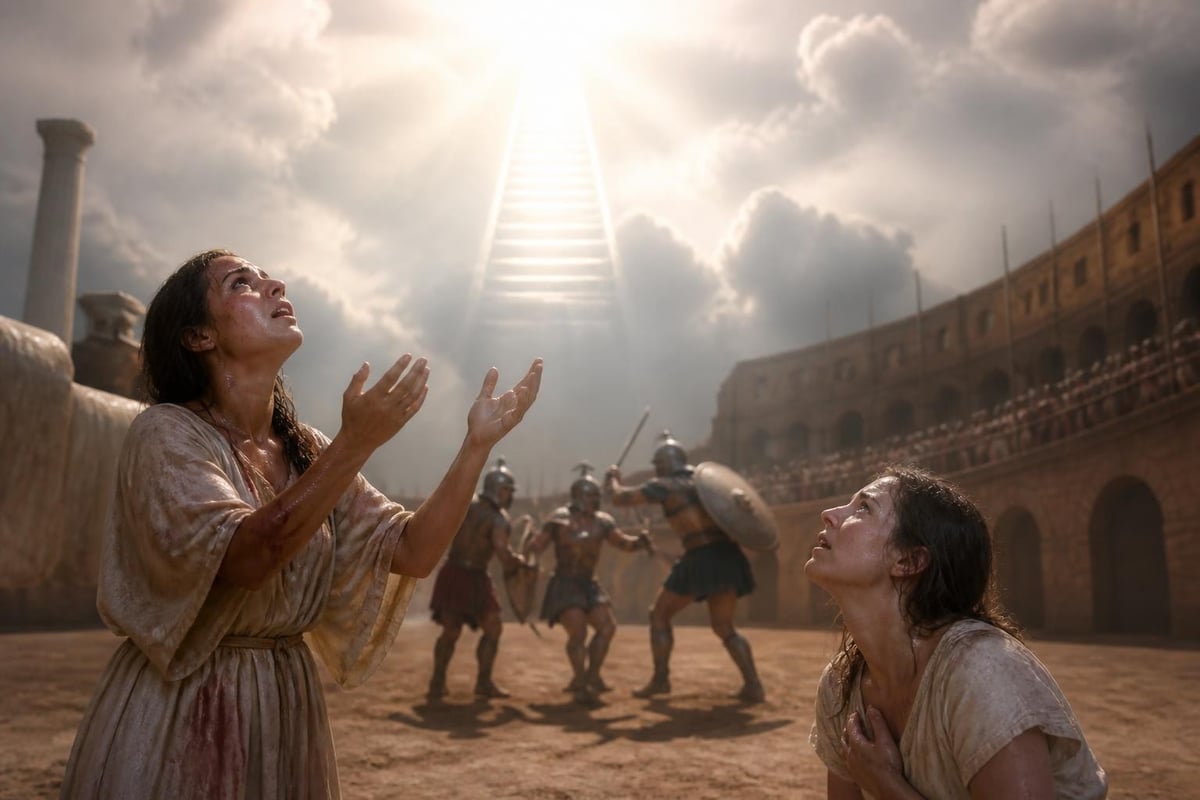
In her most famous vision, Perpetua saw a bronze ladder of tremendous height reaching to heaven. Weapons-swords, lances, hooks, and daggers-attached to its sides threatened anyone attempting to climb. A dragon lay at the ladder's base, terrorizing those who approached.
Saturus climbed first, then called for Perpetua to follow, warning her about the dragon. She responded, "In the name of Jesus Christ, he will not hurt me." Stepping on the dragon's head, she ascended the ladder. At the summit, she found a vast garden where a white-haired shepherd milked sheep surrounded by thousands of white-robed people. He offered her cheese, which she ate while the crowd said "Amen." The sweetness remained in her mouth when she awoke.
This vision clearly symbolized martyrdom's pathway to heaven. The imagery drew from Revelation and early Christian symbolism, with the dragon representing Satan, the ladder symbolizing Christ's cross, and the shepherd representing the Good Shepherd welcoming martyrs into paradise.
Combat and Victory
Another vision revealed Perpetua's upcoming ordeal using athletic imagery familiar to Roman culture. She saw herself transformed into a man, stripped for combat, and rubbed with oil like an athlete. Her opponent was a hideous Egyptian fighter. After fierce struggle, she threw him down, stepped on his head, and received a victory branch from a trainer figure. This vision both prepared her psychologically for the arena and assured her of spiritual victory through apparent physical defeat.
The Day of Martyrdom
On March 7, 203 AD, the prisoners were led from the dungeon to the amphitheater for the birthday celebration of Emperor Geta. The condemned Christians walked joyfully, with Perpetua singing psalms. Their demeanor astonished onlookers who expected to see terrified victims, not radiant witnesses to faith.
Officials attempted to force the men to wear robes of Saturn's priests and the women to dress as priestesses of Ceres. The martyrs refused, maintaining their Christian identity to the end. Their resistance succeeded, and authorities permitted them to wear their own clothing into the arena.
The Arena's Horrors
The male martyrs faced wild beasts first. A leopard mauled Saturus so severely that his blood pooled on the ground. As he lay dying, he encouraged a guard named Pudens, saying, "Stand fast in the faith and love one another. Do not let our sufferings be a stumbling block to you."
For the women, authorities prepared a mad heifer, considering it fitting that females should die by a female animal. The heifer tossed Perpetua into the air; she fell on her back. Concerned more with modesty than pain, she immediately sat up and pulled down her torn tunic to cover her thighs. She then helped Felicity, who had also been gored, to stand.
The crowd's reaction shifted from anticipation to horror. Seeing the young mother and the woman who had just given birth days earlier suffering brutally moved even hardened spectators. Officials removed the women from the arena temporarily, allowing them to recover at one of the gates.
Final Moments
Perpetua entered a trance-like state, later asking when they would face the heifer, apparently unaware the attack had already occurred. This detail suggests divine protection from full awareness of her suffering. When shown her torn clothing and wounds, she finally comprehended what had transpired.
The martyrs requested to die together in the arena's center, exchanging a final kiss of peace-a liturgical gesture signifying Christian unity even in death. Inexperienced gladiators then attempted to execute them, often striking poorly and prolonging suffering. Perpetua guided the trembling gladiator's sword to her own throat, showing courage and agency even in her final breath.
Legacy and Veneration
The martyrdom of saint perpetua and felicity profoundly impacted early Christianity. Augustine of Hippo preached about them frequently, and their feast day became one of the most celebrated in the early Church calendar. Their passion narrative circulated widely, inspiring countless Christians facing persecution.
| Aspect | Significance |
|---|---|
| Written Testimony | First-person martyrdom account by a woman |
| Social Classes | Demonstrated faith transcends social barriers |
| Maternal Witness | Mothers choosing Christ above earthly relationships |
| Visions | Divine encouragement and eschatological hope |
| Community | Christian solidarity in suffering |
The authenticity of their account remains largely unquestioned by scholars. The document's raw emotion, specific details, and theological simplicity argue against later fabrication. The narrative's preservation in both Latin and Greek indicates its widespread importance in early Christian communities.
Theological Significance
Saint perpetua and felicity embodied several crucial theological themes for early Christians. Their willingness to die rather than deny Christ demonstrated the absolute priority of faith over family, comfort, or life itself. This radical commitment answered critics who claimed Christianity appealed only to the weak or ignorant.
Their visions emphasized several early Christian beliefs. The ladder vision supported ideas about martyrdom as the surest path to heaven. Perpetua's vision of Dinocrates suggested prayers for the dead could benefit souls in purgatorial states. The combat vision portrayed spiritual warfare as real and victory as assured through Christ.

Influence on Christian Devotion
The witness of saint perpetua and felicity shaped Christian spirituality for centuries. Their story appears in martyrologies, liturgical calendars, and artistic representations throughout Church history. Medieval Christians particularly valued Perpetua's visions, seeing them as evidence that God revealed divine mysteries to women as well as men.
Many study the lives of earlier saints to understand holiness and grow in faith. The example of saint perpetua and felicity demonstrates how ordinary people-young mothers facing impossible choices-can become extraordinary witnesses through God's grace.
Modern Relevance
Contemporary Christians facing persecution worldwide find inspiration in saint perpetua and felicity. Their story reminds believers that suffering for Christ has meaning and that divine strength sustains those who remain faithful. The account offers particular encouragement to women balancing faith commitments with family responsibilities.
The relationship between Perpetua and Felicity also speaks powerfully to issues of equality and dignity. In Roman society, a noblewoman and her slave occupied entirely different worlds. Yet Christianity recognized their equal worth before God. Their shared martyrdom proclaimed that in Christ, social distinctions dissolve, and all believers stand as brothers and sisters.
Lessons from Their Witness
The lives of saint perpetua and felicity offer multiple lessons for contemporary Catholics navigating a secularizing culture. While most Western Christians do not face literal martyrdom, the call to witness Christ authentically remains constant.
Courage in Conviction
Both women could have easily recanted. A simple act of worship to Roman gods would have secured their freedom, allowing them to return to their families and normal lives. Yet they recognized that denying Christ, even externally while maintaining internal belief, constituted ultimate betrayal. Their courage challenges modern tendencies toward compromise and conformity.
Key Characteristics of Their Faith:
- Unwavering commitment to Christ despite extreme pressure
- Prioritization of eternal over temporal concerns
- Community support strengthening individual resolve
- Mystical experiences providing divine encouragement
- Maternal sacrifice choosing spiritual motherhood for many over physical motherhood for one
The Power of Christian Community
The passion narrative emphasizes how Christian community sustained the martyrs. Deacons brought food and bribed guards. Fellow believers prayed for Felicity's delivery. Saturus voluntarily joined his students in prison. This mutual support reflects early Christian understanding of the Church as one body, suffering and rejoicing together.
Contemporary Catholics can learn from this model. Faith thrives in community, not isolation. Understanding our connection to other believers, past and present, strengthens our own commitment and provides necessary support during trials.
Prayer and Intercession
Catholics have sought the intercession of saint perpetua and felicity for over 1,800 years. Many pray to them particularly for strength in suffering, protection during childbirth, and courage to witness Christ authentically. Their feast day, March 7th, provides an annual opportunity to reflect on their example and renew commitment to faithful living.
Traditional prayers invoke their example and seek their help:
Sample Prayer Structure:
- Recognition of their heroic witness
- Acknowledgment of current struggles or needs
- Request for their intercession
- Commitment to follow their example of faithfulness
- Glorification of God who strengthened them
Many Catholics incorporate their story into catechesis, using it to teach children and converts about the cost of discipleship and the power of faith. The Vatican recognizes their significance in the universal Church calendar, ensuring their memory remains alive for new generations.
Artistic and Literary Representations
Throughout Christian history, artists have depicted saint perpetua and felicity in various media. Early Christian art showed them receiving martyr's crowns. Medieval manuscripts illustrated their visions with intricate detail. Renaissance painters captured their final moments in the arena. Each artistic interpretation reflected contemporary concerns while honoring their ancient witness.
Literary treatments also abound. The original passion narrative inspired countless retellings, adaptations, and meditations. Christian poets, playwrights, and novelists have reimagined their story for new audiences. Each retelling emphasizes different aspects-maternal love, social justice, mystical experience, or pure courage-depending on the author's focus and audience's needs.
Archaeological Evidence
Archaeological discoveries in North Africa have enhanced understanding of saint perpetua and felicity's historical context. Excavations in Carthage have uncovered amphitheater remains where they likely died. Early Christian inscriptions and art fragments reference their martyrdom. These physical traces connect contemporary believers to the actual places where these holy women witnessed to Christ.
The Basilica Maiorum in Carthage, built over the cemetery where many martyrs were buried, may have contained their relics. Although the structure no longer stands, historical records describe it as a major pilgrimage site in early Christianity. Pilgrims traveled great distances to pray at the tombs of these courageous women.
Ecumenical Significance
While saint perpetua and felicity are most prominently venerated in Catholic and Orthodox traditions, many Protestant denominations also honor their memory. The authenticity and early date of their passion narrative make them acceptable examples across denominational lines. Their witness predates many later theological controversies, allowing Christians of various traditions to unite in admiring their faith.
Ecumenical discussions about martyrdom often reference saint perpetua and felicity as common heritage. Their story reminds divided Christians of shared roots in the apostolic and early Church period. In an era of increasing dialogue between Christian traditions, these ancient martyrs provide common ground for reflection and prayer.
Contemporary Persecution Parallels
Christians worldwide currently face persecution reminiscent of the Roman era. In numerous countries, profession of Christian faith can result in imprisonment, torture, or death. The witness of saint perpetua and felicity speaks directly to these modern martyrs, assuring them of divine presence in suffering and eternal reward for faithfulness.
Organizations documenting contemporary persecution often reference early martyrs like saint perpetua and felicity to provide historical context and spiritual encouragement. Their story demonstrates that persecution, while tragic, cannot ultimately overcome the Church. Blood of martyrs truly becomes seed for new believers, as their example inspires others to embrace and maintain Christian faith despite costs.
Women's Witness in the Church
The prominent role of women in early martyrdom challenges assumptions about female leadership and witness in Christianity. Perpetua's theological visions, her written testimony, and her acknowledged spiritual authority among fellow prisoners demonstrate women's significant contributions to early Christian thought and practice.
Contemporary discussions about women's roles in the Church benefit from examining historical examples like saint perpetua and felicity. These women exercised genuine spiritual authority, taught through their example, and left permanent marks on Christian tradition. Their witness occurred naturally, arising from their baptismal calling rather than formal ecclesiastical appointment.
Resources for Further Study
Those wishing to deepen understanding of saint perpetua and felicity have numerous resources available. Franciscan Media provides accessible summaries suitable for general audiences. Academic translations of the passion narrative offer scholarly insights and textual notes. Spiritual classics like Butler's Lives of the Saints include extended reflections on their significance.
Catholic schools and religious education programs frequently include saint perpetua and felicity in curriculum. Their story engages students of all ages, from young children inspired by their courage to adults grappling with faith-life tensions. Study guides and discussion questions help groups explore theological and practical implications of their witness.
Recommended Study Approaches:
- Read the original passion narrative in modern translation
- Examine historical context of Roman persecution
- Reflect on personal parallels and challenges to faith
- Discuss their example in small groups
- Pray for their intercession in specific needs
- Research contemporary martyrs continuing their witness
Organizations like Journeys of Faith provide extensive resources about Catholic saints, helping believers connect with these powerful witnesses to faith. Through books, media, and educational materials, such ministries ensure that stories like that of saint perpetua and felicity remain accessible and relevant for contemporary Catholics seeking to deepen their spiritual lives.
The testimony of saint perpetua and felicity continues inspiring Catholics nearly two millennia after their martyrdom, demonstrating how authentic faith transcends time and culture. Their courage, visions, and ultimate sacrifice for Christ provide a model of discipleship for all believers. Whether you're seeking to deepen your understanding of the saints or looking for inspiration in your own faith journey, Journeys of Faith offers extensive resources to help you grow closer to Christ through the witness of these holy men and women. Explore thousands of Catholic items including books, prayer cards, and devotional materials at our online store at https://journeysoffaith.com/collections. Journeys of Faith is blessed to provide Catholic media, including podcasts and inspirational content, free of charge across multiple media platforms for viewers and listeners around the world. While access to this content remains free, there are significant and continually increasing costs associated with producing, hosting, and distributing these programs. Your support helps us continue sharing the beauty of the Catholic faith with souls worldwide. Please make a donation at https://journeysoffaith.com/pages/donate to support our evangelization mission.
