

St Avila Teresa, more commonly known as St Teresa of Avila, stands as one of the most influential mystics and reformers in Catholic history. Born in 1515 in the town of Ávila, Spain, this remarkable woman transformed not only her own religious order but also shaped the very understanding of contemplative prayer and spiritual development for centuries to come. Her profound writings, extraordinary mystical experiences, and bold reform of the Carmelite Order earned her recognition as a Doctor of the Church, a title reserved for those whose theological contributions have significantly enriched Catholic teaching. Today, her feast day on October 15 continues to inspire countless believers seeking deeper intimacy with God through prayer and contemplation.
The life of st avila teresa represents a remarkable journey from worldly concerns to profound mystical union with God. Understanding her story provides essential insights for anyone seeking to deepen their spiritual life and embrace the transformative power of authentic prayer.
Early Life and Conversion of St Avila Teresa
Teresa de Cepeda y Ahumada entered the world on March 28, 1515, into a wealthy Spanish family in Ávila. Her childhood revealed early signs of religious fervor, including her famous attempt at age seven to run away with her brother to seek martyrdom among the Moors. This dramatic episode foreshadowed the passionate temperament that would later characterize her spiritual writings and reforms.
Despite her early piety, Teresa's teenage years drew her toward more worldly pursuits. She enjoyed romance novels, fashionable clothing, and social gatherings. This period of her life demonstrates an important truth about sanctity: saints are not born perfect but rather transformed through grace and perseverance.
The Journey to Religious Life
At age 20, Teresa entered the Carmelite Monastery of the Incarnation in Ávila, though initially without a clear sense of divine calling. Her decision stemmed more from practical considerations about marriage and her spiritual welfare than from overwhelming religious fervor. This honest acknowledgment in her autobiography reveals st avila teresa's remarkable candor about her own spiritual struggles.
The early years in religious life proved challenging. Teresa suffered from severe illness that nearly killed her and left her partially paralyzed for years. During this period, she abandoned mental prayer, believing herself unworthy of such intimate communication with God. This abandonment of prayer, which she later described as one of her greatest mistakes, lasted nearly two decades.
Brought to you by Journeys of Faith. Founded by Bob and Penny Lord, we are an Augustinian Secular Institute and Cyber Apostles. Our Mission is Evangelization through Media.
The Spiritual Awakening and Mystical Experiences
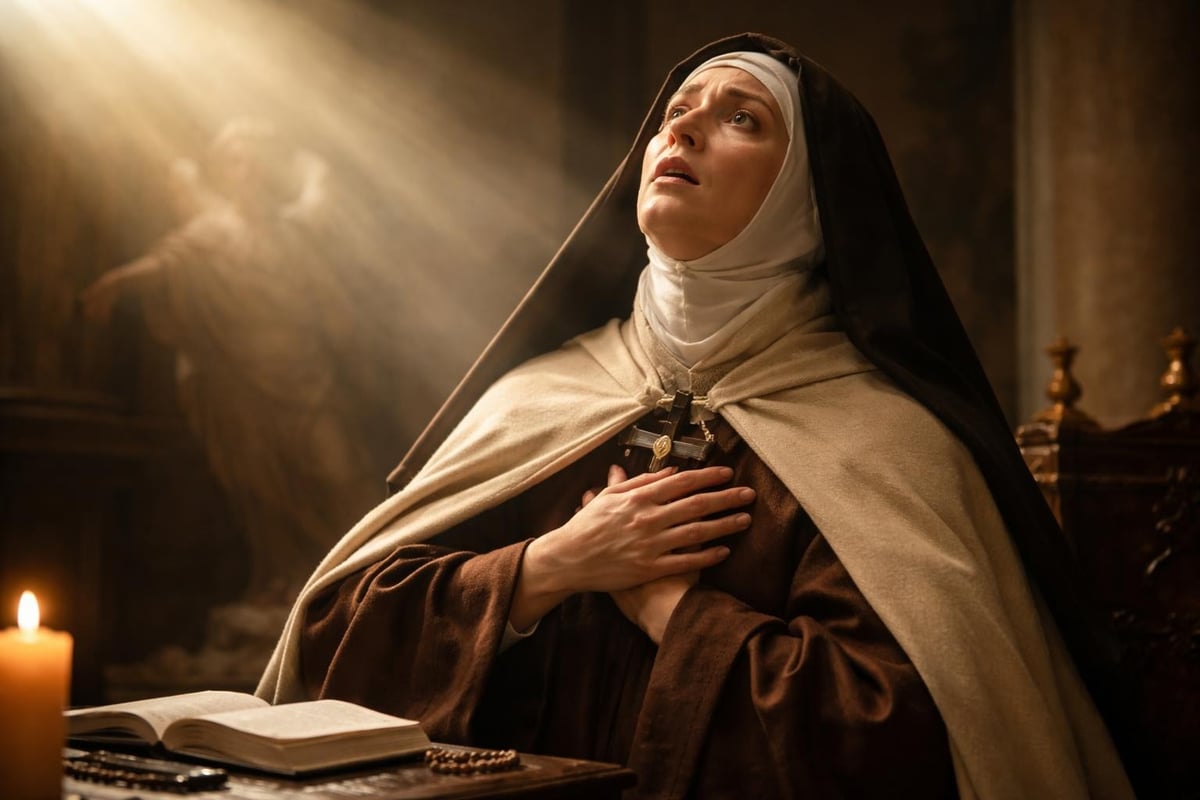
St avila teresa's profound conversion occurred around age 39, triggered by an encounter with a statue depicting the wounded Christ. This moment ignited within her a burning love for God that would never diminish. She resumed mental prayer with renewed determination and began experiencing extraordinary mystical phenomena that she would later describe in her writings.
Her mystical experiences included:
- Intellectual visions where she perceived divine truths without sensory images
- Imaginative visions including the famous vision of an angel piercing her heart with a golden spear
- Raptures and ecstasies that physically lifted her during prayer
- Spiritual marriage representing the highest union of the soul with God
These experiences initially troubled Teresa, who feared deception from the devil. She consulted numerous spiritual directors, many of whom dismissed her visions as delusions. This period of testing and discernment refined her spiritual wisdom and taught her crucial lessons about authentic mysticism versus spiritual pride.
Understanding Teresa's Teaching on Prayer
The spiritual doctrine of st avila teresa centers on mental prayer, which she defined as "nothing else than an intimate sharing between friends." Her approach to prayer emphasized relationship over technique, friendship with Christ over mere formulas. According to the comprehensive biographical account at Britannica, her teachings revolutionized how Catholics understood the contemplative life.
Teresa identified four stages of prayer, using the metaphor of watering a garden:
| Stage | Method | Effort Required | Divine Action |
|---|---|---|---|
| First Water | Manual drawing from well | High personal effort | Minimal divine intervention |
| Second Water | Water wheel mechanism | Moderate effort | Increased divine assistance |
| Third Water | Stream or river | Minimal effort | Predominantly divine |
| Fourth Water | Rain from heaven | Pure receptivity | Entirely divine gift |
This framework helped believers understand prayer as a progressive journey where human effort gradually yields to divine grace. Her realistic approach acknowledged the difficulties of prayer while encouraging perseverance through dry periods.
The Carmelite Reform Movement
The most visible achievement of st avila teresa was her reform of the Carmelite Order. By the mid-16th century, the Carmelite convents had relaxed their original rule significantly. Large communities, frequent visitors, and comfortable living conditions had replaced the austere simplicity of earlier centuries. Teresa envisioned a return to primitive observance with smaller communities, perpetual enclosure, and absolute poverty.
In 1562, despite fierce opposition from civic and religious authorities, Teresa founded the Convent of St. Joseph in Ávila. This first reformed house embraced strict poverty, going without endowments and living solely on alms. The nuns observed perpetual enclosure, wore rough wool habits, and walked barefoot or in rope sandals, earning them the name "Discalced" (shoeless) Carmelites.
Expansion and Opposition
Over the next 20 years, st avila teresa founded 17 convents across Spain, traveling thousands of miles despite poor health and primitive transportation. Each foundation required careful negotiation with local authorities, securing appropriate buildings, and forming communities of women genuinely committed to the reform.
The reform movement faced substantial resistance:
- Local Carmelite authorities viewed it as implicit criticism
- Civic leaders worried about additional convents requiring support
- Some bishops questioned a woman's authority to reform religious life
- Fellow Carmelites accused reformers of causing division
Teresa's diplomatic skills, persistence, and evident holiness gradually overcame these obstacles. She also collaborated with St. John of the Cross to extend the reform to male Carmelite houses, creating a parallel movement among the friars.
Major Writings and Spiritual Teachings
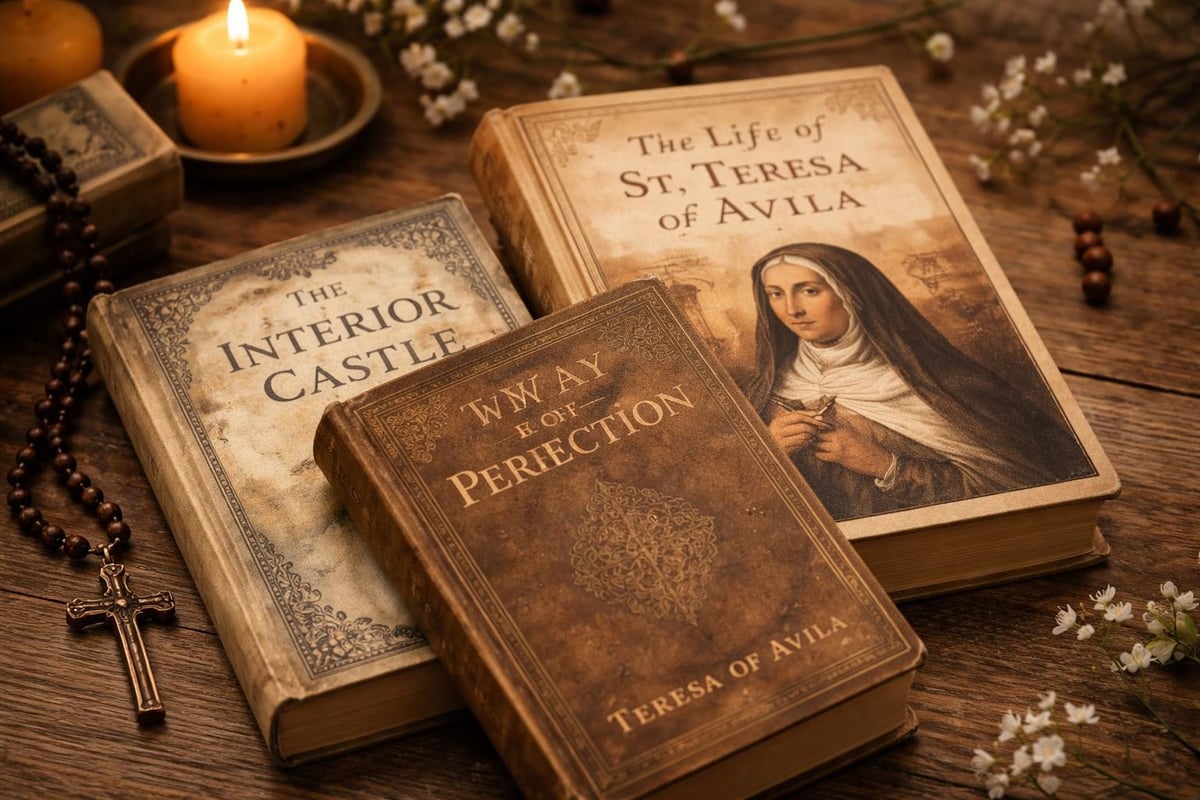
The literary legacy of st avila teresa comprises some of the most influential spiritual writings in Christian history. Written under obedience to her confessors and superiors, her books combine profound theological insight with practical wisdom and charming personal anecdotes. Her works are accessible to scholars and lay readers alike, written in colloquial Spanish rather than formal ecclesiastical Latin.
The Life of Teresa of Jesus
Teresa's autobiography, written between 1562 and 1565, provides intimate details of her spiritual journey from childhood through her early reforms. This work describes her mystical experiences with remarkable honesty, including her doubts, fears, and mistakes. The Christian Classics Ethereal Library offers access to this foundational text, allowing modern readers to encounter Teresa's own voice.
The autobiography serves multiple purposes: defending her mystical experiences against skeptics, teaching about authentic prayer, and encouraging others on the spiritual path. Her willingness to reveal personal struggles makes this work particularly valuable for those facing their own spiritual challenges.
The Way of Perfection
Written specifically for her nuns at St. Joseph's, this practical guide addresses the fundamentals of religious life and prayer. St avila teresa covers topics including:
- The importance of mutual charity within community
- Detachment from worldly concerns and family ties
- Humility as the foundation of spiritual progress
- Mental prayer and its practice
- A detailed commentary on the Our Father
This book reflects Teresa's role as a spiritual mother, addressing the concrete questions and struggles her daughters faced in living the reformed Carmelite life.
For those seeking to deepen their understanding of the saints and their wisdom, exploring Catholic Saints books can provide invaluable insights into the spiritual traditions that shaped figures like st avila teresa and continue to guide believers today.
The Interior Castle
Considered st avila teresa's masterpiece, "The Interior Castle" presents her mature teaching on the soul's journey to God. Written in 1577 during a period of intense suffering and persecution, this book uses the metaphor of a crystal castle with seven mansions to describe progressive stages of spiritual development. The soul begins in the outer mansions, distracted by worldly concerns, and gradually moves inward toward the center where God dwells.
The seven mansions represent:
- First Mansions: Initial turning toward God amid worldly distractions
- Second Mansions: Beginning practice of prayer and virtue
- Third Mansions: Consistent spiritual practice but still self-reliant
- Fourth Mansions: Transition to passive contemplation
- Fifth Mansions: Prayer of union and spiritual betrothal
- Sixth Mansions: Spiritual marriage preparation through suffering
- Seventh Mansions: Transforming union and spiritual marriage
Each mansion contains numerous rooms, indicating the complexity and variety of spiritual experiences. Teresa's framework acknowledges that spiritual growth is neither linear nor uniform, with souls moving back and forth between mansions based on their fidelity and God's particular plans for them.
Resources for studying Teresa's works include the comprehensive collections available through ICS Publications, which offer scholarly editions with helpful introductions and notes that illuminate her teachings for contemporary readers.
Practical Wisdom for Daily Living
Beyond her mystical experiences and theological contributions, st avila teresa offered remarkably practical advice for everyday Christian living. Her common sense and psychological insight make her teachings relevant to laypeople, not just religious professionals.
Key Principles from Teresa's Life
Humility and Self-Knowledge: Teresa insisted that genuine prayer begins with honest self-knowledge. She warned against spiritual pride and encouraged her followers to recognize their complete dependence on God's grace. This humility protected her from the dangers of false mysticism and kept her grounded despite extraordinary spiritual experiences.
Determination and Courage: Throughout her life, st avila teresa demonstrated remarkable courage in pursuing God's will despite opposition. She famously said, "Christ has no body now but yours," challenging believers to become God's hands and feet in the world. Her determination teaches that authentic spirituality requires action, not just contemplation.
Balance and Common Sense: Despite her mystical heights, Teresa maintained remarkable balance. She advised her nuns to take care of their health, warned against excessive penances, and valued cheerfulness in community life. Her famous statement, "Teresa and a partridge are both of God," reflected her understanding that caring for bodily needs honors the Creator.
Application to Modern Life
The teachings of st avila teresa translate remarkably well to contemporary challenges:
- Her emphasis on mental prayer offers an antidote to distraction in our hyperconnected world
- Her teaching on discernment helps navigate competing voices and ideologies
- Her example of persistence encourages those facing opposition for their beliefs
- Her integration of contemplation and action models authentic Christian witness
Understanding the lives of saints like Teresa can transform how Catholics approach their faith, as explored in resources about Catholic Saints for children and families seeking to learn from these powerful examples.
Recognition as Doctor of the Church
In 1970, Pope Paul VI declared st avila teresa a Doctor of the Church, making her the first woman to receive this title. This recognition acknowledged that her writings contain theological insights of universal value to the entire Church. The title "Doctor" signifies a teacher whose doctrine is orthodox, applicable across cultures and times, and particularly illuminating for understanding the faith.
Teresa's designation as a Doctor emphasizes several important truths:
- Women possess profound theological wisdom worthy of recognition
- Mystical experience can yield authentic theological insight
- Contemplative prayer enriches the Church's understanding of God
- Personal holiness and theological expertise often coincide
The University of Notre Dame's profile highlights how Teresa's recognition validated women's contributions to theology and spirituality, paving the way for other female Doctors including St. Catherine of Siena, St. Thérèse of Lisieux, and St. Hildegard of Bingen.
Contemporary Relevance and Veneration
Five centuries after her death on October 4, 1582, st avila teresa continues to inspire Catholics worldwide. Her body remains incorrupt in Alba de Tormes, Spain, where pilgrims visit her tomb. In 2025, her relics were publicly displayed for special veneration, drawing thousands of faithful seeking her intercession.
Living Teresa's Legacy Today
Modern disciples of st avila teresa find multiple ways to embrace her spiritual wisdom:
- Carmelite Spirituality: The Discalced Carmelite Order continues her reform worldwide, with thousands of nuns and friars living according to her Rule
- Secular Carmelites: Lay people affiliate with the order, adapting Carmelite spirituality to life in the world
- Prayer Groups: Study groups explore Teresa's writings, particularly "The Interior Castle" and "The Way of Perfection"
- Retreat Centers: Many Catholic retreat houses offer programs based on Teresian spirituality
Her teachings on prayer remain particularly relevant as people hunger for authentic spiritual experience beyond superficial religiosity. In an age of distraction and noise, Teresa's invitation to interior silence and friendship with Christ offers a compelling alternative.
The Sisters of Carmel provide resources and books to help contemporary readers engage with Teresa's timeless wisdom, making her 16th-century insights accessible to 21st-century seekers.
Teresa's Influence on Catholic Spirituality
The impact of st avila teresa extends far beyond the Carmelite Order. Her teachings have influenced virtually every subsequent development in Catholic spirituality, from St. Francis de Sales's "Introduction to the Devout Life" to modern approaches to contemplative prayer.
Key Contributions to Spiritual Theology
Teresa's theological contributions include:
Democratization of Mysticism: Before Teresa, mystical experiences were often considered rare gifts for spiritual elites. She taught that contemplative prayer represents the normal development of a committed prayer life, accessible to anyone who perseveres. This democratization made mysticism less intimidating and more approachable for ordinary believers.
Integration of Human and Divine: Teresa's psychology recognizes the interaction between natural temperament, psychological factors, and spiritual experience. She understood that grace works through human nature rather than bypassing it, an insight that modern spiritual directors continue to apply.
Feminine Perspective: As a woman writing about theology and spirituality in a male-dominated era, st avila teresa brought unique perspectives to spiritual discourse. Her motherly approach, practical wisdom, and attention to relationships enriched Catholic spirituality with distinctly feminine insights.
Balance of Action and Contemplation: Teresa exemplified the integration of deep prayer with active service. Despite profound mystical experiences, she remained deeply engaged in the practical work of founding convents, managing communities, and writing. Her life demonstrates that contemplation and action complement rather than contradict each other.
Resources for Studying St Avila Teresa
For those wishing to deepen their knowledge of st avila teresa and her teachings, numerous resources exist in various formats. Scholarly editions provide historical context and theological analysis, while popular adaptations make her wisdom accessible to general readers.
Primary Sources
Reading Teresa's own words remains the best way to encounter her spirituality. The complete works are available through multiple publishers, with ICS Publications Volume Two offering "The Interior Castle" and "The Way of Perfection" in reliable translations with helpful commentary.
Digital resources make Teresa's writings more accessible than ever. Logos Bible Software provides searchable versions of her complete works, enabling readers to study her letters, spiritual testimonies, and major books with powerful research tools.
Secondary Literature
Countless scholars have analyzed Teresa's life and teachings. Biographies range from scholarly historical studies to popular spiritual reflections. The biography offered by St. Teresa of Avila Church in San Francisco provides a concise introduction highlighting her personal challenges and spiritual growth.
Academic institutions continue producing research on st avila teresa's theology, psychology, and historical context. This ongoing scholarship ensures that her legacy remains vibrant and continues speaking to new generations of believers.
St avila teresa's extraordinary life and profound spiritual teachings continue to guide seekers toward deeper relationship with God through contemplative prayer and authentic spiritual practice. Her courage in reforming the Carmelite Order, her mystical experiences, and her timeless writings on the interior life establish her as one of Catholicism's greatest teachers. Whether you're beginning your prayer journey or seeking to deepen existing practices, exploring Teresa's wisdom can transform your spiritual life. Journeys of Faith offers extensive resources on the saints, including books, prayer cards, and educational materials that bring these holy men and women to life for modern Catholics seeking inspiration and guidance on their own journeys of faith.
Explore Additional Resources:
- Explore Journeys of Faith Online store with thousands of Catholic Items at https://journeysoffaith.com/collections
- Our Unique Mega Search Engine https://journeysoffaith.com/search is linked to hundreds of Catholic Shops and Stores
- Get the Journeys of Faith NEW App for iPhone or Android - Search for Journeys of Faith or go to https://journeysoffaith.com/pages/download-our-app
- Chat with us anytime https://chatting.page/mjxs9aerrtgm3lmpndlcepmbyosntrjn
- We need your help to reach more souls. Please Make a Donation https://journeysoffaith.com/pages/donate