
Blessed Mary is the Virgin Mary, the mother of Jesus Christ, whom Catholics honor as Mother of God, Mother of the Church and the first and most faithful disciple of her Son. The Gospel of Luke records the source of the title directly: Elizabeth greets her with the words "Blessed are you among women," and Mary herself prophesies that "all generations will call me blessed." This guide traces her life, explains the titles the Church gives her, answers common questions about the Assumption and her prayers, and shows how Catholics can grow closer to her through devotion.
What Does the Bible Say About Mary Being Blessed?
The Bible calls Mary blessed in three ways: by the angel Gabriel, by her cousin Elizabeth, and by Mary's own voice in the Magnificat.
At the Annunciation, Gabriel greets her as "full of grace" and tells her the Lord is with her (Luke 1:28). At the Visitation, Elizabeth, filled with the Holy Spirit, cries out, "Blessed are you among women, and blessed is the fruit of your womb" (Luke 1:42). She adds a second blessing that points to the heart of Mary's holiness: "Blessed is she who believed that there would be a fulfillment of what was spoken to her by the Lord" (Luke 1:45).
Mary then answers with her own prophecy: "From now on all generations will call me blessed" (Luke 1:48). Catholic devotion is, in a real sense, the fulfillment of that sentence. Every Hail Mary, every rosary decade and every Marian feast day repeats the blessing that Scripture itself began.
What Do We Know About the Life of the Blessed Virgin Mary?
Scripture and Sacred Tradition together present Mary's life as a quiet path of trust, from a young woman in Nazareth to a mother standing at the foot of the Cross.
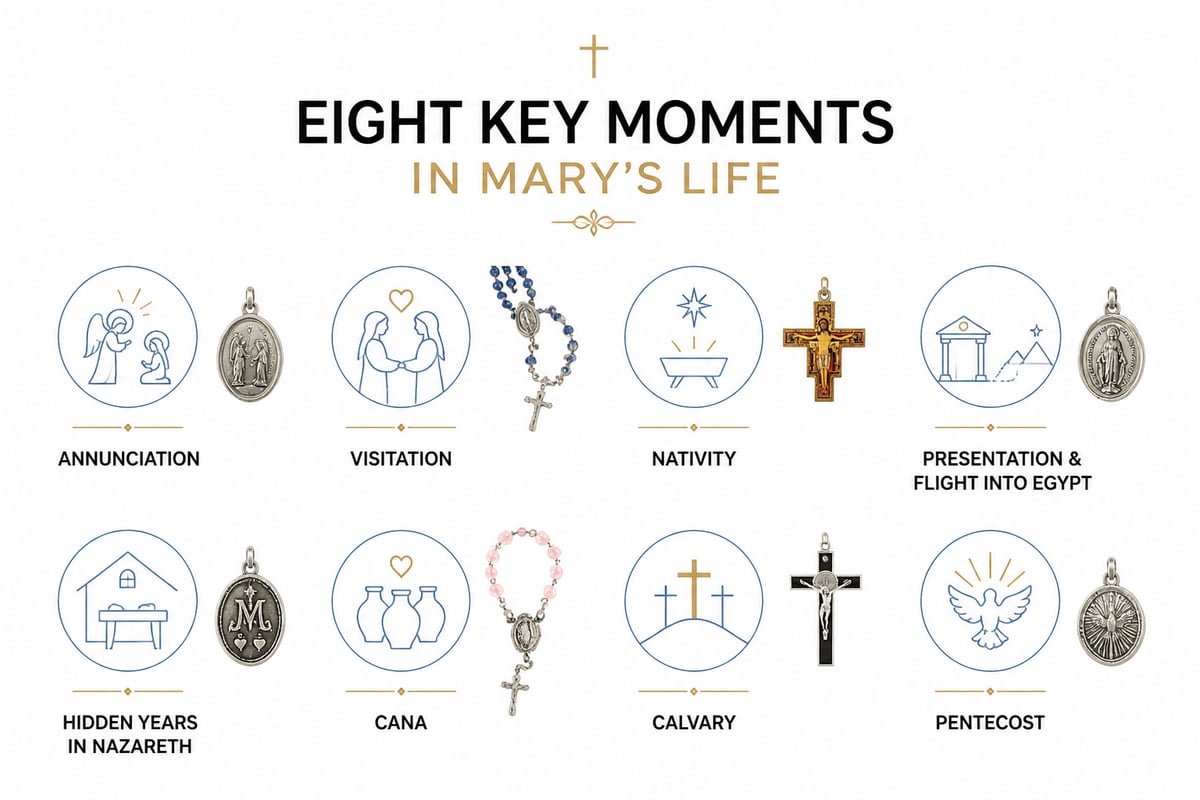
The main events can be followed in order:
- The Annunciation. Gabriel announces that Mary will conceive by the Holy Spirit, and she answers, "Let it be done to me according to your word."
- The Visitation. She travels to help Elizabeth, who is expecting John the Baptist.
- The Nativity. Jesus is born in Bethlehem, and Mary treasures these events in her heart.
- The Presentation and the flight into Egypt. She and Joseph bring the child to the Temple, then protect him from Herod.
- The hidden years in Nazareth. The Holy Family lives an ordinary life of work and prayer.
- Cana. At a wedding feast she tells the servants, "Do whatever he tells you."
- Calvary. She stands beside the Cross, and Jesus entrusts her to the beloved disciple.
- Pentecost. She prays with the apostles in the upper room as the Church is born.
Her life is marked by listening, trust and perseverance. For a deeper walk through each stage, Journeys of Faith offers a guide to the life of the Blessed Virgin Mary written for devotional readers.
Brought to you by Journeys of Faith, founded by Bob and Penny Lord. Our mission is evangelization through media.
Why Does the Church Call Her the Mother of God?
The Church calls Mary the Mother of God because the Son she bore is God incarnate, a truth about Christ before it is a statement about Mary.
The Catechism of the Catholic Church identifies Mary as the mother of Jesus and explains that she is rightly called "Mother of God" because her child is the eternal Son made flesh (CCC 495, 509). The title protects the faith in the Incarnation: if Jesus is truly God and truly man, then the woman who bore him is the mother of a divine person.
The title is ancient. According to a Vatican audience address, the Council of Ephesus affirmed "Mother of God" in 431. The Church still celebrates it each year: the Vatican lists the Solemnity of Mary, Mother of God on 1 January, and its liturgical calendar identifies 1 January 2025 as the 58th World Day of Peace, celebrated alongside the solemnity.
What Are the Main Titles of Blessed Mary?
Catholics honor Mary under many titles, each drawing out a different part of her role in salvation history.
| Title | What it expresses |
|---|---|
| Mother of God (Theotokos) | Her motherhood of Christ, true God and true man |
| Mother of the Church | Her spiritual motherhood of all believers |
| Immaculate Conception | Her preservation from original sin from the first moment of her existence |
| Ever-Virgin | Her perpetual virginity before, during and after the birth of Christ |
| Queen of Heaven | Her place in glory beside her Son, the King |
| Our Lady of the Rosary | Her intercession and the prayer that meditates on Christ's life |
The title "Mother of the Church" has a precise date. The Second Vatican Council's constitution on the Church was promulgated on 21 November 1964, and the same Vatican audience address recounts that Paul VI solemnly gave Mary this title that day.
Many other titles arise from local devotion and Marian apparitions, such as Our Lady of Guadalupe, Lourdes and Fatima. Bob and Penny Lord explore these in The Many Faces of Mary, a book that follows her appearances and the miracles associated with them across centuries and continents.
How Do the Church's Newest Teachings Treat Marian Titles?
The Vatican's most recent word on Marian titles is the doctrinal note Mater Populi Fidelis, dated 4 November 2025, issued by the Dicastery for the Doctrine of the Faith.
The note addresses titles that concern Mary's cooperation in the work of salvation. Its purpose is pastoral and doctrinal clarity: to help the faithful understand which expressions of devotion best reflect Mary's unique relationship to Christ, the one Redeemer, and to the Church. It does not diminish devotion to her. It places that devotion within the Church's settled teaching.
For Catholics who pray the rosary and novenas, the practical lesson is steady. Mary always points to Jesus. John Paul II's encyclical Redemptoris Mater develops this theme at length, describing her maternal care for the Church and the devotional titles that have grown around her.
What Is the Dogma of the Assumption?
The dogma of the Assumption teaches that Mary, having completed the course of her earthly life, was taken up body and soul into heavenly glory.
Pope Pius XII defined it in 1950, giving formal expression to a belief held in the Church for centuries. The Church celebrates the feast on August 15. It is closely tied to the Immaculate Conception: because Mary was preserved from sin, she was not subject to the corruption of the grave.
The Assumption is also a sign of hope. What happened to Mary is the destiny God intends for all the redeemed, the resurrection of the body and life with Christ. Catholics who want to see how this belief shaped devotion across the world will find it woven into many of the apparitions and shrines described in the Many Faces of Mary apparitions collection.
What Is Mary's Prayer in the Bible?
Mary's prayer in the Bible is the Magnificat, her song of praise spoken at the Visitation (Luke 1:46-55).
It begins, "My soul proclaims the greatness of the Lord, my spirit rejoices in God my Savior." In a few lines it gives thanks for God's mercy, remembers his promises to Abraham and celebrates his care for the lowly. The Church prays the Magnificat every day in Evening Prayer, which means Mary's own words form part of the daily prayer of priests, religious and laity around the world.
Her other recorded words are brief and consistent. At the Annunciation she says yes. At Cana she directs the servants to her Son. Her theology is trust, expressed in few words.
How Do You Say the Hail Mary Prayer?
The Hail Mary joins the words of Gabriel and Elizabeth from Luke 1 with a petition added by the Church.
Hail Mary, full of grace, the Lord is with thee. Blessed art thou among women, and blessed is the fruit of thy womb, Jesus. Holy Mary, Mother of God, pray for us sinners, now and at the hour of our death. Amen.
The first half is Scripture. The second half asks for her intercession, as one asks a fellow believer to pray. The prayer is the core of the rosary, which invites the faithful to meditate on the mysteries of Christ's life while repeating it.
Catholics who want a prayer to carry with them can choose from devotional cards such as the Litany of the Blessed Virgin Mary prayer card or the Consecration to the Blessed Virgin Mary premium metal prayer card. The book The Rosary: The Life of Jesus and Mary pairs each mystery with the Gospel account behind it.
How Can Catholics Grow Closer to Mary in Daily Life?
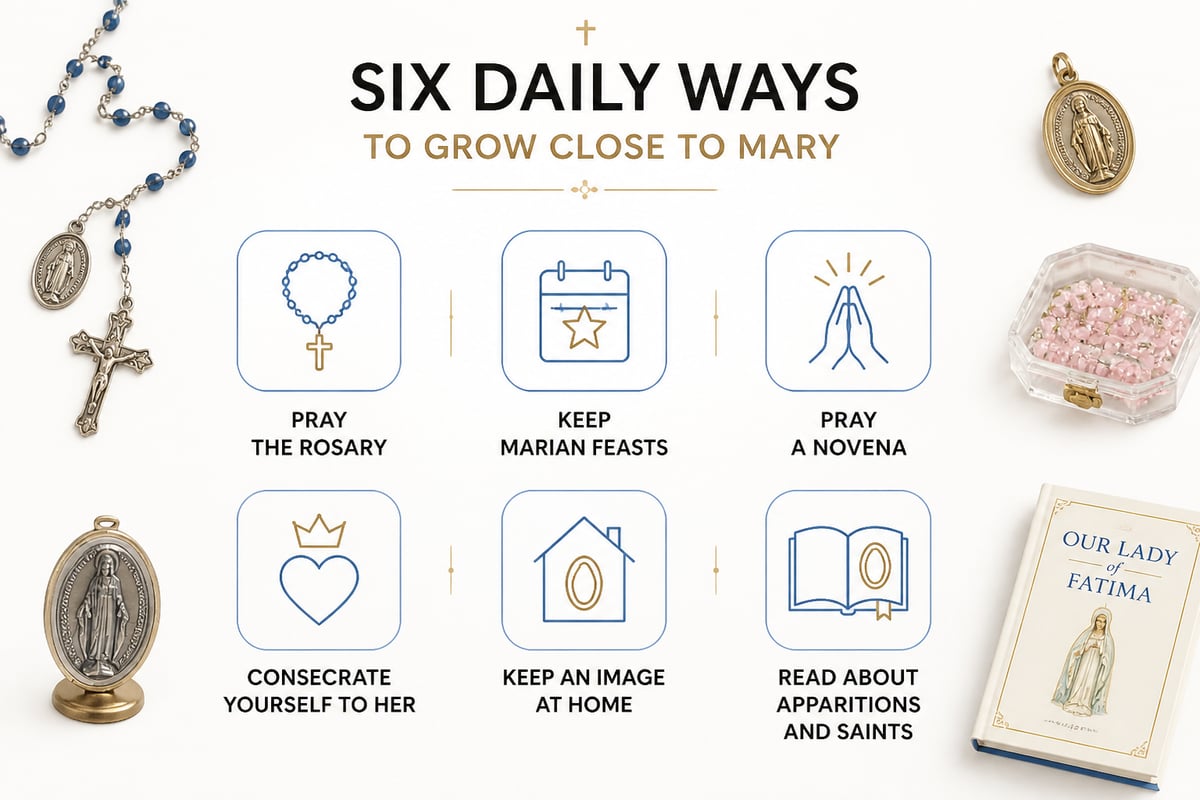
Catholics grow closer to Mary through steady, simple habits that lead them back to Christ.
- Pray the rosary daily, even one decade on a busy day.
- Keep her feasts: January 1, March 25 (the Annunciation), August 15 and December 8.
- Pray a novena to Mary under a title that speaks to your need.
- Make a consecration to her, following the tradition of entrusting yourself to Jesus through Mary.
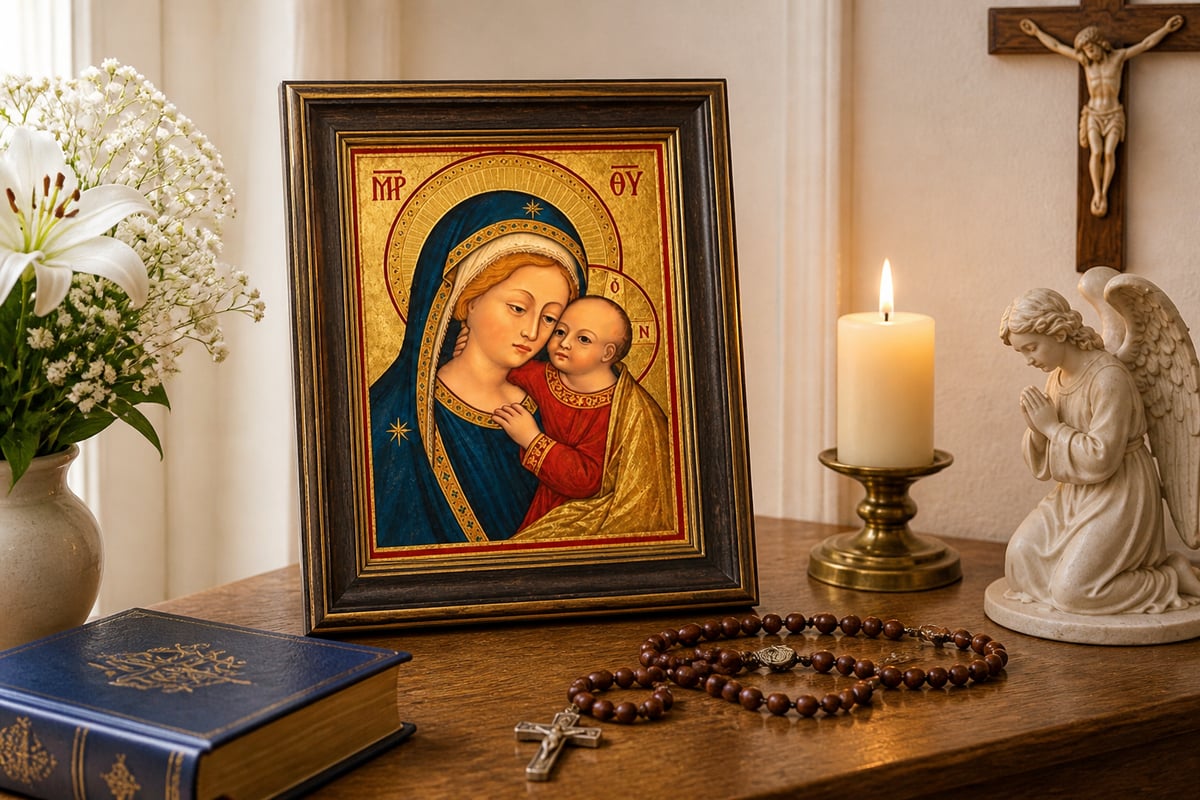
- Place an image in your home, a visible reminder to pray.
- Read about the apparitions and the saints who loved her.
Devotion to Mary under particular titles often begins with a story. Our Lady of Good Counsel, for example, is honored by Catholics seeking wisdom in hard decisions, and Journeys of Faith carries Our Lady of Good Counsel items for those who wish to place her image in their prayer space.
For readers who prefer to start with background, the Journeys of Faith article Our Lady of Mary: Understanding the Blessed Mother offers a gentle introduction to her many names.
What Is the Difference Between Honoring Mary and Worshiping Her?
Catholics honor Mary but worship God alone, and the Church has always kept that distinction clear.
Worship, or adoration, belongs to the Holy Trinity. Veneration is the respect given to the saints, and Mary receives the highest form of it because of her unique place as the mother of Christ. When a Catholic prays "pray for us," the request is the same one made to any believer, with confidence that the Mother of Jesus prays with special power.
Her own words at Cana show the pattern: "Do whatever he tells you." Every title, feast and prayer is meant to lead toward her Son. That is why the Eucharist and Mary belong together in Catholic life. Journeys of Faith explores this connection in its guide to honoring the Blessed Sacrament, and the same Christ-centered spirit shapes the essential guide to Our Blessed Virgin Mary.
FAQ
Why do Catholics say "Blessed Mary" and "Blessed Virgin Mary"?
"Blessed" echoes Elizabeth's greeting in Luke 1 and Mary's prophecy that all generations would call her blessed. "Blessed Virgin Mary" adds the title that recalls her virginal conception of Jesus. Both forms are common in Catholic prayer and liturgy.
Is Mary the Mother of the Church?
Yes. Paul VI solemnly gave Mary the title "Mother of the Church" on 21 November 1964, the day the Second Vatican Council promulgated its constitution on the Church. It expresses that, as mother of Christ the Head, she is also spiritual mother of his Body, the Church.
What day is the Solemnity of Mary, Mother of God?
The Solemnity of Mary, Mother of God is celebrated on 1 January, the octave day of Christmas. It also marks the World Day of Peace.
Begin today with one decade of the rosary, praying the Hail Mary slowly and meditating on a single mystery of her life. For books, audio and devotional items to deepen that prayer, from Our Lady of Good Counsel to prayer cards and rosaries, Journeys of Faith offers Catholic media from founders Bob and Penny Lord, with free shipping on orders over $50. Here are two more ways to continue: 1. Explore the Journeys of Faith online store with thousands of Catholic items at journeysoffaith.com/collections. 2. Journeys of Faith is blessed to provide Catholic media, including podcasts and inspirational content, free of charge across multiple media platforms for viewers and listeners around the world. While access to this content remains free, there are significant and continually increasing costs associated with producing, hosting and distributing these programs, and your support helps us continue sharing the beauty of the Catholic faith with souls, so please make a donation. Browse the full catalog of rosaries, books and holy cards and shop now at Journeys of Faith.
