

Catholic saint cards are small devotional cards that pair an image of a saint with a prayer, a short biography, or a novena, and Catholics carry them to ask for the saint's intercession in daily life. Choosing a good one comes down to the saint, the prayer printed on the back, the quality of the card, and how you plan to use it: for personal devotion, for a novena, or as a gift for a child or godchild.
The practice is rooted in Church teaching. The Catechism says Catholics may ask the saints to intercede for them and for the whole world, as stated in paragraph 2683 of the Catechism of the Catholic Church. A saint card is a simple, portable way to put that teaching into practice, whether it sits in a missal, a wallet, or a bedroom frame.
What Are Catholic Saint Cards and Where Did They Come From?
Catholic saint cards, also called holy cards or prayer cards, are pocket-sized cards that carry a sacred image on the front and a prayer or devotional text on the back. They developed from printed devotional images that circulated in Europe for centuries, and they became widely affordable once color printing improved in the nineteenth century. Before that, devotional images were often hand-painted or produced in small runs, which kept them closer to the possession of churches, religious communities, and wealthier families than of ordinary parishioners.
The back of the card is where the devotion becomes practical. It may hold a short prayer, a litany, a novena, or a few lines of biography, so the card works as both an image to look at and words to pray. Cards are commonly given at baptisms, First Communions, Confirmations, ordinations, and funerals, which is why a single card can mark a family milestone as well as a point of prayer.
Many Catholics grew up with a funeral card tucked into a prayer book or a first Communion card kept in a drawer. These cards are still passed down in families, and interest in the older ones is growing. A 2026 article from EWTN UK describes holy cards as part of Catholic devotional life and reports that antique-card collector Pellegrini began posting images online around 2015.
Journeys of Faith has written a useful history of Catholic prayer cards and their modern uses for readers who want the fuller background.
How Do You Choose the Right Saint Card?
Start with the intention, then match the saint, the prayer, and the card itself. A card works best when you will actually pray with it, so the saint should connect to something specific in your life.
Consider these questions before buying:
- What is the need? Protection, healing, a safe journey, a lost item, a vocation, a family struggle, or a petition for someone who has died.
- Is there a patron saint for it? Saint Michael for protection, Saint Anthony for lost things, Saint Jude for desperate cases, Saint Rita for impossible situations, Saint Joseph for fathers and families.
- Does the card include a full prayer? A name and image alone are less useful than a prayer you can say aloud.
- Is the prayer approved and doctrinally sound? Look for prayers drawn from the Church's tradition rather than invented text with no source.
- Will it last? Laminated or cardstock finishes survive a wallet or a missal far better than thin paper.
A short brief on the saint's life is a helpful feature, especially for children and new converts, because it turns the card into a small lesson in the faith.
Which Saints Are Most Popular on Prayer Cards?
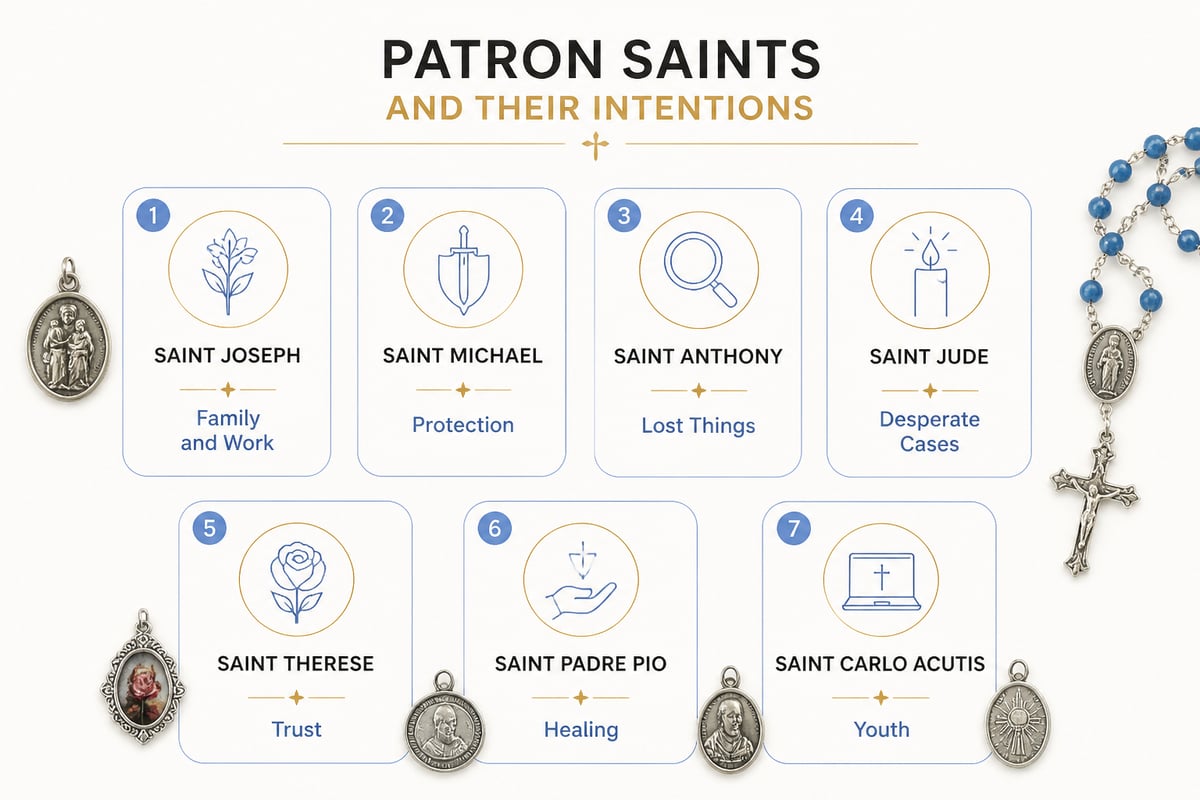
The most requested saints are those with a clear patronage that connects to everyday needs. The table below pairs common patron saints with the intentions Catholics typically bring to them.
| Saint | Common Patronage | Typical Intention |
|---|---|---|
| Saint Joseph | Fathers, workers, the universal Church | Family, employment, a happy death |
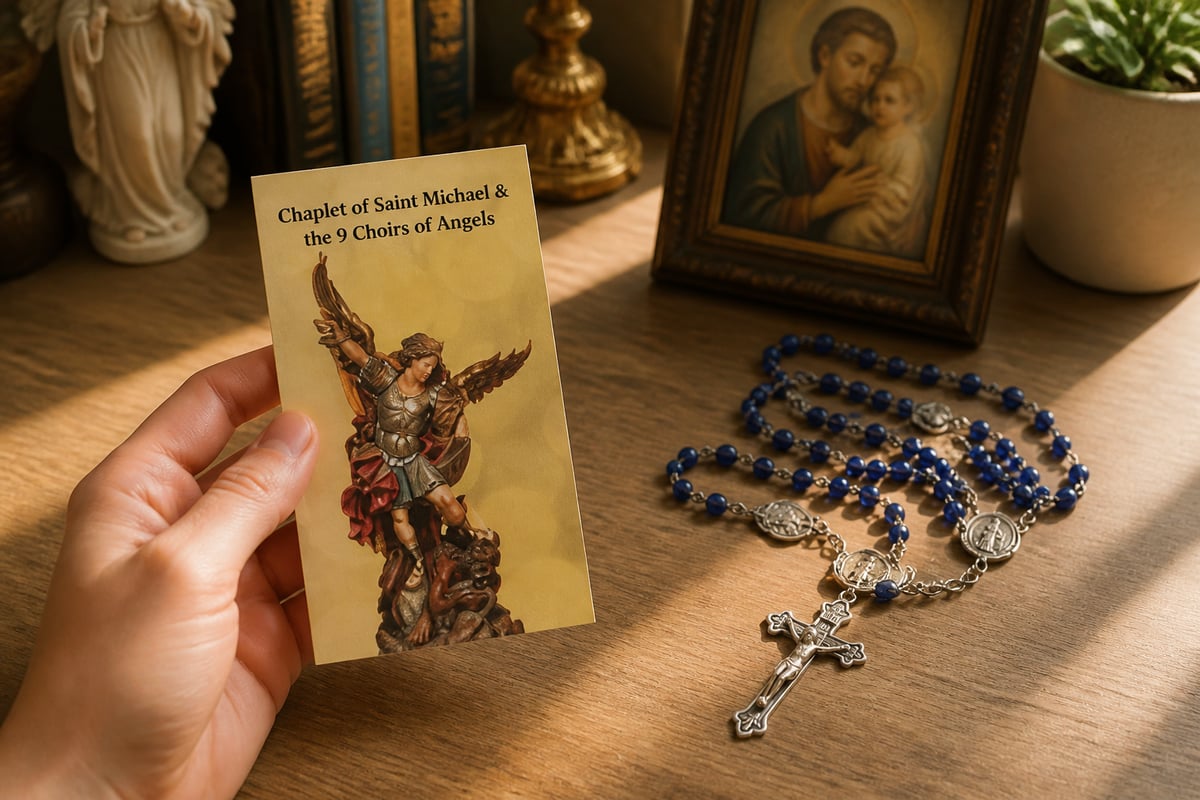
| Saint Michael the Archangel | Protection, soldiers, police | Spiritual warfare, safety |
| Saint Anthony of Padua | Lost things | Finding objects, recovering what is lost |
| Saint Jude | Desperate and hopeless cases | Severe trials, last-resort petitions |
| Saint Therese of Lisieux | Missions, the "Little Way" | Trust, small daily sacrifices |
| Saint Padre Pio | Healing, spiritual fathers | Illness, confession, perseverance |
| Saint Carlo Acutis | Young people, the internet | Youth, devotion to the Eucharist |
Newer figures are appearing alongside the classics. The Vatican scheduled the proclamation of Saint John Henry Newman as a Doctor of the Church for All Saints' Day, November 1, 2025, according to the Vatican Calendar of Celebrations. Cards honoring recently honored saints are a good way to introduce a family to figures who feel close to our own time.
Brought to you by Journeys of Faith, founded by Bob and Penny Lord, a Catholic media company dedicated to evangelization through media.
How Are Catholic Saint Cards Used in Prayer?
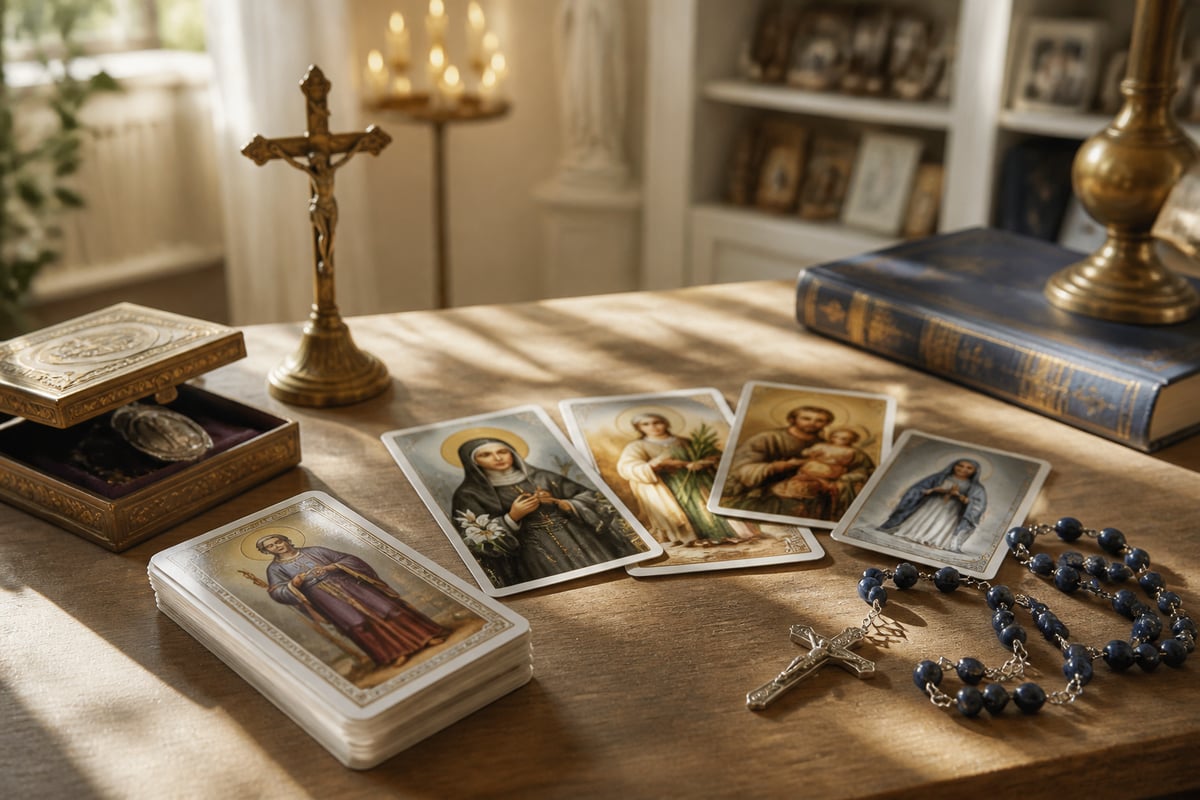
Saint cards are used as a focus for prayer, a reminder of a saint's example, and a physical anchor for novenas and daily devotions. They are not objects of worship. The saint is asked to pray alongside the one holding the card, just as you would ask a friend or relative to pray for you.
Common ways to use them include:
- Daily devotion. Place a card where you will see it each morning, and say the prayer on the back before leaving the house.
- Novenas. Use one card for nine consecutive days of prayer, tracking each day as you go. Journeys of Faith offers a complete guide to novena cards for those new to the practice.
- Rosary and Mass. Keep a card in your rosary pouch or missal as a bookmark that prompts a short prayer to the saint of the day.
- Bedside and family prayer. A card on a nightstand or the family table gives children something to hold during evening prayers.
- Remembrance. Funeral and memorial cards keep the names of the departed before you so you can pray for their souls.
For readers wanting doctrinal context on why Catholics invoke the saints, this Catechism excerpt on the intercession of saints offers helpful background.
How Do Saint Cards Differ From Novena and Prayer Cards?
The terms overlap, but each serves a slightly different purpose. A saint card centers on one saint with a short prayer. A novena card lays out a nine-day structure with a daily prayer. A general prayer card may feature the Sacred Heart, the Eucharist, or Our Lady rather than a specific saint.
For Catholics who pray the rosary and novenas regularly, a small set of each type is practical. Keep a few saint cards for personal patrons, a handful of novena cards for seasonal needs, and a Marian card for each rosary you pray. Journeys of Faith's guide to Catholic holy cards explains the meaning of the symbols that appear on many of them, such as the lily for purity or the keys for Saint Peter.
The Prayer Cards and Novenas collection at Journeys of Faith brings together Jesus, Mother Mary, Saint Joseph, Saint Michael, and many other saints' cards along with novenas, so a reader can find a card for a specific intention in one place.
What Should You Know Before Buying Catholic Saint Cards as a Gift?
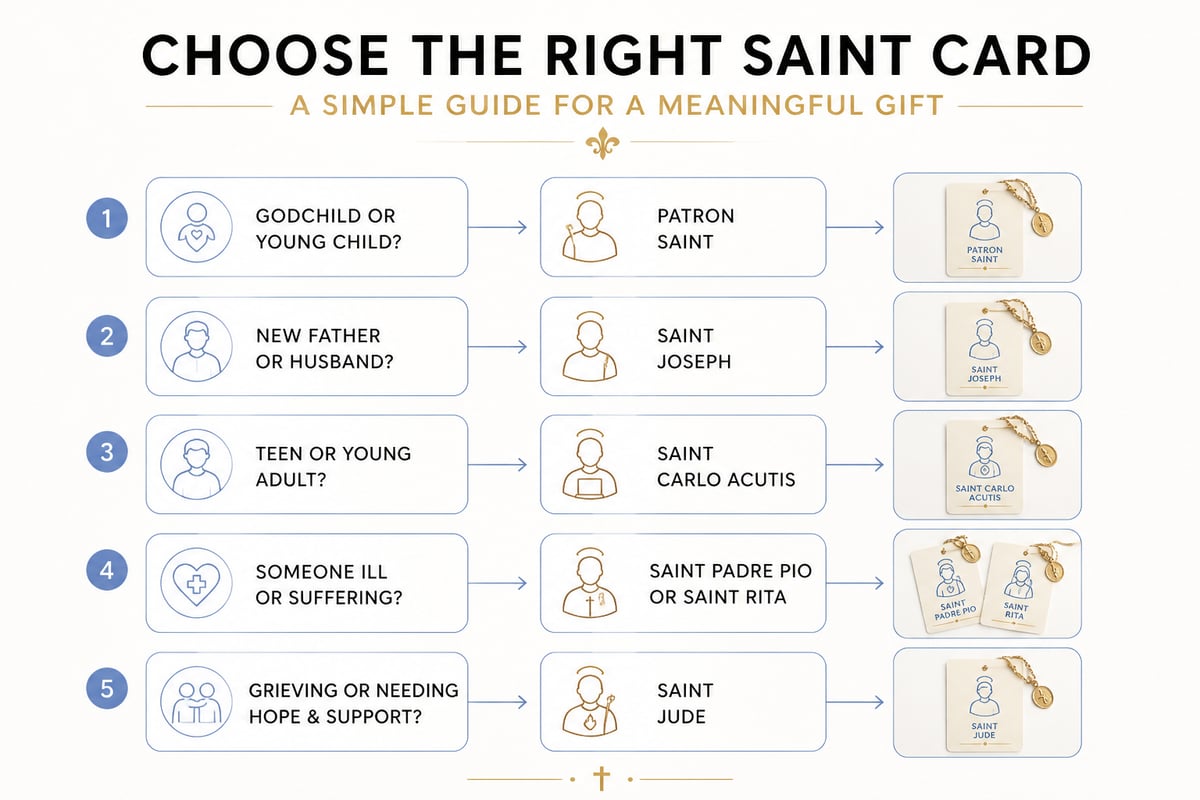
A saint card makes a meaningful gift when it fits the recipient's name, vocation, or season of life. Matching the saint to the person turns a small card into a personal gesture rather than a generic item.
Practical gift ideas include:
- Godchildren. A card of the child's patron saint, tucked into a baptism, First Communion, or Confirmation gift.
- New parents or fathers. A Saint Joseph lace paper prayer card on cardstock is a fitting keepsake.
- Young children. Cards paired with a short story about the saint, or a saint-themed item like a bingo game set with mini saints, help them learn the saints' names and stories.
- Teens and young adults. A card of Saint Carlo Acutis, the patron of the internet, speaks to a generation that lives online.
- Those who are ill or grieving. A card of Saint Padre Pio, Saint Rita, or Saint Jude, with a prayer for hope, offers quiet encouragement.
Check that the card's prayer matches the occasion, and consider writing a short personal note on the back. A handwritten line about why you chose that saint gives the card a lasting place in someone's prayer life.
How Should You Care for and Display Saint Cards?
Treat saint cards with the care you would give any sacred image, because they carry a prayer and often a memory. Keep them in a missal, a small cardholder, or a wallet sleeve to prevent bending and fading.
When a card becomes too worn to use, the traditional practice is to dispose of blessed or sacred items respectfully rather than throwing them away. Many Catholics bury them, burn them, or return them to a parish that accepts old sacramentals. Display options include:
- A small frame on a dresser or desk.
- A corner of the family prayer space beside a crucifix or statue.
- A clip on a visor for a card of Saint Christopher, patron of travelers.
- A magnet on the refrigerator, such as the Saint Anthony magnet for lost things or the Saint Michael Archangel magnet, so the saint is present in the busiest room of the home.
Rotating cards with the liturgical year is a simple habit that keeps the devotion fresh. Place a Marian card in May and October, a Saint Joseph card in March, and a card for the Holy Souls in November.
How Can You Learn More About the Saints Behind the Cards?
A saint card is a starting point. Reading or watching the story behind the image deepens the devotion and makes the prayer more personal. The image on the front usually carries clues worth following: a lily, a book, a skull, a set of keys, or a particular habit each point to a specific life, and the short biography on the back often names the century, the country, and the work that made that person a patron.
Journeys of Faith, founded by Bob and Penny Lord, offers Catholic books, DVDs, and religious items on the saints, Mother Mary, and the Eucharist. For viewers who want to see the places where the saints lived and prayed, the Catholic Rome Saints video download and the 12 Catholic Saints video bundle bring their lives to the screen. Journeys of Faith's Catholic media is available free of charge across multiple platforms.
A good habit is to read one short saint biography each month, keeping the matching card nearby. Read it on or near the saint's feast day when you can, since the Church's calendar gives each name a natural moment for attention. Then return to the prayer on the back of the card with what you have learned, and notice how differently the words land once you know what the saint endured. Over a year, you will have gotten to know twelve saints rather than simply owning twelve cards.
Choose one saint whose story speaks to a need in your life right now, and keep that card where you will see it every day this week. Journeys of Faith offers many options in its Prayer Cards and Novenas collection, along with books, DVDs, and rosaries to deepen your devotion, so you can shop now for the cards and resources that fit your prayer life.
- Explore the Journeys of Faith online store, with thousands of Catholic items, at journeysoffaith.com/collections.
- Journeys of Faith is blessed to provide Catholic media, including podcasts and inspirational content, free of charge across multiple media platforms for viewers and listeners around the world. While access to this content remains free, there are significant and continually increasing costs associated with producing, hosting, and distributing these programs. Your support helps us continue sharing the beauty of the Catholic faith with souls. Please make a donation.
