

Francis of Assisi (c. 1181 to 1226) was an Italian friar who gave up a wealthy merchant's life to follow Christ in radical poverty, founded the Franciscan Order, and became one of the most beloved saints in the Church. For anyone searching for francis assisi, the short answer is this: he is the saint of simplicity, peace, creation and the Cross, and in 2026 the Church marks the 800th anniversary of his death with a special jubilee year.
His story still draws Catholics because it is so concrete. A young man hears Christ speak from a crucifix, strips off his fine clothes, rebuilds a ruined chapel with his own hands, and ends his life bearing the wounds of the Lord. This guide walks through his life step by step, from his birth in Assisi to the devotions that keep his memory alive in Catholic homes today.
Brought to you by Journeys of Faith, founded by Bob and Penny Lord. We are an Augustinian Secular Institute, Cyber Apostles, and our mission is evangelization through media.
Who Was Saint Francis of Assisi and Why Does He Matter?
Saint Francis of Assisi was the founder of the Franciscan Order, a reformer who called the Church back to the Gospel through poverty, humility and joy. He matters because his way of life showed that the words of Christ could be lived literally, and because his example renewed Christian life across Europe in the thirteenth century and continues to do so.
His significance reaches well beyond his own order. He is a patron of Italy and, by tradition, of animals and the natural environment. His Canticle of the Creatures is among the earliest great poems in the Italian language. Popes, artists and ordinary families have looked to him for eight centuries as a model of conversion.
The Church celebrates his feast day on 4 October, according to Vatican News.
Was Francis of Assisi Born Rich?
Yes. Francis was born around 1181 or 1182 in Assisi, the son of Pietro di Bernardone, a prosperous cloth merchant, and his wife Pica. He grew up with money, fine clothes and a lively circle of friends, and he dreamed of knightly glory.
His baptismal name was Giovanni. His father reportedly began calling him Francesco, "the Frenchman," perhaps in honor of his business ties to France. The name stuck.
As a young man Francis was known for generosity, wit and love of festivity. He joined a military campaign against the neighboring city of Perugia, was captured, and spent about a year as a prisoner. A serious illness followed. These experiences loosened his hold on worldly ambition and prepared him for what came next. For a fuller account of this period, the Journeys of Faith article on the life of Saint Francis of Assisi is a helpful companion.
How Did Francis Convert?
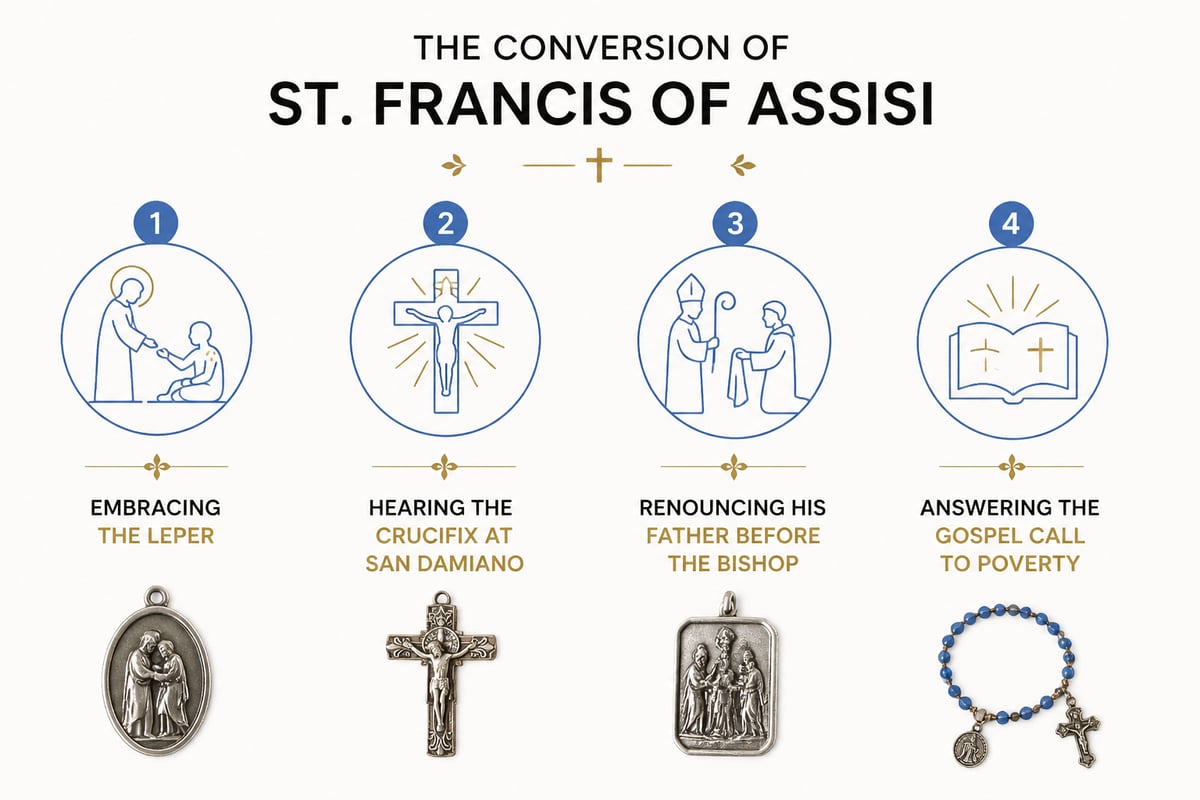
Francis converted through a series of encounters that moved him from self-regard to service of Christ and the poor. No single moment explains it, but four events stand out:
- The leper. Riding near Assisi, Francis met a man with leprosy, a sight he had always dreaded. He dismounted, embraced the man and kissed his hand. He later described this as the turning point when what was bitter became sweetness of soul.
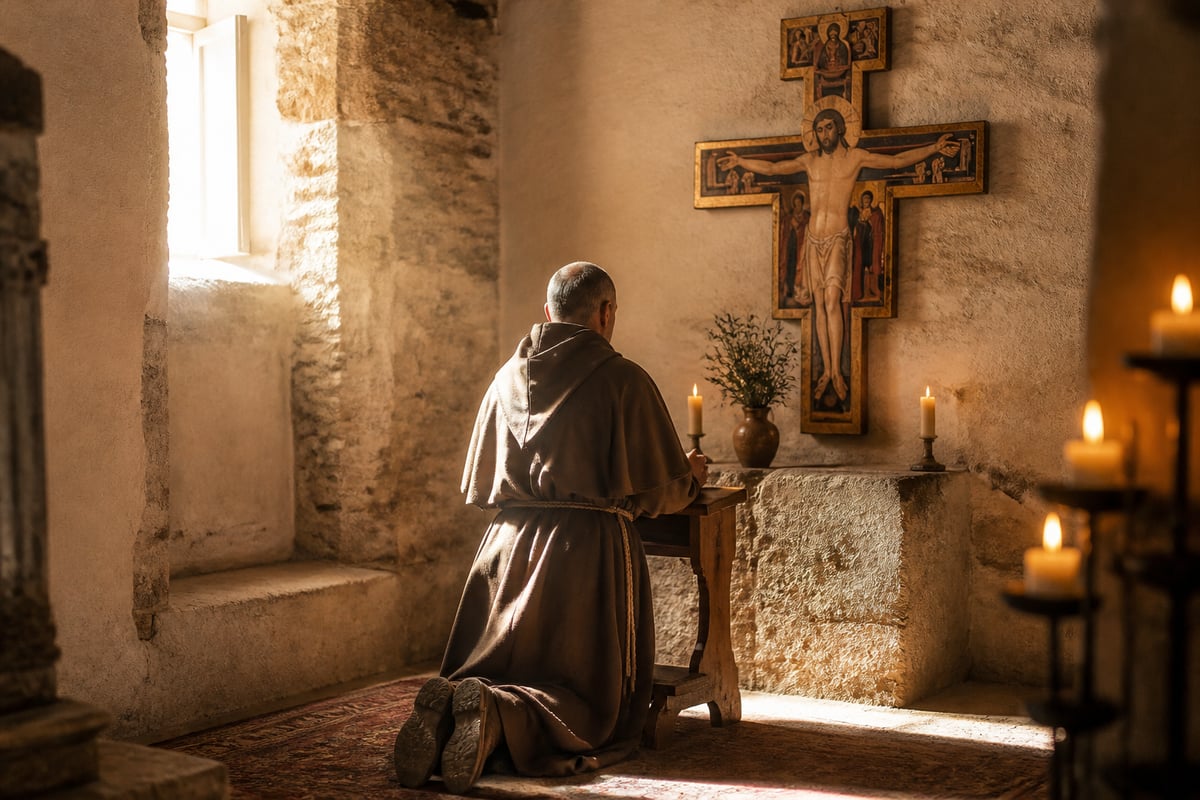
- The crucifix at San Damiano. Praying before an old Byzantine-style cross in a crumbling chapel, he heard the words, "Francis, go and repair my house, which, as you see, is falling into ruin." He first took this literally and began rebuilding the chapel stone by stone.
- The break with his father. After Francis sold some of his father's cloth to fund the repairs, Pietro hauled him before the bishop. Francis returned his clothes and said that from then on he would call only God his Father.
- The Gospel call. Hearing the Gospel read at Mass about the apostles being sent out without purse or staff, he understood his vocation to live in evangelical poverty and to preach repentance.
Pope Benedict XVI discussed the early development of Francis's call and his community in a general audience on Saint Francis. For a devotional treatment, see the radical conversion of Francis of Assisi from Journeys of Faith.
Did Francis of Assisi Have a Wife?
No. Francis never married and had no wife or children. After his conversion he embraced consecrated poverty, chastity and obedience, and he asked the same of the friars who joined him.
The saint most often connected with him in this way is Clare of Assisi, but their bond was spiritual, not marital. Clare, from a noble Assisi family, heard Francis preach and left her home in 1212 to follow the same Gospel poverty. She founded the Order of Poor Ladies, later known as the Poor Clares, and the two remained lifelong friends in Christ. Journeys of Faith tells her story in Saint Clare of Assisi, Sister Moon to Francis, Brother Sun.
How Did the Franciscan Order Begin?
The Franciscan Order began when a handful of men joined Francis in living the Gospel in poverty, preaching repentance and serving the poor. By around 1209 he had written a simple rule and traveled to Rome, where Pope Innocent III gave verbal approval to the new fraternity.
The brothers owned nothing, begged for their daily bread, worked with their hands, and went out two by two to preach in towns and villages. They lived near the little chapel of the Portiuncula outside Assisi, which remained the heart of the movement.
As the community grew, a more formal rule became necessary. The Franciscan Rule received its definitive confirmation from Pope Honorius III in 1223, as Vatican News records. That rule is still the foundation of Franciscan life today.
Francis also stayed firmly within the Church. He honored priests, revered the Eucharist, and sought the approval of the Pope at every stage. His reform was never a rebellion. It was an act of obedience that renewed the Church from within.
What Is the Story Behind the Christmas Nativity Scene?
Francis is traditionally associated with the first live Christmas nativity scene, staged at Greccio in 1223. He wanted the faithful to see with their own eyes the humility of Christ born in a stable, with an ox and a donkey beside the manger.
Vatican News notes this tradition among the best-known episodes of his life. The custom spread across Italy and then the whole Christian world, and the crib in Catholic homes today descends from that night. The scene reflects something central to Francis: devotion to the Incarnation and to the Eucharist, the same Lord who humbled himself in Bethlehem and humbles himself on the altar.
What Are the Stigmata of Saint Francis?
The stigmata are the wounds of Christ's Passion that Francis is said to have received in his own body, making him the first widely recorded stigmatist in Church history. According to the Vatican State account, he received them at La Verna on 17 September 1224, while in prayer and fasting on the mountain.
The accounts describe a vision of a seraph, a winged figure bearing the likeness of the crucified Christ. When the vision faded, Francis bore marks in his hands, feet and side. He hid them as best he could and kept silent about them for the remainder of his life, which was marked by suffering and failing eyesight.
For Catholics who pray before the crucifix, this event is the center of Franciscan spirituality: Francis began his conversion before a cross at San Damiano and ended his life conformed to the Crucified. Journeys of Faith explores this theme in the miracles of the cross of Saint Francis of Assisi.
What Is the Canticle of the Creatures?
The Canticle of the Creatures is a hymn of praise in which Francis thanks God for sun, moon, wind, water, fire and earth, calling each one a brother or sister. He composed it in 1225, according to Vatican State, during a painful illness, when he was nearly blind.
The poem is not nature worship. Every creature is praised because it reflects its Creator, and the hymn is addressed to "Most High, all-powerful, good Lord." Francis added verses on forgiveness and on "Sister Death," showing a faith able to welcome even the end of life with trust.
His love for animals belongs to the same vision. The stories of the wolf of Gubbio and of his preaching to the birds are among the most familiar in Catholic tradition, and they explain his role as patron of animals and ecology.
How and When Did Francis Die, and When Was He Canonized?
Francis died on the evening of 3 October 1226 at the Porziuncola in Assisi, as Vatican News records. He died in his mid-forties. At his request he was laid on the bare ground, and the friars sang as he passed from this life.
The Church acted quickly. Pope Gregory IX canonized him on 16 July 1228, less than two years after his death, according to Vatican State. The Basilica of Saint Francis was begun in Assisi soon after, and his tomb there remains a major place of pilgrimage.
What Is the Year of Saint Francis in 2026?
The Year of Saint Francis is a jubilee period marking the 800th anniversary of his death, running from 10 January 2026 through 10 January 2027. The Vatican's Apostolic Penitentiary issued the decree announcing it, which also addresses the granting of indulgences for the occasion.
For Catholics, this is a natural time to deepen a Franciscan devotion. Practical ways to observe the year include:
- Praying the Prayer before the Crucifix that Francis offered at San Damiano
- Reading the Canticle of the Creatures aloud as a family
- Making a pilgrimage, whether to Assisi or to a local Franciscan church
- Observing the feast on 4 October with Mass, a blessing of pets, or a crib in the home
- Reading a good biography slowly over the course of the year
How Can You Grow Closer to Saint Francis Through Prayer and Study?
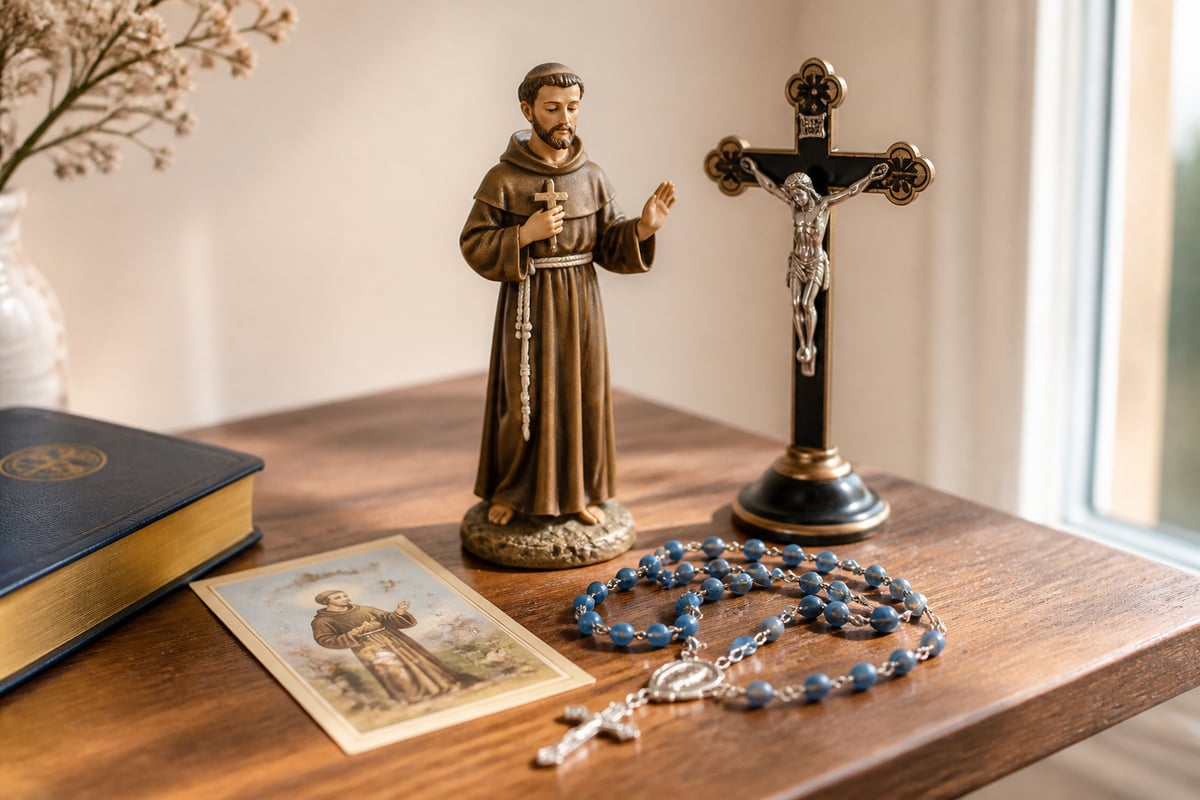
The surest way is to pair daily prayer with steady reading, and to let a few simple devotional objects keep him in view. Many Catholics find that a crucifix, a holy card or a small statue in the prayer corner helps them return to his example each day.
For study, short and accessible works are the best starting point. The Saint Francis of Assisi 48-page minibook from Journeys of Faith gives a clear overview of his life, and the same title is also available as an ebook and an audiobook for those who prefer to listen. Families can also explore the Catholic Saints Minibooks for family prayer time, short printed booklets that fit easily into an evening routine.
For prayer, the Prayer of Saint Francis prayer cards are easy to keep in a missal or give to others. Journeys of Faith also offers resources such as a Saint Francis resin statue with the wolf of Gubbio for those who wish to remember his peace-making in a visible way. Journeys of Faith, founded by Bob and Penny Lord, offers Catholic resources that can help anyone study Francis in a Catholic context.
FAQ
What is the most famous prayer of Saint Francis?
The most widely known is the "Prayer of Saint Francis" beginning "Lord, make me an instrument of your peace." This text is not among the writings Francis is known to have composed, but it expresses his spirit. The prayer he certainly composed is the Prayer before the Crucifix, which he prayed at San Damiano.
Why is Saint Francis the patron of animals and ecology?
Francis saw every creature as a gift from God and a sign of the Creator's goodness, as his Canticle of the Creatures shows. Stories of him preaching to birds and making peace with the wolf of Gubbio shaped the tradition. He is widely regarded as a patron of ecology.
Is Francis of Assisi the same as Pope Francis's namesake?
Yes. Pope Francis chose his papal name in honor of Saint Francis of Assisi, citing his love of the poor and his care for creation.
A good next step is to pick one practice for the Year of Saint Francis, such as praying the Prayer before the Crucifix each morning, and begin this week. Journeys of Faith, founded by Bob and Penny Lord, offers books, DVDs, holy cards, medals and statues to support that devotion, including the Catholic Saints Minibooks and orders over $50 ship free, so you can shop now for what your prayer life needs. Explore the Journeys of Faith online store with thousands of Catholic items. Journeys of Faith is blessed to provide Catholic media, including podcasts and inspirational content, free of charge across multiple media platforms for viewers and listeners around the world. While access remains free, there are significant and continually increasing costs associated with producing, hosting and distributing these programs, and your support helps us keep sharing the beauty of the Catholic faith with souls, so please make a donation if you are able.
