

The story of Our Lady of La Salette remains one of the most compelling and urgently relevant Marian apparitions in Catholic history. On September 19, 1846, in the remote Alpine village of La Salette, France, two shepherd children encountered a weeping woman bathed in light who delivered a message that would resonate through generations. This profound encounter changed not only the lives of Mélanie Calvat and Maximin Giraud but also transformed how Catholics understand Mary's role as mother, intercessor, and messenger of divine warning.
The Historical Context of Our Lady of La Salette
The 1846 apparition occurred during a period of significant spiritual decline in France. Following the French Revolution and subsequent political upheaval, religious practice had diminished considerably throughout rural communities. Many Catholics had abandoned Sunday Mass obligations, routinely profaned the Lord's Day through unnecessary labor, and demonstrated a general apathy toward the sacraments.
La Salette itself was a small mountain village where faith had grown cold among many residents. The agricultural community faced severe crop failures, with potato harvests devastated by blight and wheat yields drastically reduced. These material hardships reflected a deeper spiritual crisis that Our Lady addressed directly in her message.
The Two Shepherd Children
Mélanie Calvat, fourteen years old, and Maximin Giraud, eleven, were simple shepherd children from poor families. Neither had received extensive religious education, and both were known for their straightforward, uncomplicated nature. Their simplicity would later serve as powerful testimony to the authenticity of their experience, as the theological depth and prophetic nature of the message they conveyed far exceeded their natural capacities.
On that September morning, the children were tending their cows on the mountain when they witnessed a brilliant light near a dried-up spring. Within the light sat a woman weeping, her head in her hands. As she stood and approached them, they saw she wore a distinctive costume with a crucifix bearing the instruments of Christ's Passion suspended from a chain around her neck.
The Message of Our Lady of La Salette
The Beautiful Lady, as the children called her, spoke to them in French and in their local dialect. Her message combined maternal tenderness with prophetic urgency, addressing both immediate concerns and broader spiritual realities. The Virgin Mary revealed her profound sorrow over humanity's sinfulness, particularly the violation of Sundays and the profanation of her Son's name through casual blasphemy.
Key elements of the La Salette message included:
- A call to conversion and penance for personal and societal sins
- Warning about divine punishment if humanity refused to repent
- Emphasis on proper Sunday observance and reverence for God's name
- Promise of abundance if people returned to faithful practice
- Prediction of crop failures and famine as consequences of sin
The message addressed practical matters like agricultural failure while simultaneously calling attention to the spiritual causes underlying material suffering. Our Lady of La Salette wept not simply over bread shortages but over souls endangered by sin and indifference.

The Secrets Entrusted to the Children
Beyond the public message, Our Lady of La Salette entrusted each child with a personal secret. These secrets, eventually written down and sent to Pope Pius IX in 1851, contained prophetic elements about the Church's future trials. While the full content remains partially undisclosed, the secrets addressed threats to faith, the rise of false teachings, and challenges facing religious life and the priesthood.
The existence of these secrets, similar to those given at Fatima decades later, underscored the prophetic dimension of the La Salette apparition. The historical significance of Marian apparitions demonstrates how Our Lady communicates urgent divine messages through chosen messengers during critical moments in Church history.
Brought to you by Journeys of Faith Founded by Bob and Penny Lord - We are an Augustinian Secular Institute - Cyber Apostles - Our Mission is Evangelization through Media.
Church Investigation and Approval
The local bishop, Monsignor Philibert de Bruillard of Grenoble, initiated a thorough investigation almost immediately after reports of the apparition spread. The canonical inquiry involved extensive interviews with the children, examination of their character and consistency, consultation with theologians, and investigation of reported miracles attributed to Our Lady of La Salette's intercession.
The investigation proved remarkably rigorous. Skeptics questioned the children separately and repeatedly, searching for inconsistencies in their accounts. Yet Mélanie and Maximin maintained identical descriptions of the event throughout years of interrogation, despite attempts to confuse or discredit them.
| Investigation Phase | Duration | Key Activities |
|---|---|---|
| Initial Inquiry | 1846-1847 | Witness interviews, character assessment |
| Formal Commission | 1847-1851 | Theological review, miracle documentation |
| Final Deliberation | 1851 | Episcopal consultation, doctrinal verification |
| Official Approval | September 19, 1851 | Pastoral letter declaration |
On September 19, 1851, exactly five years after the apparition, Bishop de Bruillard officially declared the apparition of Our Lady of La Salette worthy of belief. This ecclesiastical approval meant Catholics could confidently embrace the message and devotion without fear of deception or error.
Missionary Impact and the La Salette Order
The apparition inspired the founding of the Missionaries of Our Lady of La Salette, a religious congregation dedicated to spreading the reconciliation message. Founded in 1852 by Bishop de Bruillard and two priests who had assisted in the apparition's investigation, the order adopted the distinctive La Salette Crucifix as their symbol.
This crucifix depicts Christ crucified with the instruments of His Passion, hammer and pincers, representing humanity's role in both causing and healing Christ's wounds through sin and conversion. The imagery powerfully communicates Our Lady of La Salette's central message: human choices matter eternally, and conversion remains always possible through God's mercy.
Global Spread of the La Salette Devotion
The Missionaries of La Salette established communities worldwide, building shrines and churches dedicated to Our Lady under this title. Major pilgrimage sites emerged in France at the original apparition location, in Massachusetts at the National Shrine of Our Lady of La Salette, and at numerous other locations globally. These shrines continue drawing pilgrims seeking reconciliation and spiritual renewal.
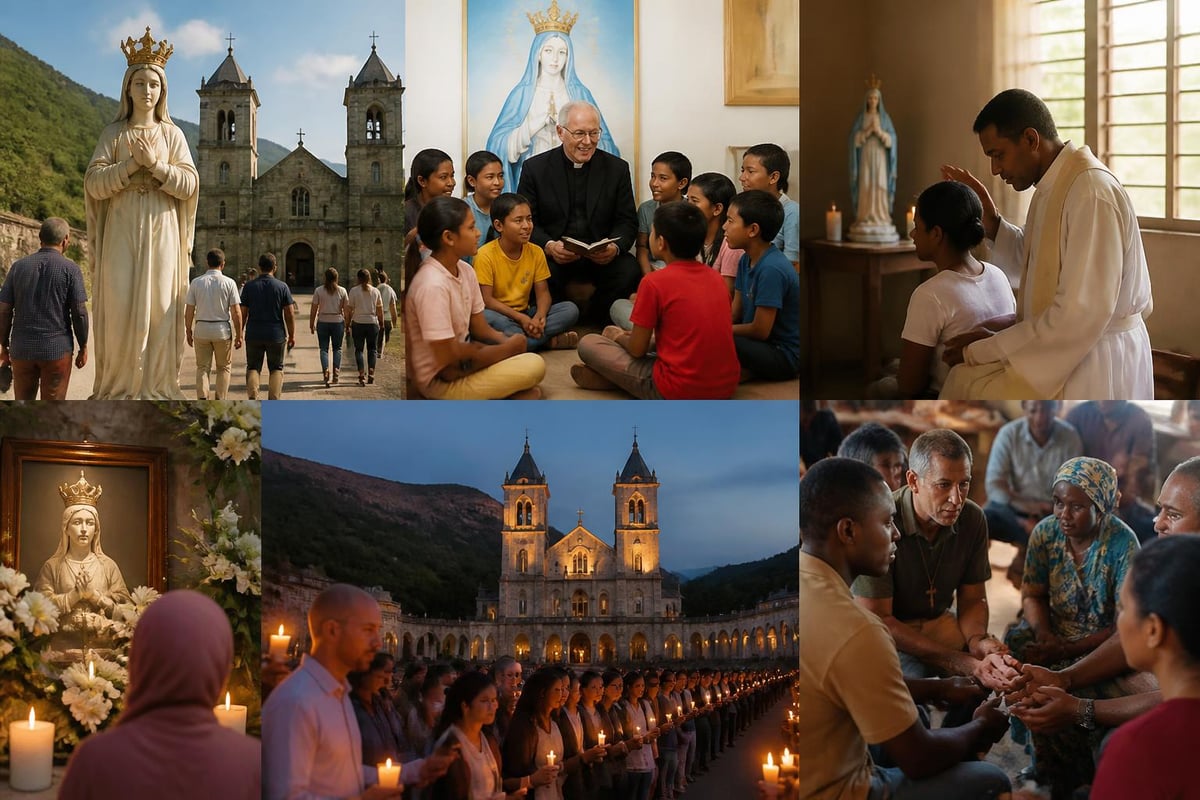
The Wisconsin La Salette Shrine in Twin Lakes emphasizes the message's contemporary relevance, offering programs focused on reconciliation, healing, and returning to sacramental life. Such ministries demonstrate how Our Lady of La Salette's 1846 message addresses timeless spiritual needs.
The La Salette Message for Contemporary Catholics
The urgent call of Our Lady of La Salette resonates powerfully in 2026 as Catholic practice faces similar challenges to those of 1846 France. Declining Mass attendance, casual attitudes toward sacred obligations, and growing indifference to spiritual matters mirror the conditions that prompted Mary's tears on that Alpine mountainside.
Modern applications of the La Salette message include:
- Renewed Sunday observance - Protecting the Lord's Day from secular encroachment
- Reverence in speech - Avoiding casual profanity and blasphemy
- Regular sacramental confession - Embracing reconciliation as ongoing conversion
- Authentic penance - Accepting sacrifice as expression of love and reparation
- Active evangelization - Sharing faith urgently with those drifting from God
The message challenges cultural assumptions that religious practice represents personal preference rather than sacred obligation. Our Lady of La Salette emphasized that humanity's relationship with God carries real consequences, both temporal and eternal.
Weeping for Souls Lost to Indifference
Perhaps the most haunting aspect of the La Salette apparition involves Mary's tears. Unlike joyful appearances at Guadalupe or Lourdes, Our Lady appeared weeping at La Salette, manifesting profound maternal grief over souls endangered by sin. Her tears revealed that heaven itself suffers over human choices toward destruction.
This sorrowful aspect connects Our Lady of La Salette to the prophecy of Simeon, who told Mary that a sword would pierce her heart. At La Salette, that sword pierces anew as she witnesses her children rejecting her Son through negligence, blasphemy, and hardened hearts. Her weeping calls Catholics to recognize sin's gravity and embrace the reconciliation Christ offers.
Theological Significance of the Apparition
Our Lady of La Salette occupies important theological ground within Catholic teaching on Mary's role as mediatrix and co-redemptrix. The apparition demonstrates several key Mariological principles that enrich understanding of Mary's participation in salvation history.
The title "Our Lady of La Salette" emphasizes Mary's maternal concern for all humanity. She appears not to condemn but to warn, not to punish but to call children back to the Father's mercy. This maternal mediation reflects her unique position as both Mother of God and Mother of the Church.
Connection to Other Marian Apparitions
Our Lady of La Salette shares thematic connections with other approved apparitions while maintaining distinctive elements. Like Fatima, La Salette included secrets about future Church trials and emphasized penance. Like Lourdes, which occurred twelve years later, La Salette involved simple children receiving messages beyond their education level and featured miraculous healings at the site.
The progression of 19th and 20th century apparitions reveals a consistent maternal strategy. Mary's various appearances address specific historical circumstances while reinforcing timeless calls to prayer, penance, and conversion. Our Lady of La Salette represents a crucial link in this chain of divine communication.
For those seeking to deepen their understanding of Mary's role throughout salvation history and her continued intercession through apparitions, exploring comprehensive resources about Marian devotion proves invaluable. Catholic Saints Books provide detailed accounts of how the saints studied other holy lives as paths to holiness, including deep devotion to Our Lady under her various titles.


Celebrating the Feast of Our Lady of La Salette
The Catholic Church celebrates the feast of Our Lady of La Salette annually on September 19, commemorating the anniversary of the 1846 apparition. This liturgical recognition affirms the apparition's authentic supernatural character and encourages devotion among the faithful.
Parishes and shrines dedicated to Our Lady of La Salette often hold special celebrations on this feast day, including:
- Solemn Masses emphasizing reconciliation and conversion
- Processions with the La Salette Crucifix
- Opportunities for sacramental confession
- Renewal of baptismal promises
- Prayer services focusing on reparation for sin
These celebrations transform the feast day into a practical application of the La Salette message, providing concrete occasions for the conversion and penance Our Lady requested.
Pilgrimages to La Salette Sites
Visiting La Salette shrines offers pilgrims tangible connection to the apparition's grace and message. The original apparition site in France features the spring that miraculously began flowing again after Our Lady's visit, a basilica consecrated in 1879, and stations depicting the apparition's narrative.
American Catholics frequently visit the National Shrine in Attleboro, Massachusetts, known for its spectacular annual Festival of Lights display drawing hundreds of thousands of visitors. These pilgrimage experiences provide opportunities for spiritual renewal, reconciliation, and recommitment to living the Gospel message that Our Lady of La Salette emphasized.
Living the La Salette Spirituality Daily
Embracing Our Lady of La Salette's message requires more than annual commemoration. The spirituality emerging from this apparition calls for daily conversion expressed through concrete practices that honor God and serve neighbor.
Practical steps for living La Salette spirituality:
- Begin each Sunday with consciousness of sacred obligation and privilege
- Guard speech against casual blasphemy or irreverent language
- Schedule regular confession, treating reconciliation as ongoing journey
- Offer voluntary penances, particularly fasting, for personal conversion and others' salvation
- Study Scripture and Church teaching to combat ignorance that enables sin
- Evangelize through witness and word, sharing faith with those who've drifted
The La Salette message particularly emphasizes parental responsibility for children's faith formation. Our Lady specifically lamented parents who blaspheme and children who work on Sundays without understanding the day's sacred character. This places special obligation on Catholic parents to model reverence and prioritize religious education.
Reconciliation as Central Theme
Among all elements of the La Salette message, reconciliation emerges as the paramount theme. Our Lady appeared as reconciler, calling humanity back to relationship with God through her Son. The Missionaries of La Salette adopted reconciliation as their defining charism, and shrines dedicated to Our Lady of La Salette emphasize this sacramental healing.
This reconciliation operates on multiple levels simultaneously. It addresses individual reconciliation through sacramental confession, communal reconciliation through reformed social practices, and cosmic reconciliation between heaven and earth through humanity's return to right relationship with the Creator.
Modern saints continue demonstrating how living this reconciliation transforms both personal holiness and effective evangelization. Their examples provide contemporary models for embracing the La Salette message with conviction and consistency.
The Prophetic Warning Element
Our Lady of La Salette's message contained unmistakable prophetic warning about consequences of continued impenitence. She predicted specific agricultural failures that indeed occurred, lending credibility to her broader spiritual warnings about souls' eternal destiny and Church trials.
This prophetic dimension places La Salette within the biblical tradition of divine messengers calling people to conversion before judgment. Like the Old Testament prophets who warned Israel of exile unless they returned to covenant faithfulness, Our Lady warned 19th century France and, by extension, all nations of consequences stemming from abandoned faith.
| Prophetic Element | Immediate Fulfillment | Broader Significance |
|---|---|---|
| Crop failures | 1846-1850 agricultural crisis | Material consequences of spiritual negligence |
| Potato blight | Widespread famine | Warning about rejecting divine providence |
| Children's deaths | Infant mortality spike | Eternal consequences of unrepentant sin |
| Future Church trials | Ongoing challenges to faith | Need for vigilance and fidelity |
Modern Catholics sometimes struggle with prophetic messages that include warning or judgment themes. Yet Our Lady of La Salette demonstrates that authentic maternal love includes warning children of genuine dangers. Her tears reveal that warnings emerge from love, not vindictiveness, from desire to save, not condemn.
Miraculous Confirmations and Healings
Like other approved apparition sites, La Salette became associated with numerous miraculous healings and conversions. The spring that had dried up on the mountainside began flowing again immediately after the apparition, and water from this source became connected with physical and spiritual healings.
Documentation exists for hundreds of claimed miracles at La Salette sites, including cures of blindness, paralysis, and terminal illnesses. More significantly, countless spiritual conversions occurred, with hardened sinners returning to sacramental practice after visiting the shrine or learning about the apparition.
These miraculous confirmations served multiple purposes within God's providence. They validated the apparition's supernatural character, demonstrated divine power active in responding to Mary's intercession, and provided tangible hope that conversion and healing remain always possible regardless of past sins' severity.
The Role of Faith in Receiving Grace
Our Lady of La Salette emphasized that receiving grace requires faith and cooperation with divine initiative. Her message called people to active conversion, not passive waiting for automatic salvation. This aligns with consistent Catholic teaching that God's grace requires human response, that divine mercy awaits human acceptance.
Pilgrims visiting La Salette shrines or embracing the message's spirituality discover that miracles often follow genuine conversion rather than preceding it. The apparition challenges magical thinking that seeks supernatural intervention without personal transformation, instead emphasizing that God's greatest miracle involves changing human hearts hardened by sin.
Educational and Formational Resources
Understanding Our Lady of La Salette's message and incorporating its spirituality into daily life benefits from quality educational resources. Comprehensive guides to Catholic saints provide context for how apparitions fit within the broader communion of saints and Church teaching.
Books, minibooks, and multimedia resources exploring Marian apparitions help Catholics develop informed, authentic devotion grounded in Church-approved teaching rather than speculation or sensationalism. These resources distinguish between essential message elements requiring belief and optional devotional practices enriching personal piety.
For families seeking to introduce children to the La Salette story and message, accessible formats presenting the historical narrative alongside theological explanation prove particularly valuable. The example of Mélanie and Maximin resonates with young people, demonstrating that God chooses ordinary children for extraordinary missions.
The message of Our Lady of La Salette continues calling Catholics to conversion, reconciliation, and renewed commitment to living their faith authentically in contemporary culture. Her tears remind us that our choices carry eternal weight and that heaven itself longs for humanity's return to God. Whether you're seeking deeper understanding of Marian apparitions, exploring paths to reconciliation, or desiring resources that strengthen Catholic faith, Journeys of Faith offers extensive materials including books, DVDs, prayer cards, and religious items dedicated to promoting the Eucharist, Mother Mary, and the Saints.
- Explore Journeys of Faith Online store with thousands of Catholic Items at https://journeysoffaith.com/collections
- Our Unique Mega Search Engine https://journeysoffaith.com/search is linked to hundreds of Catholic Shops and Stores
- Get the Journeys of Faith NEW App for IPhone or Android - Search for Journeys of Faith or go to https://journeysoffaith.com/pages/download-our-app
- Chat with us anytime https://chatting.page/mjxs9aerrtgm3lmpndlcepmbyosntrjn
- We need your help to reach more souls - Please Make a Donation https://journeysoffaith.com/pages/donate
