

The Catholic tradition overflows with stories of holy men and women whose compassion extended beyond humanity to embrace all of God's creation. When we speak of a saint of animals, most Catholics immediately think of Saint Francis of Assisi, whose remarkable relationship with birds, wolves, and even fish has inspired believers for eight centuries. Yet Francis stands among a wider company of saints who demonstrated special care for creatures, revealing a profound theological truth: our treatment of animals reflects our understanding of God's creative love and our responsibility as stewards of creation.
Understanding the Role of Animal Patron Saints
The concept of a saint of animals emerges from the Church's recognition that holiness touches every aspect of creation. Throughout hagiographic literature, we find countless examples of saints who displayed extraordinary relationships with the natural world, particularly with animals. These stories serve multiple purposes within the faith tradition.
Theological Foundations of Saints and Animals
Saints who cared for animals demonstrated a recovery of humanity's original relationship with creation before the Fall. According to Scripture, Adam lived in harmony with all creatures in the Garden of Eden, naming them and dwelling peacefully among them. The saint of animals restores this harmony through sanctity, offering a glimpse of paradise regained.
Research from King's College London examining hagiography and animal motifs demonstrates how these narratives functioned within medieval Christian communities. The saints' interactions with animals were not merely charming anecdotes but profound theological statements about:
- The power of holiness to transform relationships between species
- God's care extending to all creatures, not just humanity
- The potential for creation to recognize sanctity
- Humanity's proper role as compassionate stewards
Brought to you by Journeys of Faith. Founded by Bob and Penny Lord, we are an Augustinian Secular Institute and Cyber Apostles. Our Mission is Evangelization through Media.

Historical Development of Animal Patronage
The designation of saints as special protectors of animals developed gradually throughout Church history. Early martyrs and desert fathers often appeared in stories alongside wild beasts who miraculously refused to harm them. These accounts, documented in works like the Routledge volume on companion species in medieval literature, evolved into formal patronages as devotional practices matured.
By the medieval period, specific saints became associated with particular animals or animal-related professions:
| Saint | Animal Association | Feast Day |
|---|---|---|
| Francis of Assisi | All animals, especially birds | October 4 |
| Anthony of Padua | Horses, donkeys, lost animals | June 13 |
| Hubert of Liège | Hunters and hunting dogs | November 3 |
| Blaise | Wild animals, throat ailments in animals | February 3 |
| Martin de Porres | Mice, rats, dogs | November 3 |
Saint Francis of Assisi: The Universal Saint of Animals
No discussion of the saint of animals would be complete without exploring the life and legacy of Saint Francis of Assisi (1181-1226). Born Giovanni di Pietro di Bernardone in the Italian hill town of Assisi, Francis underwent a radical conversion that transformed him from a wealthy merchant's son into the founder of the Franciscan Order and perhaps the most beloved saint in Catholic tradition.
The Sermon to the Birds and Other Animal Miracles
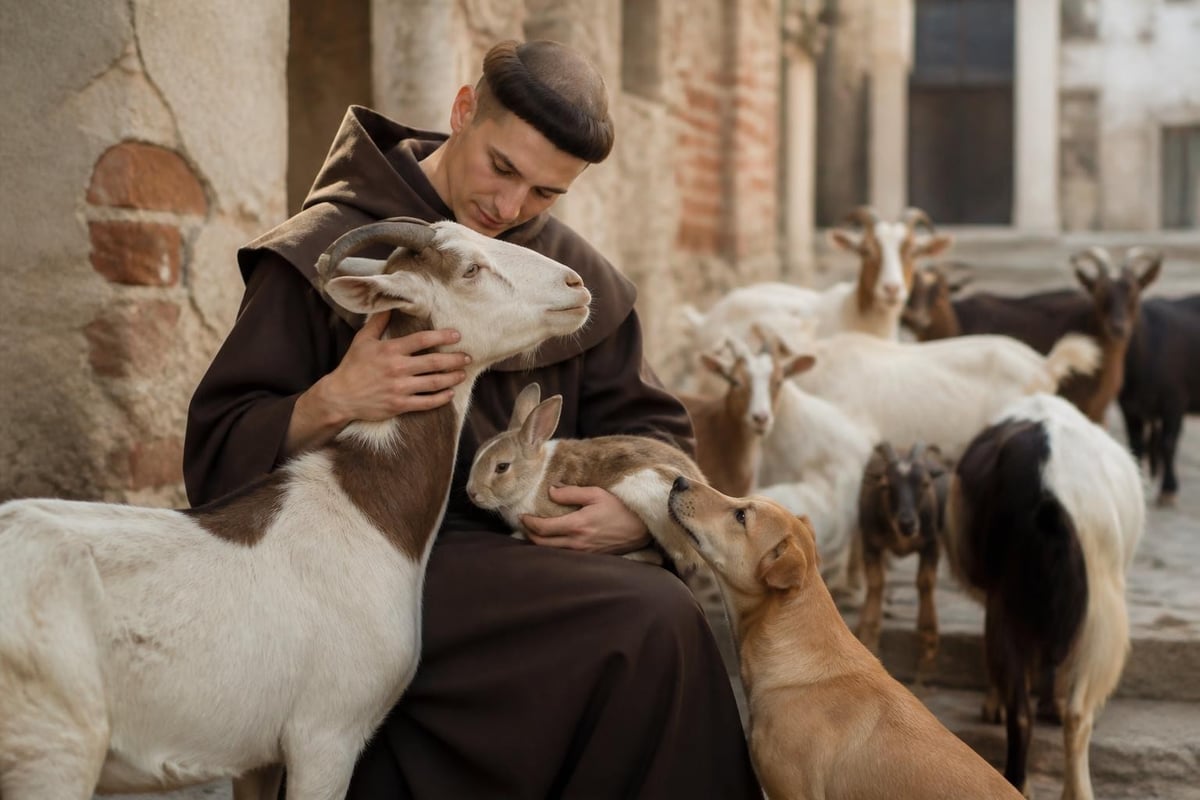
Francis's most famous encounter with animals occurred when he preached to a flock of birds near Bevagna. According to his earliest biographers, Francis addressed the birds as his sisters, praising God for clothing them in feathers and giving them freedom to fly. The birds reportedly listened attentively, extending their necks and spreading their wings in response to his blessing.
This event was not isolated. Francis's life overflowed with animal encounters that demonstrated his unique charism:
- The Wolf of Gubbio: Francis tamed a fierce wolf terrorizing the town of Gubbio, brokering peace between the creature and the townspeople
- The Cicadas: Francis asked cicadas to praise God, and they sang on command
- The Rabbits: Wild rabbits sought Francis's company and refused to leave his side
- The Fish: Even fish listened when Francis preached, reportedly leaping from the water
The St Andrews Encyclopaedia of Theology's discussion of nonhuman animals in Christian thought places Francis's approach within the broader theological framework of creation care. Francis saw animals not merely as resources but as fellow creatures worthy of respect and capable of praising God in their own way.
Franciscan Spirituality and Creation Care
Francis's relationship with animals flowed from his comprehensive theology of creation. He composed the "Canticle of the Creatures," one of the first great poems in Italian literature, which praises God through Brother Sun, Sister Moon, Brother Fire, and Sister Water. Animals occupied a central place in this vision of universal kinship under God.
For Francis, every creature possessed inherent dignity as God's handiwork. This perspective challenged medieval attitudes that viewed animals merely as property or resources. His approach anticipated modern Catholic social teaching on environmental stewardship by eight centuries. Those seeking to deepen their understanding of Franciscan spirituality can explore resources on Catholic saints and their teachings.
Other Notable Patron Saints of Animals
While Francis holds preeminence as the universal saint of animals, numerous other holy men and women have been invoked for the protection and care of creatures. Each brings unique charisms and areas of patronage.
Saint Anthony of Padua (1195-1231)
A contemporary and fellow Franciscan of Saint Francis, Anthony of Padua became known for his preaching and miraculous interventions. His connection with animals stems from several legendary accounts, including one where his mule knelt before the Blessed Sacrament. Anthony is particularly invoked for:
- Finding lost animals and pets
- Protecting horses and donkeys
- Healing sick livestock
- Safeguarding animals during travel
Saint Blaise of Sebastea (d. 316)
Bishop and martyr Blaise lived as a hermit in a cave, where wild animals sought his blessing and healing. According to tradition, hunters discovered him surrounded by sick and injured animals he had healed through prayer. When imprisoned for his faith, Blaise miraculously cured a child choking on a fishbone, leading to his patronage of throat ailments in both humans and animals.
Saint Martin de Porres (1579-1639)
This Dominican lay brother from Peru demonstrated extraordinary charity that extended to the humblest creatures. Martin established an animal hospital at his monastery and cared for mice, rats, and stray dogs that others considered vermin. His holiness was such that natural enemies-cats, dogs, and mice-reportedly ate peacefully together in his presence.
Animal Blessing Ceremonies and Devotional Practices
The feast day of Saint Francis of Assisi, October 4, has become the traditional date for blessing animals in Catholic parishes worldwide. These ceremonies reflect the Church's acknowledgment that God's providence extends to all creatures and that animals enrich human life spiritually, emotionally, and practically.
The Blessing of Animals on Saint Francis's Feast Day
Parish celebrations on October 4 typically include:
- Gathering of pets and their owners in church courtyards or outdoor spaces
- Opening prayers acknowledging God as Creator of all life
- Scripture readings emphasizing creation care (Genesis 1-2, Psalm 148, Romans 8)
- Individual blessings with holy water for each animal present
- Closing prayer of thanksgiving for the gift of animals
These blessings are not sacraments but sacramentals-sacred signs that prepare hearts to receive grace and express the Church's care for all creation. Many parishes welcome not only traditional pets but also service animals, farm animals, and even photographs of deceased or distant animal companions.
Prayer Resources and Novenas
Catholics seeking the intercession of the saint of animals can draw upon rich devotional traditions. For those who appreciate traditional devotional aids, the Catholic Saints minibooks offer accessible resources for deepening one's knowledge of Francis and other animal-loving saints, making them excellent companions for family prayer time focused on creation care and the protection of animals.

Traditional prayers to Saint Francis for animals include:
Prayer for Pet Protection:
"Saint Francis, beloved servant of Jesus Christ, you loved all of God's creatures. To you they were your brothers and sisters. Help us to follow your example of treating every living thing with kindness. Saint Francis, patron saint of animals, watch over my pet and keep my companion safe and healthy. Amen."
Prayer for a Sick Animal:
"Heavenly Father, Creator of all, you gave us stewardship over the animals. I ask you to heal this creature who is suffering. Through the intercession of Saint Francis, restore health and wholeness. Grant me the wisdom to provide proper care and the compassion to ease this animal's distress. Amen."
Theological Insights on Saints and the Natural World
The phenomenon of saints who displayed special rapport with animals invites deeper theological reflection. These relationships were not merely personality quirks but manifestations of profound spiritual truths.
Animals in Hagiographic Literature
Medieval saints' lives consistently feature animals in symbolic and didactic roles. Research from the University of Edinburgh on holy and noble beasts reveals patterns in how hagiographers employed animal episodes. These narratives served to:
- Demonstrate the saint's holiness through creatures' recognition of sanctity
- Illustrate moral lessons about humility, trust, and divine providence
- Connect the saint to biblical precedents like Daniel in the lions' den
- Prefigure eschatological peace when the wolf dwells with the lamb
Analysis from Cambridge studies on early Anglo-Saxon saints' lives identifies obedience as a central motif. Wild animals obeying saints reversed the disorder introduced by sin, offering glimpses of renewed harmony.
Modern Applications of Creation Care
Contemporary Catholic teaching on environmental stewardship draws heavily on the witness of the saint of animals. Pope Francis, who took his papal name from the saint of Assisi, issued the encyclical Laudato Si' in 2015, calling Catholics to integral ecology that honors all creation.
This teaching builds on earlier papal statements:
| Document | Pope | Year | Key Teaching on Animals |
|---|---|---|---|
| Caritas in Veritate | Benedict XVI | 2009 | Humans must respect the created order |
| Centesimus Annus | John Paul II | 1991 | Limits to human dominion over nature |
| Evangelii Gaudium | Francis | 2013 | Creation reflects God's beauty |
| Laudato Si' | Francis | 2015 | Every creature has intrinsic value |
The example of Francis and other saints who loved animals provides concrete models for implementing these principles. When we treat animals with compassion and respect, we acknowledge their Creator and fulfill our vocation as stewards rather than exploiters.
Iconography and Artistic Representations
Artistic depictions of the saint of animals have shaped Catholic visual culture for centuries. Saint Francis appears in countless paintings, sculptures, and stained glass windows, almost always accompanied by birds, wolves, or other creatures.
Traditional Symbols and Attributes
Artists developed consistent iconographic elements to identify Francis and other animal-loving saints:
- Francis of Assisi: Brown Franciscan habit, stigmata, birds perched on hands or shoulders, wolf at feet
- Anthony of Padua: Infant Jesus in arms, lily, sometimes with a donkey
- Hubert of Liège: Hunter's attire, stag with crucifix between antlers
- Martin de Porres: Dominican habit, broom, dog and cat together, mice
The National Gallery's entry on Saint Hubert provides authoritative context for understanding how European artists represented this hunter-turned-saint and his miraculous encounter with a stag bearing a crucifix.
Evolution Across Artistic Periods
Representations of the saint of animals evolved across artistic movements:
Medieval Period: Emphasized hierarchical order with saints commanding obedience from animals, reflecting feudal worldviews.
Renaissance: Introduced naturalistic detail and emotional connection between saint and creature, humanizing both.
Baroque: Dramatic compositions showing miraculous moments-Francis preaching, wolves tamed, birds in flight-with theatrical lighting.
Modern: Simplified, accessible images for devotional cards, books, and digital media, often emphasizing gentleness and environmental themes.
Devotional materials like prayer cards featuring saints continue this tradition, making the witness of animal-loving saints accessible for personal meditation and parish use.
Prayers and Novenas for Animal Concerns
Catholic tradition offers numerous prayers invoking the intercession of the saint of animals for various needs related to creatures. These range from ancient liturgical blessings to contemporary compositions.
Prayers for Different Situations
For a Lost Pet:
"Saint Anthony, patron of lost things and animals in distress, I turn to you in my anxiety. My beloved companion is missing, and I fear for its safety. Guide those searching to find this creature. Bring my pet home safely or grant me peace to accept God's will. Amen."
Before Veterinary Treatment:
"Lord Jesus Christ, you created all living beings and care for even the sparrows. Bless this animal now facing medical treatment. Guide the veterinarian's hands and mind. Through Saint Francis's intercession, restore health if it be your will, or grant peaceful passage if this creature's time has come. Amen."
For Working Animals:
"Blessed Saint Hubert, protector of those who work with animals, watch over the horses, dogs, and other creatures who labor alongside humans. Keep them from harm, ensure their humane treatment, and remind their caretakers that these animals are gifts from God deserving of respect and care. Amen."
Structuring a Novena to the Saint of Animals
A nine-day novena to Saint Francis for animal-related intentions follows traditional Catholic devotional patterns:
- Begin with the Sign of the Cross and an Act of Contrition
- Recite the opening prayer acknowledging Francis's special charism with creatures
- Meditate on a different animal encounter from Francis's life each day
- State your specific intention for an animal's welfare
- Pray one Our Father, Hail Mary, and Glory Be
- Close with the Prayer to Saint Francis for animal protection
- Conclude with the Sign of the Cross
Many Catholics have found that maintaining this practice deepens their appreciation for animals as fellow creatures and increases their sensitivity to creation care. Those exploring the broader legacy of Catholic evangelization through various media will discover how devotion to saints like Francis connects to contemporary environmental concerns.
Contemporary Relevance and Animal Welfare
The witness of the saint of animals speaks powerfully to contemporary challenges in animal welfare, environmental protection, and ethical treatment of creatures. As factory farming, habitat destruction, and species extinction accelerate, the example of Francis and his spiritual companions offers both critique and hope.
Catholic Teaching on Animal Rights and Welfare
The Catechism of the Catholic Church (paragraphs 2416-2418) addresses the moral status of animals, teaching that:
- Animals are God's creatures deserving respect as part of creation
- Humans may use animals for food, clothing, work, and medical research
- However, it is contrary to human dignity to cause animals needless suffering
- Excessive spending on animals while neglecting human needs is morally problematic
- The love shown by saints toward animals reflects proper care without disordered attachment
This balanced approach, modeled by the saint of animals, avoids both exploitation and sentimentalization. Francis loved animals profoundly but never placed them above human welfare or confused affection with worship.
Modern Saints Continuing the Tradition
The tradition of saints who care especially for animals continues in modern witnesses:
Blessed Solanus Casey (1870-1957): This Capuchin friar maintained an animal hospital at his Detroit monastery, personally caring for injured strays and teaching that kindness to animals reflects Christ's compassion.
Saint Kateri Tekakwitha (1656-1680): The first Native American saint demonstrated reverence for creation consistent with indigenous spirituality and Catholic faith, treating animals as relations within God's family.
Blessed Carlo Acutis (1991-2006): This young computer programmer loved animals and insisted his family rescue strays, integrating traditional Franciscan spirituality with contemporary youth culture.
These modern examples demonstrate that the charism of the saint of animals remains vital and relevant across cultures and centuries. The pattern established by Francis continues to inspire Catholics to see Christ in all creation.
The tradition of the saint of animals, exemplified by Francis of Assisi and countless other holy men and women, reveals the breadth of God's love extending to every creature. Their witness challenges us to examine our treatment of animals and our role as stewards of creation. Whether you're seeking prayers for a beloved pet, exploring Catholic teaching on environmental responsibility, or simply deepening your spiritual life, Journeys of Faith offers extensive resources on the saints, including books, prayer cards, and media that bring these holy witnesses to life.
Resources:
- Explore Journeys of Faith Online store with thousands of Catholic items at https://journeysoffaith.com/collections
- Journeys of Faith is blessed to provide Catholic media, including podcasts and inspirational content, free of charge across multiple media platforms for viewers and listeners around the world. While access to this content remains free, there are significant and continually increasing costs associated with producing, hosting, and distributing these programs. Your support helps us continue sharing the beauty of the Catholic faith with souls. Please make a donation at https://journeysoffaith.com/pages/donate
