

Saint Therese of Lisieux was a French Carmelite nun who died at 24 in 1897 and became one of the most beloved saints of the Church through her "Little Way," a path of holiness built on trust in God and small acts done with great love. Known as the Little Flower, she was canonized in 1925 and later named a Doctor of the Church. For Catholics who pray novenas and seek a simple, practical spirituality, her life offers a clear and accessible model.
Her story is quiet on the surface. She never preached to crowds, founded an order or performed public works. Yet her autobiography, Story of a Soul, has reached readers around the world, and her teaching continues to shape how Catholics understand ordinary life as a road to sainthood.
Brought to you by Journeys of Faith, founded by Bob and Penny Lord. We are an Augustinian Secular Institute and Cyber Apostles. Our mission is evangelization through media.
Who Was Saint Therese of Lisieux?
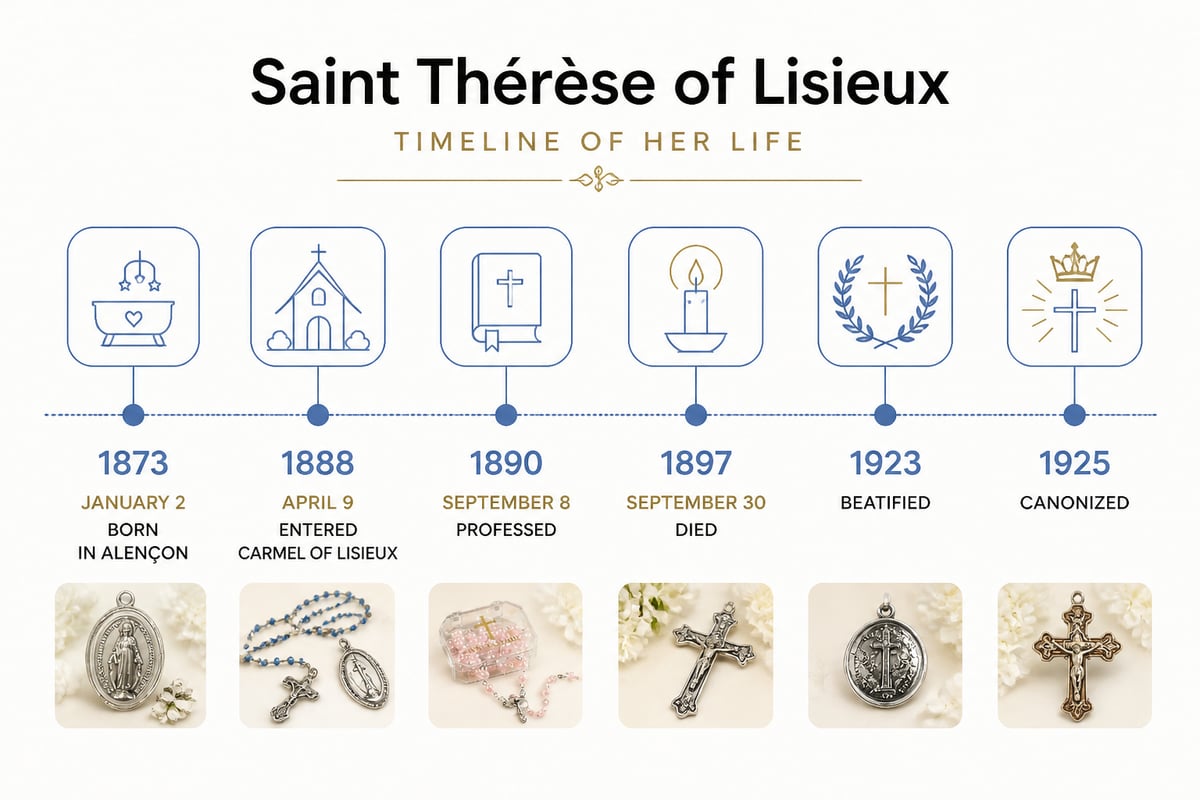
Thérèse Martin was born in Alençon, France, on January 2, 1873, and grew up in a devout family that placed prayer at the center of home life. According to the Vatican's liturgical profile, she entered the Carmel of Lisieux on April 9, 1888, and made her religious profession on September 8, 1890.
She lived in the cloister for just over nine years. During that time she served in humble roles, including assisting with the novices, and she wrote the pages that would become her autobiography at the request of her superiors. Tuberculosis claimed her life on September 30, 1897, at age 24, as noted by Vatican News.
Her name in religion was Thérèse of the Child Jesus and the Holy Face. The first part reflects her love of Christ's childhood and spiritual littleness. The second reflects her devotion to the suffering face of Christ.
What Is the Story of Saint Therese of Lisieux?
The story of Saint Therese of Lisieux moves from a tender childhood marked by loss, through a determined desire to enter Carmel young, to a short religious life of hidden faithfulness and a long illness borne in trust.
Key moments include:
- Childhood loss. Her mother, Zélie Martin, died when Thérèse was a young child, and the family moved to Lisieux, where her father, Louis Martin, raised his daughters.
- The Christmas grace. At 13, she described a sudden spiritual conversion on Christmas night 1886 that freed her from oversensitivity and deepened her desire to love and save souls.
- The pilgrimage to Rome. In 1887 she knelt before Pope Leo XIII and asked permission to enter Carmel at 15, which showed both her boldness and her confidence in God.
- Entrance into Carmel. She joined her sisters in the cloister and embraced its daily rhythm of prayer, silence and work.
- Her final illness. During her last months she endured physical suffering and spiritual darkness, yet she continued to speak of love and trust.
For a fuller narrative told with warmth, Journeys of Faith offers an article on the life of Saint Therese of Lisieux that fits well alongside this overview.
How Many Siblings Did Saint Therese Have?
Thérèse was the youngest of the children born to Louis and Zélie Martin, and several of her siblings died in infancy or early childhood, leaving five surviving sisters.
Those five sisters were Marie, Pauline, Léonie, Céline and Thérèse. Four of them eventually entered religious life: Pauline, Marie and Thérèse joined the Carmel of Lisieux, Céline followed later, and Léonie became a Visitation nun. Their parents, Louis and Zélie Martin, were also later recognized as saints by the Church, making theirs a notable saintly family.
This family setting matters for understanding her spirituality. Her trust in God grew from a household where faith was lived daily, and her sisters remained her closest companions and spiritual guides throughout her life.
What Is the Little Way of Saint Therese?
The Little Way is Thérèse's teaching that holiness is reachable by anyone through childlike trust in God and love expressed in ordinary actions. As the Vatican State profile explains, it emphasizes trust in God and seeking holiness through ordinary actions, even seemingly insignificant ones, done for love of God.
She did not believe she could accomplish great deeds, so she chose a different approach. She compared herself to a small child who cannot climb a steep staircase but can be lifted by a loving father. In her image, Jesus is the elevator that carries the soul upward.
The Little Way rests on a few principles:
- Trust over achievement. God loves the soul in its weakness and does not require spiritual accomplishments.
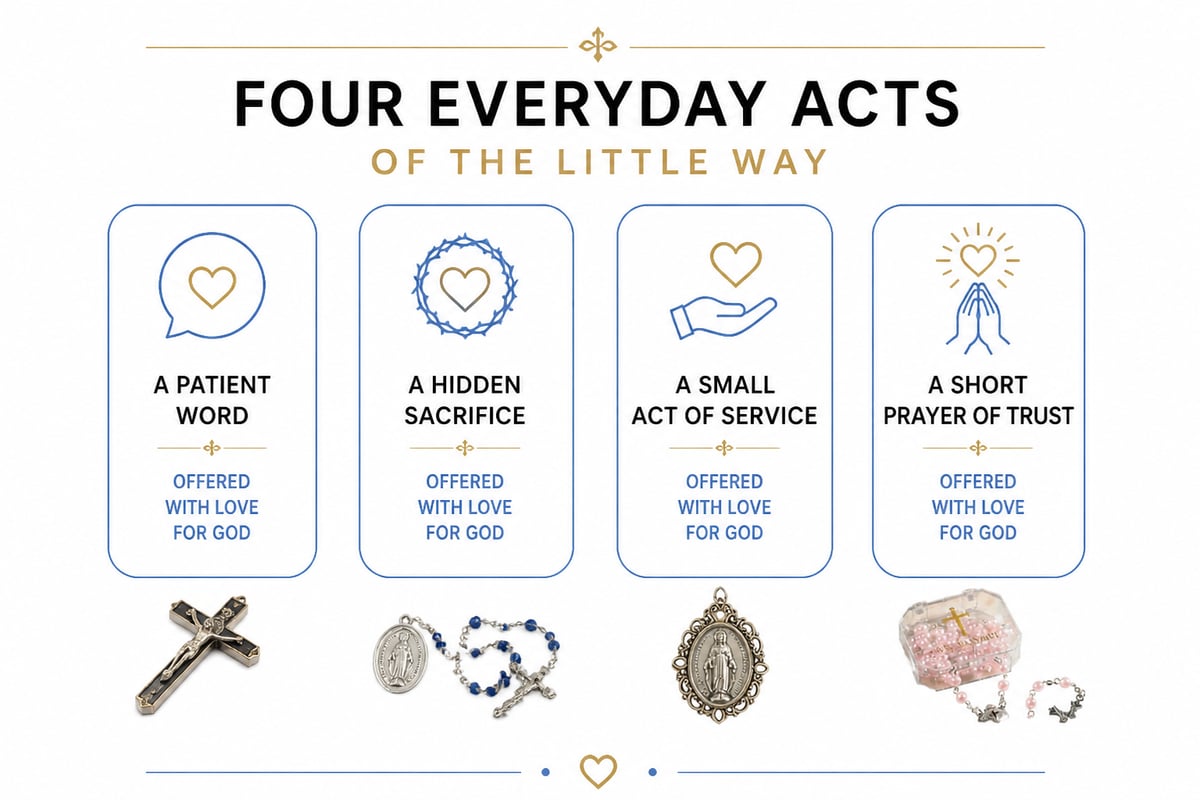
- Love in small things. A kind word, patience with an irritating person or a hidden sacrifice carries real value when offered with love.
- Acceptance of littleness. Admitting one's limits becomes a doorway to grace rather than a cause for discouragement.
- Confidence in mercy. She placed her hope in God's mercy rather than in her own merits.
You can read more on this teaching in Journeys of Faith's reflection on the Little Way of Saint Therese of Lisieux.
How Can You Practice the Little Way Day to Day?
You practice the Little Way by choosing small, concrete acts of love and offering them to God without expecting recognition.
Thérèse found her opportunities in the cloister, but they translate readily to family, work and parish life. Consider these examples:
- Answer an impatient message with gentleness and say a short prayer for the person.
- Complete a tedious household task without complaint and offer it for a specific intention.
- Smile at someone who is difficult to like, as she did with a sister who tried her patience.
- Begin and end the day with a brief act of trust, such as "Jesus, I trust in You."
- Accept a small disappointment quietly instead of voicing frustration.
A helpful habit is a nightly review that asks one question: where did I have a chance to love today, however small? Over time this builds the attentiveness she described. The aim is not perfection but faithful repetition.
Why Is She Called the Little Flower?
Thérèse is called the Little Flower because she described herself as a small flower in God's garden, content to bloom in the place and way God intended. She wrote of the variety of flowers in a meadow, each giving glory to God simply by being what it was made to be.
The title also connects to roses, which became a lasting sign of her intercession. She is often associated with roses, drawn from her promise to spend her heaven doing good on earth and to let fall a shower of roses. Journeys of Faith explains why Saint Therese is called the Little Flower for readers who want the background in more detail.
Is Saint Therese of the Child Jesus the Same as Saint Therese of Lisieux?
Yes, Saint Therese of the Child Jesus and Saint Therese of Lisieux are the same person, known by her religious name and by the town where she lived and died.
Several other titles refer to her as well: the Little Flower, Thérèse of the Child Jesus and the Holy Face, and Saint Thérèse of Lisieux. She should not be confused with Saint Teresa of Jesus, also called Teresa of Ávila, the sixteenth-century Spanish Carmelite reformer. Teresa of Ávila founded the Discalced Carmelite reform and wrote The Interior Castle. Thérèse entered the Carmelite family that Teresa helped renew, and she held her great predecessor in deep respect.
Spelling varies as well. "Thérèse" is the French form, while "Therese" and "Theresa" appear in English usage, and all point to the same saint when paired with Lisieux or the Little Flower.
When Did She Become a Saint?
She was beatified on April 29, 1923, and canonized on May 17, 1925, both by Pope Pius XI, as recorded by Vatican State. That is less than three decades after her death, a notably swift timeline.
Her cause moved quickly in large part because of the spread of Story of a Soul and the many favors attributed to her intercession. Her reputation for holiness spread widely in the years after her death. In 1997, Pope John Paul II declared her a Doctor of the Church, recognizing the depth and reliability of her teaching for the whole Church. Her feast day is celebrated on October 1 in the current Roman calendar.
What Is Story of a Soul?
Story of a Soul is Thérèse's autobiography, assembled from three manuscripts she wrote in Carmel and published after her death. It recounts her childhood, her vocation and her spiritual insights in simple, direct language.
For readers who want to meet her in her own words, Journeys of Faith carries the hardcover classic edition of Story of a Soul and a Voyage Classics edition. Those who prefer to listen can choose the Saint Therese of Lisieux audiobook, which suits commutes or quiet evening prayer.
A good approach is to read a few pages at a time and pause over a single line. Her chapters on charity and on her "vocation of love" repay slow reading.
How Do You Pray the Novena to Saint Therese?
The novena to Saint Therese is a nine-day prayer, traditionally prayed for a specific intention, asking her to intercede and to send a sign of her help, often understood as a rose. The Novena Rose Prayer is among the best known forms.
A simple way to pray it:
- Choose a clear intention and keep it consistent for all nine days.
- Pray at a set time each day so the habit holds.
- Open with the Sign of the Cross, then a short act of trust in God.
- Say the novena prayer, then conclude with an Our Father, Hail Mary and Glory Be.
- On the ninth day, give thanks, whatever the outcome, and entrust the intention to God's will.
Journeys of Faith provides a full guide to the novena to Saint Therese and her heavenly intercession. Many people also keep a laminated prayer card of Saint Therese of the Child Jesus in a missal or rosary pouch so the prayer is always at hand.
How Can a Devotional Item Support Devotion to Saint Therese?
A devotional item serves as a physical reminder to pray and to practice the small acts she taught, which is helpful for a spirituality built on daily faithfulness. A medal worn on a chain or a rosary kept in a pocket invites a brief prayer many times a day.
Journeys of Faith offers a broad selection of crucifixes, rosaries and medals, including rosaries from many parts of the world, Miraculous Medals and saints medals.
Saint Therese herself is represented in several forms, including a silver-tone medal of Saint Therese of Lisieux. Free shipping applies on all Journeys of Faith orders over $50. For sizes, materials and other product details, consult each product page directly.
What Can You Do to Learn More About Her and Her Place?
Visiting Lisieux, where the Carmel and the basilica dedicated to her stand, is a meaningful pilgrimage, and many Catholics also deepen their knowledge through reading and media from home.
Media can be a gentle way to continue learning. Journeys of Faith's catalogue includes a Saint Therese of Lisieux video download and an ebook edition, both drawn from the work of Bob and Penny Lord. Journeys of Faith is also a winner of the 1995 International Catholic Film Festival, and a free app is available to download.
For readers who enjoy comparing the lives of holy women, the collection Saints and Other Powerful Women in the Church places Thérèse alongside other models of faith, which can enrich a study group or personal reading plan.
FAQ
What is Saint Therese's feast day?
Her feast day is October 1 in the current Roman calendar. She died on September 30, 1897, and the Church celebrates her memorial the following day.
What does it mean that she is a Doctor of the Church?
It means the Church recognizes her writings and teaching as a trustworthy guide for all believers. Pope John Paul II gave her this title in 1997, noting the lasting value of her doctrine of confidence and love.
Why do people associate roses with Saint Therese?
She promised to spend her heaven doing good on earth and to let fall a shower of roses. Many who pray to her, especially during a novena, hope for a sign of her intercession, often associated with roses.
Choose one small act of love today, offer it with a short prayer to Saint Therese, and begin a nine-day novena if you carry a particular intention. When you are ready to deepen your devotion, you can find a rosary, medal or crucifix to keep her example close, and you can explore Journeys of Faith's online store with thousands of Catholic items at journeysoffaith.com/collections. Journeys of Faith is blessed to provide Catholic media, including podcasts and inspirational content, free of charge across multiple media platforms for viewers and listeners around the world. While access to this content remains free, there are significant and continually increasing costs associated with producing, hosting and distributing these programs, and your support helps us continue sharing the beauty of the Catholic faith with souls, so please make a donation. To find prayer cards, books and sacramentals for your own prayer life, Shop now at Journeys of Faith.
