

In an age marked by unprecedented levels of anxiety, financial uncertainty, and relational strain, countless Catholics are rediscovering an old devotion with profound relevance for modern stress: the surrender novena for stress. This nine-day prayer journey, attributed to the servant of God Father Dolindo Ruotolo, invites believers to release their worries into God's hands with the simple yet radical prayer, "Jesus, You take over." As mental health professionals increasingly recognize the value of incorporating religious and spiritual practices in therapy, this traditional Catholic novena offers both theological depth and practical relief for those wrestling with the weight of daily anxieties.
Understanding the Surrender Novena's Origins and Structure
The surrender novena for stress finds its roots in the life and writings of Father Dolindo Ruotolo, a Neapolitan priest who lived from 1882 to 1970. According to devotional tradition, Father Dolindo received what believers consider a private revelation from Jesus during a particularly difficult period of his own life, when he faced false accusations and ecclesiastical censure. The official website dedicated to Father Dolindo provides historical context about this priest whose cause for canonization was opened in 2002.
What Constitutes a Novena in Catholic Tradition
A novena represents a nine-day period of public or private prayer for a specific intention. The U.S. Conference of Catholic Bishops explains that this practice stems from the nine days the Apostles and Mary spent in prayer between the Ascension and Pentecost. Catholics pray novenas for various purposes: intercession of saints, preparation for feast days, or petition during times of need.
The surrender novena for stress follows this traditional structure while emphasizing one particular spiritual posture: complete abandonment to divine providence. Each day, the faithful repeat a core prayer that begins with acknowledging their worry and concludes with the refrain "Jesus, You take over."

The Text and Theology Behind the Prayer
The full text of the surrender novena for stress can be found in printable format through various Catholic resources. The prayer's theological foundation rests on several scriptural passages:
- Matthew 6:25-34: Jesus's teaching about not worrying about tomorrow
- Philippians 4:6-7: "Do not be anxious about anything, but in every situation, by prayer and petition, with thanksgiving, present your requests to God"
- 1 Peter 5:7: "Cast all your anxiety on him because he cares for you"
The novena's distinctive contribution lies not merely in asking God to resolve problems, but in surrendering the very act of problem-solving itself. This represents a profound shift from petition to abandonment, from asking God to work within our plans to allowing God to remake the plans entirely.
The Psychological and Spiritual Dimensions of Surrender
Modern research validates what spiritual masters have long taught: the act of surrendering control can paradoxically reduce anxiety and improve mental health outcomes. A systematic review of religious coping during COVID-19 found that certain forms of religious coping, particularly those involving trust and surrender, correlated with lower levels of anxiety and depression.
Measuring Surrender as a Psychological Construct
Researchers have developed frameworks to study surrender to God as a measurable psychological variable. A peer-reviewed study on surrender to God examined how this spiritual practice relates to well-being, anxiety, and overall health. The findings suggest that genuine spiritual surrender involves:
- Cognitive relinquishment: Letting go of the need to control outcomes
- Emotional trust: Developing confidence in divine benevolence
- Behavioral adaptation: Acting in accordance with perceived divine will
- Relational intimacy: Deepening one's sense of connection with God
The surrender novena for stress activates all four dimensions through its nine-day repetition and specific prayer content.
How Repetition Rewires Anxious Thought Patterns
| Neurological Mechanism | How Novena Prayer Engages It | Expected Outcome |
|---|---|---|
| Neural pathway formation | Nine consecutive days of prayer creates new mental associations | Automatic turn to God during stress |
| Cognitive restructuring | Repeated surrender language challenges control-based thinking | Reduced rumination patterns |
| Emotional regulation | Daily expression of trust builds affect tolerance | Lower baseline anxiety |
| Attentional focus | Structured prayer redirects from worry to devotion | Improved present-moment awareness |
The surrender novena for stress functions as a form of what psychologists call "exposure with response prevention," where the practitioner acknowledges the anxiety-provoking situation but prevents the typical anxious response (rumination, control attempts) by deliberately choosing surrender instead.
Brought to you by Journeys of Faith, founded by Bob and Penny Lord. We are an Augustinian Secular Institute, Cyber Apostles, whose mission is evangelization through media.
Practical Application: Praying the Surrender Novena for Specific Stressors
While the traditional surrender novena follows a set text, Catholic spiritual directors have long counseled that authentic prayer requires personal engagement with the words. The surrender novena for stress becomes most powerful when practitioners bring their concrete worries into the prayer.
Adapting the Novena for Common Stress Categories
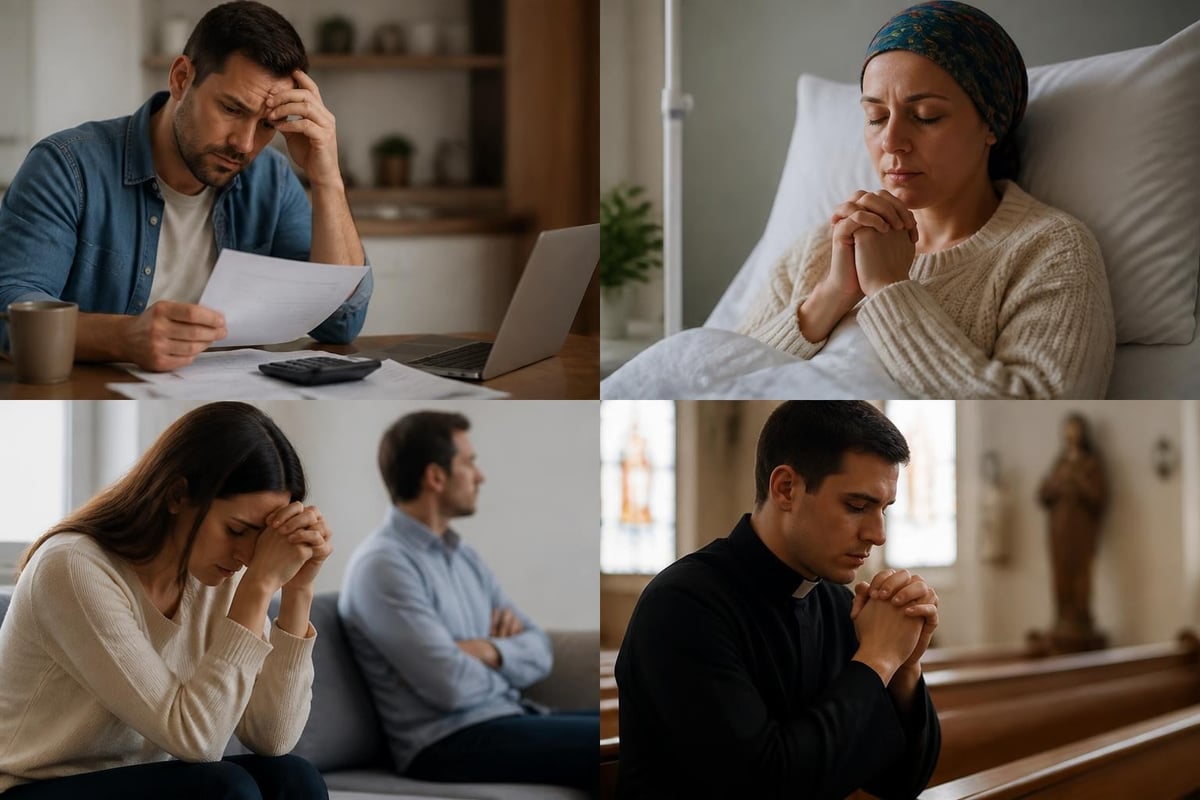
Financial Anxiety
When facing economic uncertainty, job loss, or overwhelming debt, begin each day's prayer by naming the specific financial concern before surrendering it. "Jesus, I am worried about making next month's mortgage payment. Jesus, You take over." This specificity prevents the prayer from becoming abstract.
Health-Related Stress
Chronic illness, medical test results, or caring for a sick family member creates sustained stress. The surrender novena for stress offers particular relief here because health situations often exceed our control. Many Catholics report that nine days of intentional surrender helps them distinguish between responsible action (taking medication, attending appointments) and destructive worry.
Relationship Difficulties
Conflict with a spouse, estrangement from adult children, or workplace tension generates persistent emotional stress. The novena invites practitioners to surrender not only the resolution but also the timeline and the outcome itself.
Creating Space for Daily Prayer Commitment
Successfully completing a surrender novena for stress requires intentional scheduling. Consider these strategies:
- Morning dedication: Pray immediately upon waking, before the day's anxieties accumulate
- Commute prayer: Use driving or public transit time for focused recitation
- Lunch break retreat: Step away from work to pray in a quiet space
- Evening reflection: Review the day's worries and consciously surrender each one
- Family participation: Invite household members to join for mutual support
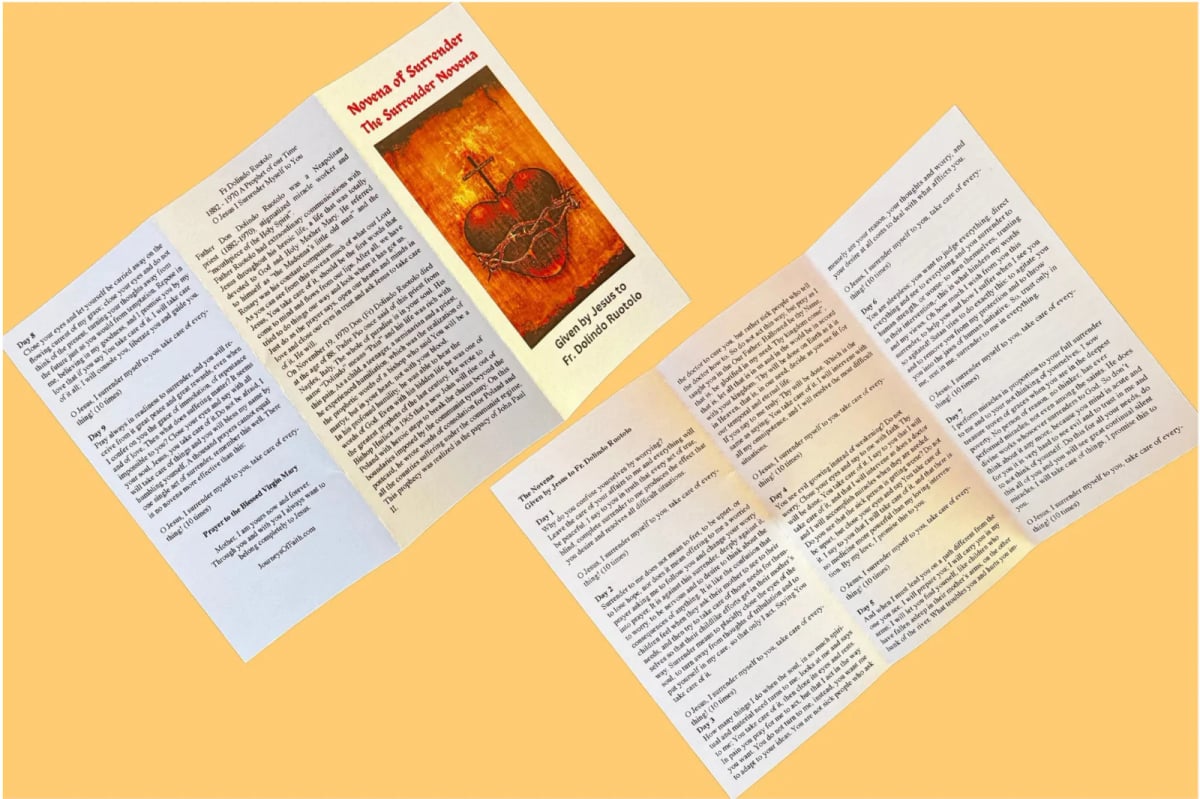
For those seeking a tangible aid to maintain this commitment, resources like the Surrender Novena Packages provide portable, professionally printed cards that fit easily in a pocket, purse, or Bible, ensuring the prayer text remains accessible throughout the nine days.
Theological Cautions and Proper Understanding
The Vatican's recent guidance on private revelations reminds Catholics that even widely practiced devotions arising from private revelations do not carry the same authority as Sacred Scripture or defined doctrine. The surrender novena for stress, while spiritually fruitful for many, should be understood within this proper context.
Surrender Does Not Mean Passivity
A common misunderstanding treats surrender as resignation or spiritual laziness. Authentic Christian surrender actually combines two seemingly opposite movements:
- Active trust: Continuing to work, seek help, make decisions, and fulfill responsibilities
- Interior detachment: Releasing anxiety about outcomes and accepting God's will
Saint Ignatius of Loyola captured this balance in his principle of "working as if everything depends on you, praying as if everything depends on God." The surrender novena for stress cultivates the prayer dimension while never suggesting believers abandon prudent action.
When Surrender Novena Should Complement Professional Help
| Situation Type | Appropriate Novena Use | Professional Help Also Needed |
|---|---|---|
| Situational stress from life changes | Primary spiritual practice | Optional support counseling |
| Moderate anxiety affecting daily function | Valuable complement to therapy | Yes, concurrent treatment |
| Severe anxiety or panic disorder | Part of spiritual coping toolkit | Essential psychiatric care |
| Depression with religious themes | May be helpful with guidance | Critical mental health intervention |
| Trauma-related stress | Secondary spiritual support | Primary trauma therapy required |
Research on religiosity and mental health in older adults confirms that religious practices work best alongside, not as replacement for, appropriate medical and psychological care.
Deepening the Practice: Nine Days and Beyond
Many who complete one surrender novena for stress find themselves returning to it repeatedly, creating a rhythm of nine-day prayer cycles that punctuate their spiritual year. This pattern reflects the Catholic understanding that spiritual transformation occurs gradually through sustained practice rather than instant conversion.
Journaling Through the Novena
Keeping a prayer journal during the nine days enhances awareness of how surrender affects daily experience. Recommended journal prompts include:
- What specific worry am I surrendering today?
- What thoughts or feelings arise when I say "Jesus, You take over"?
- Where did I notice God's providence working today?
- What control am I still trying to maintain?
- How has my perspective on this situation shifted?
Linking the Surrender Novena with Sacramental Life
The surrender novena for stress gains power when integrated into the broader sacramental and liturgical life of the Church. Consider timing your nine days to:
- Prepare for Confession: Surrendering specific sins and their underlying anxieties before sacramental absolution
- Lead into Sunday Mass: Culminating the novena with Eucharistic reception deepens the surrender
- Align with liturgical seasons: Advent and Lent provide natural frameworks for surrender themes
- Precede major decisions: Using the novena before discernment creates interior freedom
Common Spiritual Experiences During the Nine Days
Practitioners of the surrender novena for stress report varied experiences:
Days 1-3: Initial Relief and Resistance
The first days often bring a sense of relief from naming anxieties aloud in prayer. Simultaneously, deeper resistance may surface as the mind rebels against releasing control. This is normal and expected.
Days 4-6: The Temptation to Take Back
Mid-novena, many experience strong temptation to "take back" what they surrendered, especially if circumstances don't immediately improve. This phase tests genuine trust versus merely seeking quick relief.
Days 7-9: Deepening Peace or Continued Struggle
Some report profound peace emerging as the novena concludes. Others find the struggle continuing, which teaches that surrender is a process, not a transaction. Neither experience indicates failure; both represent authentic prayer.
Historical Witnesses to Surrender in Catholic Spirituality
The surrender novena for stress stands within a rich tradition of Catholic teaching on abandonment to divine providence. Understanding this broader context enriches the novena practice.
Father Dolindo's Own Example
Father Dolindo Ruotolo practiced radical surrender during decades of ecclesiastical trial. Falsely accused of doctrinal errors, his writings were placed on the Index of Forbidden Books from 1938 until the Index was abolished. Rather than becoming bitter, he reportedly deepened his surrender prayer, which eventually became the novena text Catholics use today.
Saint Thérèse and the "Little Way"
Saint Thérèse of Lisieux's spirituality of spiritual childhood shares the surrender novena's emphasis on trust. Her famous prayer, "O Jesus, I know it, love is repaid by love alone," expresses similar abandonment to God's will rather than anxious striving.
Abandonment to Divine Providence by Father de Caussade
Jean-Pierre de Caussade's classic text Abandonment to Divine Providence provides theological depth for understanding surrender. He taught that the present moment contains God's will, and accepting it with trust constitutes the heart of holiness. The surrender novena for stress applies this principle through structured nine-day practice.
Addressing Common Questions and Objections
"Isn't This Just Magical Thinking?"
Critics sometimes dismiss devotional practices like the surrender novena for stress as superstitious attempts to manipulate God. Proper understanding reveals the difference:
Magical thinking assumes:
- Correct formula forces God to act
- Prayer is transactional
- Results must match our expectations
- Our understanding exceeds God's wisdom
Authentic surrender recognizes:
- God cannot be manipulated
- Prayer transforms the one praying
- Results may differ from our desires
- God's wisdom infinitely exceeds ours
The surrender novena for stress belongs to the second category when prayed with mature faith.
"What If Nothing Changes After Nine Days?"
This question reveals expectations requiring examination. The novena's primary purpose is interior transformation, not external circumstantial change. Journeys of Faith emphasizes in its evangelization work that authentic Catholic devotion seeks first the kingdom of God, trusting that all else will be provided according to divine wisdom.
Faithful completion of a surrender novena for stress succeeds when:
- Interior peace deepens, even if circumstances remain difficult
- Perspective shifts from control to trust
- Spiritual intimacy with Christ grows
- Capacity to endure trials increases
External resolution of the stressful situation, when it occurs, represents additional grace rather than the novena's primary goal.
Extending Surrender Beyond the Nine Days
The surrender novena for stress serves as training ground for a lifelong spirituality of abandonment. Those who complete one or more novenas often discover this nine-day practice initiating permanent shifts in how they relate to anxiety and control.
Daily Surrender Prayer as Ongoing Practice
Many Catholics adopt a brief daily surrender prayer drawn from the novena:
"O Jesus, I surrender myself to You. Take care of everything."
This five-second prayer, repeated throughout the day when anxiety surfaces, extends the novena's fruit indefinitely. It functions as a spiritual "circuit breaker" interrupting anxious thought spirals.
Surrender as Preparation for Carrying Crosses
Catholic teaching holds that suffering, when united with Christ's cross, participates in redemption. The surrender novena for stress doesn't eliminate suffering but transforms our relationship to it. Rather than seeing stress as purely negative, surrendered suffering becomes an offering.
Building a Support Community Around Surrender
Praying the surrender novena for stress within a community amplifies its power. Consider:
- Parish small groups: Coordinating nine-day novenas together
- Online prayer partners: Daily check-ins with fellow practitioners
- Family novenas: Teaching children to surrender age-appropriate worries
- Workplace faith sharing: Praying the novena simultaneously with Catholic colleagues
The surrender novena for stress offers modern Catholics a time-tested pathway through anxiety toward peace. By combining scriptural trust, traditional novena structure, and the specific wisdom of Father Dolindo Ruotolo, this nine-day practice addresses both the spiritual and psychological dimensions of stress. Whether facing financial pressure, health crises, relationship conflicts, or the ambient anxiety of contemporary life, believers find in this prayer a concrete method for releasing control and embracing divine providence. The novena's power lies not in magical formulas but in the slow, deliberate work of training the heart to say "Jesus, You take over" with increasing authenticity each day.
Resources and Next Steps:
-
Explore Journeys of Faith's online store with thousands of Catholic items, including prayer resources, books, and devotional materials.
-
Journeys of Faith is blessed to provide Catholic media, including podcasts and inspirational content, free of charge across multiple media platforms for viewers and listeners around the world. While access to this content remains free, there are significant and continually increasing costs associated with producing, hosting, and distributing these programs. Your support helps us continue sharing the beauty of the Catholic faith with souls. Please make a donation to support this mission of evangelization.
Through resources, community, and commitment to spreading the Gospel, Journeys of Faith supports Catholics seeking deeper prayer lives and authentic surrender to God's will in every circumstance.
Shop Surrender Novena Devotionals for Peace in Stressful Times
When life feels overwhelming, hand it over: "O Jesus, I surrender myself to you, take care of everything!" These resources help you keep the prayer close all day, at home, at work, and on the go:
- Surrender Novena Prayer Booklet: the full nine-day novena, perfect for a daily quiet moment
- Surrender Novena Folded Prayer Card (3" x 6"): slips easily into a Bible, planner, or desk drawer
- Surrender Novena Trifold Card Packages: pocket-size cards to keep and to share
- Surrender Novena Cards 20-Pack: share peace with your prayer group, parish, or coworkers, free shipping
- Large Print Surrender Novena Cards: easy on tired eyes
- Chaplet of Divine Mercy Prayer Card: a calming prayer that pairs beautifully with surrender
- "Jesus, I Trust in You" 8" Wood Plaque: a daily reminder of trust for your home or office
- Divine Mercy Diary of Saint Faustina: go deeper into total trust in Jesus
