

The search for authentic Catholic teaching leads believers to a vast collection of sacred texts, official documents, and approved publications. Understanding what constitutes "the catholic church book" encompasses far more than a single volume - it represents the rich literary tradition spanning two millennia of faith, scholarship, and divine revelation. From Scripture to the Catechism, from papal encyclicals to the lives of the saints, these books form the intellectual and spiritual foundation of Catholic Christianity. Knowing which texts carry the Church's approval and authority helps believers navigate the modern publishing landscape with confidence and discernment.
Understanding The Catholic Church Book Tradition
The concept of "the catholic church book" extends beyond any single publication to embrace the entire corpus of authoritative Catholic literature. The Church has maintained a rigorous system for approving and recommending texts throughout history. This tradition ensures that what Catholics read aligns with authentic doctrine and supports genuine spiritual growth.
Central to this tradition are several key categories:
- Sacred Scripture (the Bible)
- The Catechism of the Catholic Church
- Papal encyclicals and apostolic letters
- Vatican Council documents
- Lives of the saints and approved apparitions
- Theological works with ecclesiastical approval
The imprimatur represents the Church's official declaration that a book may be published without doctrinal error. This Latin term meaning "let it be printed" provides readers with confidence that content has been reviewed by competent Church authority. Not every valuable Catholic book requires an imprimatur, but its presence offers additional assurance for works dealing with faith and morals.
The Foundation: Sacred Scripture
Sacred Scripture stands as the preeminent Catholic book. The Bible contains divine revelation presented through human authors under the inspiration of the Holy Spirit. The Catholic canon includes 73 books - 46 in the Old Testament and 27 in the New Testament - differentiating it from Protestant Bibles which contain fewer Old Testament books.
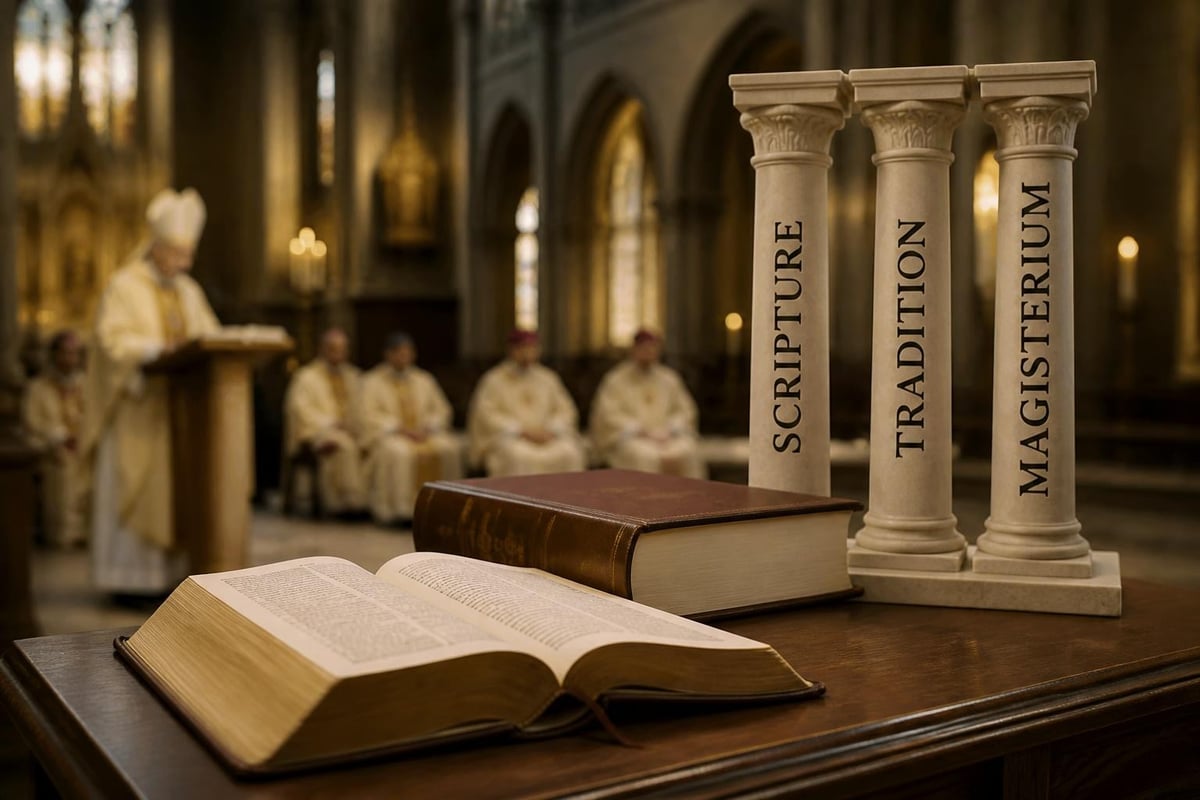
Reading Scripture within the Catholic tradition means understanding it through the lens of Tradition and the Magisterium. The Church teaches that Scripture cannot be properly interpreted in isolation from the living Tradition that produced it. Resources like CatholicLibrary.org provide access to authoritative translations and commentaries that guide believers in orthodox interpretation.
Brought to you by Journeys of Faith, founded by Bob and Penny Lord - We are an Augustinian Secular Institute - Cyber Apostles - Our Mission is Evangelization through Media.
Essential Reference Works Every Catholic Should Know
The Catechism of the Catholic Church stands as the most comprehensive single-volume summary of Catholic teaching available today. Published in 1992 following the Second Vatican Council, this monumental work organizes Catholic doctrine into four major sections: the profession of faith, the celebration of the Christian mystery, life in Christ, and Christian prayer.
Key features of the Catechism include:
- Systematic presentation of Church teaching
- Scriptural foundations for each doctrine
- Cross-references to Church Fathers and councils
- Practical applications for daily life
- Comprehensive index for topic research
Beyond the Catechism, several other reference works provide essential guidance. The Code of Canon Law governs Church discipline and practice. Papal encyclicals address contemporary issues through the lens of Catholic social teaching. Vatican II documents revolutionized many aspects of Church life and continue to shape Catholic identity in the modern world.
Historical and Theological Perspectives
Understanding the development of Catholic thought requires engagement with historical texts. Thomas Bokenkotter's "A Concise History of the Catholic Church" offers readers an accessible overview of how the Church evolved through twenty centuries. Such historical perspective illuminates why certain doctrines developed and how Catholics responded to changing cultural contexts.
| Resource Type | Primary Use | Authority Level |
|---|---|---|
| Scripture | Divine Revelation | Highest |
| Catechism | Doctrine Summary | Official Teaching |
| Encyclicals | Contemporary Issues | Papal Guidance |
| Canon Law | Church Governance | Legal Framework |
| Council Documents | Major Reforms | Collegial Authority |
Theological depth comes from engaging works that carry ecclesiastical approval. Richard Gaillardetz's "By What Authority?" explores how Catholics understand the interplay between Scripture, Tradition, and the Magisterium - a question central to Catholic identity and one that distinguishes Catholic Christianity from other traditions.
Devotional Literature and Spiritual Formation
Devotional books constitute a major category within the catholic church book tradition. These works focus on deepening personal relationship with God through prayer, meditation, and spiritual practice. Unlike doctrinal texts, devotional literature aims primarily at the heart rather than the intellect, though the best devotional works integrate both dimensions.
The lives of the saints provide particularly powerful devotional reading. These biographical accounts demonstrate how ordinary people achieved extraordinary holiness through cooperation with divine grace. As explored in stories from the lives of Catholic saints, these narratives offer concrete examples of faith lived authentically in diverse circumstances.
Prayer Books and Liturgical Resources
Prayer books compile the Church's official prayers alongside traditional devotions passed down through generations. The Liturgy of the Hours, also called the Divine Office, represents the Church's official daily prayer. Smaller prayer books contain novenas, litanies, and personal prayers for various intentions.
Popular devotional book categories include:
- Marian devotions and apparition accounts
- Eucharistic adoration guides
- Saint biographies and collected writings
- Examination of conscience materials
- Seasonal liturgical reflections
- Meditation methods and contemplative prayer guides
The EWTN Library houses thousands of devotional texts alongside doctrinal resources, making it an invaluable repository for Catholics seeking to deepen their spiritual lives. This collection demonstrates the breadth of approved Catholic literature available for formation and growth.

Specialized Catholic Books for Evangelization
Evangelization through the written word has remained central to the Catholic mission since the printing press revolutionized information dissemination. Books dedicated to explaining and defending the faith serve both cradle Catholics seeking deeper understanding and those exploring Catholicism for the first time. These apologetics works address common questions and objections with clarity and charity.
Testimony books share personal conversion stories and faith journeys. These narratives connect doctrine to lived experience, making abstract theological concepts tangible and relatable. Journeys of Faith has produced numerous works in this vein, including the widely-read Miracles of the Eucharist series by Bob and Penny Lord, which documents extraordinary Eucharistic miracles that strengthen belief in the Real Presence. These books combine historical research with spiritual reflection, making them valuable both for personal faith enrichment and for sharing with others curious about Catholic belief.
Books on Catholic Liturgy and Sacraments
Understanding the Mass requires knowledge that extends beyond simple participation. Books explaining the liturgy unpack the rich symbolism, historical development, and theological meaning embedded in Catholic worship. James-Charles Noonan's "The Church Visible" provides detailed insight into the ceremonial life and protocol of the Roman Catholic Church, helping readers appreciate the depth of liturgical tradition.
Sacramental theology books explore the seven sacraments as encounters with Christ. These works explain how physical signs communicate spiritual grace, a distinctly Catholic understanding of how God interacts with creation. From baptism through anointing of the sick, each sacrament merits dedicated study through approved theological literature.
Navigating Publishing Quality and Authenticity
Not every book labeled "Catholic" meets the standards of orthodox teaching. The modern publishing landscape includes works that claim Catholic identity while promoting ideas contrary to authentic doctrine. Discerning readers must develop skills for evaluating quality and orthodoxy.
Key indicators of reliable Catholic books:
- Imprimatur or nihil obstat (formal Church approval)
- Published by established Catholic publishers
- Author credentials in theology or recognized ministry
- Endorsements from bishops or recognized Catholic scholars
- Alignment with Catechism teaching
- Absence of theological red flags or novelties
Catholic publishers like Ignatius Press, Tan Books, Sophia Institute Press, and Catholic Truth Society have established reputations for doctrinal reliability. University presses associated with Catholic institutions also produce scholarly works of high quality. Online resources such as Veritas Catholica and DCRef provide access to primary source materials that serve as touchstones for evaluating other works.
Academic and Scholarly Resources
Serious study of Catholic theology requires engagement with academic literature. Seminary libraries like the Souvay Memorial Library offer online access to specialized resources including the Summa Theologiae, patristic writings, and canonical commentaries. These advanced texts support graduate-level research and provide depth unavailable in popular works.
| Audience Level | Recommended Book Types | Example Topics |
|---|---|---|
| Beginner | Catechism, basic apologetics, saint stories | What Catholics believe, prayer basics |
| Intermediate | Theological reflections, Church history, devotional classics | Sacramental theology, spiritual growth |
| Advanced | Academic theology, scholarly exegesis, canon law | Christology, ecclesiology, moral theology |
Even specialized academic works can inform popular understanding. For instance, research into mathematical methods in liturgical books reveals how the Church determined ecclesiastical dates - a fascinating intersection of faith and science that enriches appreciation for Catholic intellectual tradition.
Building a Personal Catholic Library
Creating a home library of Catholic books supports ongoing formation and provides resources for family catechesis. A well-chosen collection balances reference works, devotional literature, and specialized topics matching personal interests and vocational needs. Starting with essentials allows for gradual expansion as knowledge deepens.
Foundation titles for every Catholic library:
- Catholic Bible (RSV-CE, NABRE, or Douay-Rheims)
- Catechism of the Catholic Church
- Lives of the saints collection
- Marian devotion book
- Introduction to prayer and meditation
- Church history overview
- Catholic apologetics primer
Beyond these basics, personal interests guide collection development. Parents need children's catechesis materials. Those discerning religious life benefit from books on spirituality and vocation. Professionals in healthcare, law, or business appreciate Catholic moral teaching applied to their fields. The male saints who serve as pillars of faith offer particular inspiration for men seeking role models of masculine holiness.
Digital Resources and E-Books
Technology has revolutionized access to Catholic literature. Digital libraries now place thousands of texts at readers' fingertips. E-readers allow Catholics to carry extensive libraries while traveling. Smartphone apps provide daily readings, prayer resources, and quick reference tools.
Advantages of digital Catholic resources include:
- Searchability across multiple texts simultaneously
- Portability of entire libraries
- Often free or low-cost access to public domain classics
- Integration with study tools and note-taking features
- Environmental benefits of reduced paper consumption
However, physical books retain advantages for sustained study and contemplative reading. Many readers find printed pages less distracting and more conducive to deep engagement. A balanced approach incorporating both formats serves most Catholics well.
The Role of Books in Catholic Education
Formal Catholic education at all levels depends on quality textbooks and supplementary reading. Elementary catechesis introduces children to basic prayers, Bible stories, and Church teachings through age-appropriate materials. Secondary education deepens understanding through systematic presentation of doctrine, moral teaching, and Church history.
University-level Catholic studies engage original sources and scholarly analysis. Seminarians study systematic theology through multi-volume works covering each major doctrinal area. Continuing education for laity through parish programs and online courses similarly relies on well-written, doctrinally sound books that make complex theology accessible.
The comprehensive nature of Catholic education through books addresses:
- Biblical literacy and interpretation methods
- Systematic theology across all major areas
- Church history from apostolic times to present
- Moral theology and Catholic social teaching
- Liturgical theology and sacramental practice
- Spirituality and prayer traditions
- Apologetics and evangelization methods
Resources like those available through Journeys of Faith support this educational mission by providing materials suitable for various formation levels. Their commitment to promoting understanding of the Eucharist, Mother Mary, and the saints through multiple media formats extends the reach of Catholic education beyond traditional classroom settings.
Books on Catholic Mysticism and Extraordinary Phenomena
Catholic mysticism represents a specialized but significant category within the catholic church book tradition. Works by and about mystics document extraordinary spiritual experiences while remaining grounded in orthodox theology. These accounts of visions, locutions, and mystical graces inspire readers while demonstrating that such experiences serve to deepen rather than replace ordinary faith practice.
The remarkable mystics in Catholic Church history include figures like Teresa of Avila, John of the Cross, and Thérèse of Lisieux. Their writings, now considered spiritual classics, guide contemporary readers in contemplative prayer and radical surrender to God. Modern mystics like Padre Pio and Faustina Kowalska continue this tradition, their diaries and correspondence offering windows into profound communion with the Divine.
Approved Apparitions and Private Revelation
Books documenting Marian apparitions at Lourdes, Fatima, and Guadalupe carry special significance. The Church carefully investigates such phenomena before granting approval, ensuring reported messages align with revealed truth. These accounts strengthen devotion while respecting the principle that private revelation, even when approved, never supersedes public revelation contained in Scripture and Tradition.
Reading about approved apparitions serves multiple purposes. These accounts demonstrate God's ongoing care for the Church. They often carry urgent calls to prayer, penance, and conversion. Messages received by visionaries consistently point back to Scripture, the sacraments, and authentic Catholic practice rather than introducing novel teachings.
Contemporary Issues in Catholic Publishing
The catholic church book landscape continues evolving in response to cultural changes and technological advances. New challenges include maintaining doctrinal integrity amid market pressures, addressing contemporary moral issues through a Catholic lens, and reaching younger generations through media they actually consume.
Current trends in Catholic publishing include:
- Graphic novels and comics presenting saint stories
- Podcast transcripts and social media content in book form
- Integration of QR codes linking to supplementary digital content
- Focus on mental health and wellness from Catholic perspective
- Environmental stewardship and creation care titles
- Books addressing technology, AI, and bioethics
Publishers increasingly recognize the need for diverse voices within orthodox boundaries. Books by and for Catholics of various cultural backgrounds, socioeconomic situations, and life circumstances enrich the tradition. Works addressing disability, addiction recovery, and complex family situations demonstrate the universal applicability of Catholic teaching.
Quality Control in an Age of Self-Publishing
Self-publishing platforms have democratized book production, allowing authors to bypass traditional gatekeepers. While this creates opportunities, it also floods the market with unvetted material. Catholics must exercise particular caution with self-published religious books lacking ecclesiastical review or endorsement from recognized authorities.
Seeking recommendations from trusted sources helps identify quality amid abundance. Parish priests, spiritual directors, and Catholic educators can suggest appropriate titles. Book reviews in Catholic periodicals and websites provide guidance. Looking for patterns - multiple sources recommending the same title - increases confidence in a book's value and orthodoxy.
Understanding what constitutes the catholic church book involves appreciating the breadth of approved Catholic literature available for every aspect of faith development. From foundational texts like Scripture and the Catechism to specialized works on mysticism, liturgy, and contemporary issues, these books form an indispensable resource for authentic Catholic formation. Whether you're seeking to deepen your understanding of the Eucharist, grow in devotion to Mother Mary, or draw inspiration from the saints, Journeys of Faith offers a wealth of resources to support your spiritual journey through books, media, and devotional materials rooted in authentic Catholic teaching.
Explore More:
- Explore Journeys of Faith online store with thousands of Catholic items at https://journeysoffaith.com/collections
- Journeys of Faith is blessed to provide Catholic media, including podcasts and inspirational content, free of charge across multiple media platforms for viewers and listeners around the world. While access to this content remains free, there are significant and continually increasing costs associated with producing, hosting, and distributing these programs. Your support helps us continue sharing the beauty of the Catholic faith with souls. Please make a donation at https://journeysoffaith.com/pages/donate
