

St Rita of Cascia stands among the most beloved saints in Catholic tradition, known worldwide as the patron saint of impossible causes, difficult marriages, and desperate situations. Born in 1381 in the small mountain village of Roccaporena near Cascia, Italy, her life journey from devoted wife and mother to widowed peacemaker to contemplative nun reveals a woman of extraordinary faith who turned suffering into sanctity. Her story continues to inspire millions who face seemingly insurmountable challenges, offering hope that nothing is truly impossible with God's grace.
The Early Life and Marriage of St Rita of Cascia
Rita Lotti grew up in a devoutly Catholic family during a turbulent period in Italian history. Her parents, Antonio and Amata Lotti, were known as peacemakers in their community, mediating disputes and promoting reconciliation during the violent feuds that characterized fourteenth-century Italy. From childhood, Rita felt drawn to religious life and desired to enter an Augustinian convent, but her parents arranged her marriage to Paolo Mancini, a local nobleman with a violent temper.
The marriage presented Rita with her first impossible situation. Paolo was known for his harsh disposition and involvement in the bitter feuds that plagued the region. Rather than resist or despair, Rita embraced her vocation as wife with extraordinary patience and prayer. She endured years of verbal and possibly physical abuse while maintaining her charitable works and deep prayer life.
Her approach to this difficult marriage included:
- Daily prayer and devotion to Christ's Passion
- Practicing patience and gentleness despite provocation
- Maintaining charitable works in the community
- Setting a peaceful example for her twin sons
- Trusting completely in God's providence
Brought to you by Journeys of Faith, founded by Bob and Penny Lord. We are an Augustinian Secular Institute and Cyber Apostles. Our mission is evangelization through media.
Widowhood and the Path to Forgiveness
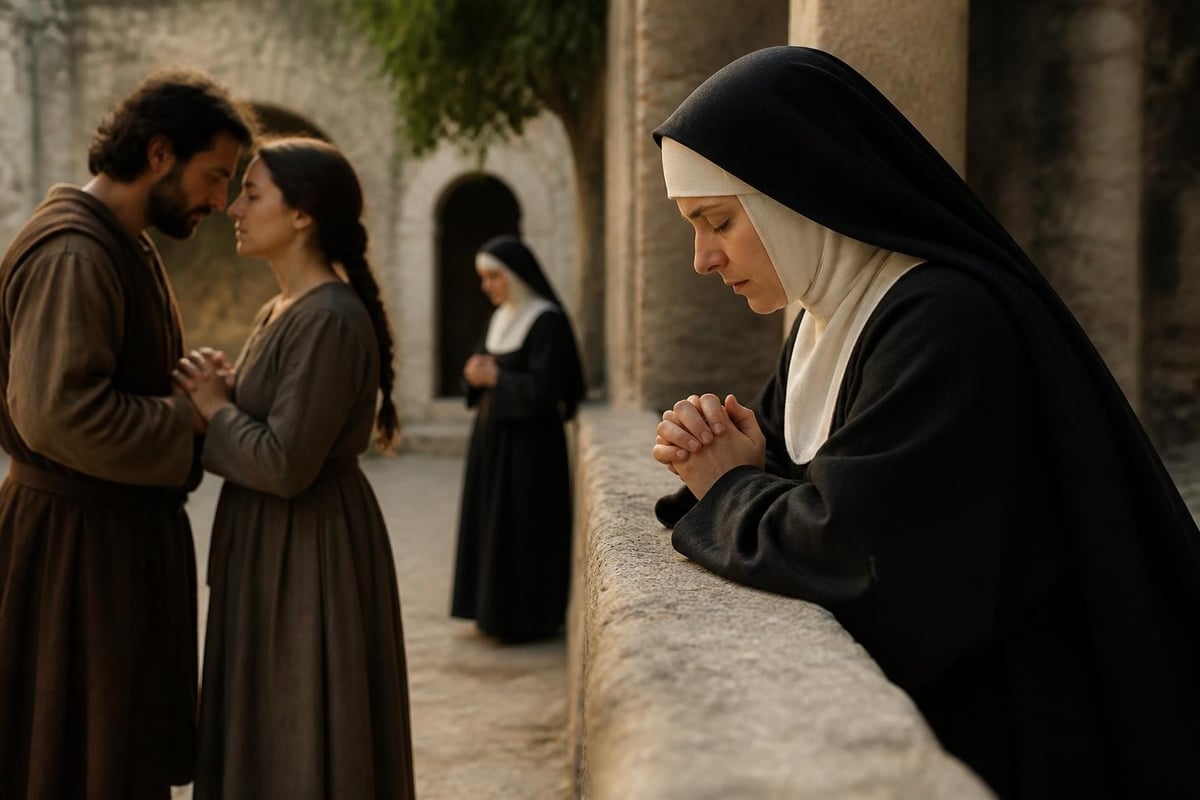
After nearly eighteen years of marriage, Rita's prayers bore fruit when Paolo underwent a conversion and renounced his violent ways. However, this period of peace was short-lived. Paolo was assassinated in 1416, likely in revenge for his past actions. The Santuario of Santa Rita da Cascia preserves the historical records of this tragic turning point in her life.
Rita faced another impossible situation when her twin sons vowed to avenge their father's death, continuing the cycle of violence that had destroyed so many families. Rita prayed desperately that God would take her sons rather than allow them to commit murder and damn their souls. Within a year, both sons died of natural causes after forgiving their father's killers, a resolution Rita attributed to divine intervention.
Now alone at age 36, St Rita of Cascia turned her attention toward her childhood desire for religious life. She applied three times to enter the Augustinian monastery in Cascia but was refused each time because the community only accepted virgins, not widows. The rule seemed absolute, another impossible obstacle.
| Challenge Faced | Rita's Response | Outcome |
|---|---|---|
| Violent husband | Prayer, patience, charity | Paolo's conversion |
| Sons seeking revenge | Prayer for God's will | Sons died after forgiving |
| Monastery rejection | Persistent prayer and faith | Miraculous acceptance |
The Miraculous Entry into Religious Life
The story of how St Rita of Cascia finally entered the monastery has become one of the most celebrated miracles associated with her life. According to tradition, Rita prayed to her three patron saints: John the Baptist, Augustine of Hippo, and Nicholas of Tolentino. One night in 1417, these three saints appeared to her and miraculously transported her inside the locked monastery walls.
When the sisters discovered Rita inside the cloister the next morning, they recognized the miracle and accepted her as a postulant. This supernatural intervention removed the impossible barrier that human rules had created. Rita spent the next forty years as an Augustinian nun, deepening her prayer life and serving her community with humility and devotion.
Her religious life was marked by:
- Profound meditation on Christ's Passion - She spent hours contemplating the sufferings of Jesus
- Rigorous penance and fasting - Rita embraced austere practices while maintaining joyful charity
- Service to the sick and poor - She continued her charitable works within and beyond the monastery
- Spiritual counsel to others - Many sought her wisdom for seemingly impossible situations
- Complete obedience to her superiors - Rita practiced heroic humility throughout her religious life
The Stigmata and the Thorn
Around 1442, while meditating on Christ's crown of thorns during a Good Friday service, St Rita of Cascia received a mystical wound on her forehead. According to accounts preserved at the shrine in Philadelphia, she experienced a single thorn from Christ's crown piercing her forehead, creating a wound that remained with her for the last fifteen years of her life.
This stigmata became both a blessing and a trial. The wound emitted such a foul odor that Rita was confined to the monastery, unable to participate in community activities or make a planned pilgrimage to Rome. She accepted this humiliation with characteristic patience, viewing it as participation in Christ's sufferings.
The only time the wound temporarily healed was when her superiors commanded her to join a pilgrimage to Rome for the Jubilee Year of 1450. The wound miraculously closed for the duration of the trip, then reopened upon her return to Cascia. This phenomenon demonstrated both the supernatural nature of the stigmata and Rita's complete obedience.
The Rose and Fig Miracles
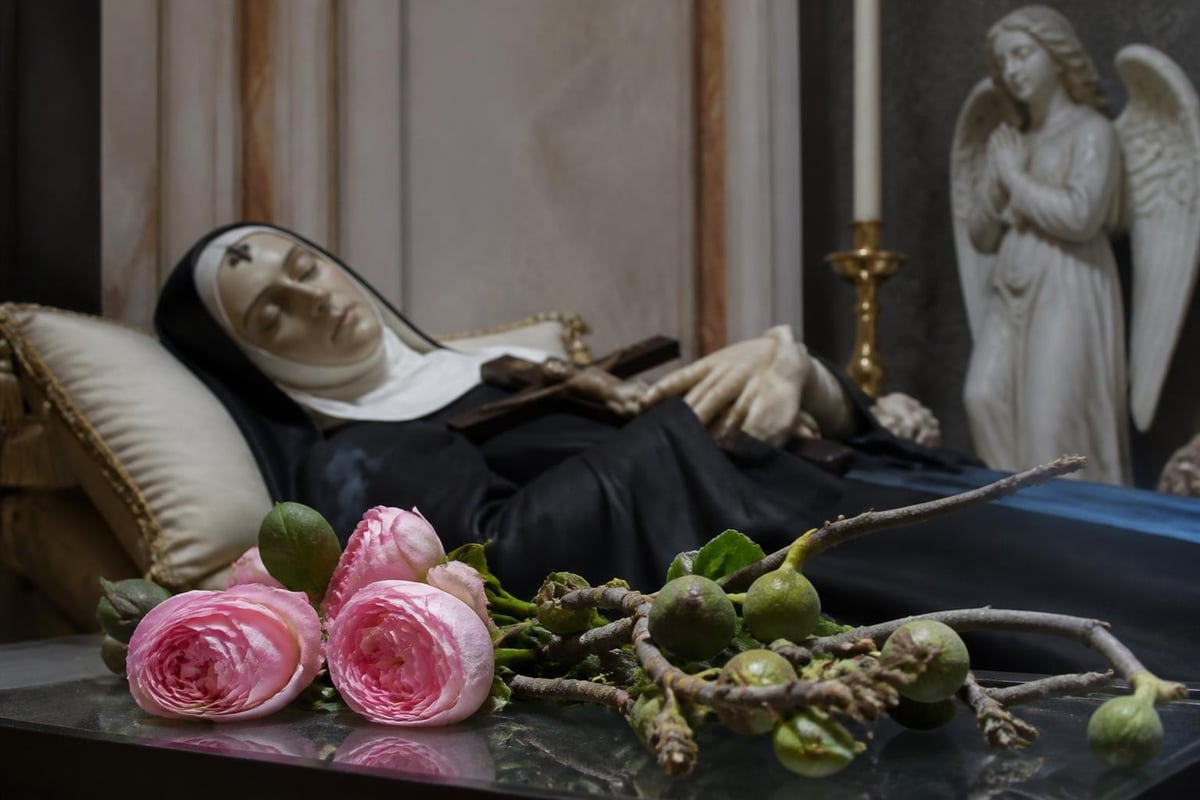
As St Rita of Cascia lay dying in 1457, bedridden and weakened by illness, she received a visit from a cousin. Rita asked for a rose from her family's garden in Roccaporena. Since it was January and the middle of winter, the request seemed impossible. Yet when the cousin arrived at the garden, she found a single blooming rose, which she brought to Rita.
Shortly after, Rita made another impossible request for two figs from a tree in the same garden. Again, despite the season, the cousin found fresh figs on the tree. These miracles became associated with St Rita of Cascia's intercession for impossible causes, and roses remain central to her iconography and devotion.
The symbolism of the rose miracle includes:
- Hope in impossible situations - What seems impossible to humans remains possible for God
- God's tender care - Divine attention to small requests shows personal love
- Seasonal defiance - Grace operates outside natural limitations
- Sweetness amid suffering - Beauty and consolation accompany trials
- Living legacy - The miracle continues through rose blessings at her feast day
According to contemporary Italian accounts, the tradition of blessing roses on St Rita's feast day (May 22) continues throughout Italy and worldwide. Devotees bring roses to be blessed, then keep the petals as sacramentals, believing in their intercessory power for impossible causes.
Canonization and Cult of St Rita of Cascia
St Rita of Cascia died on May 22, 1457, and her body was placed in an open casket in the monastery church. Her body has remained incorrupt for over five centuries, a phenomenon documented by numerous ecclesiastical and medical examinations. The body is enshrined in the basilica built in her honor in Cascia, where pilgrims from around the world come to venerate this beloved saint.
The process toward her canonization took centuries. She was beatified by Pope Urban VIII in 1627, but full canonization did not occur until May 24, 1900, when Pope Leo XIII officially declared her a saint. The delay reflected not doubts about her holiness but the careful deliberation the Church applies to such declarations.
Many devotees seek St Rita's intercession through dedicated prayer cards and novenas, which provide structured ways to ask for her help in impossible situations. Prayer Cards and Novenas offer Catholics tangible connections to the saints, carrying these petitions in pockets and prayer books as constant reminders of hope.

| Date | Event | Significance |
|---|---|---|
| 1381 | Birth in Roccaporena | Beginning of her earthly journey |
| 1397 | Marriage to Paolo Mancini | Acceptance of difficult vocation |
| 1416 | Paolo's death | Transition to widowhood |
| 1417 | Entry into monastery | Miraculous beginning of religious life |
| 1442 | Reception of stigmata | Deep mystical union with Christ's Passion |
| 1457 | Death and rose miracle | Final witness to God's power |
| 1627 | Beatification | Church recognition of holiness |
| 1900 | Canonization | Official declaration as saint |
Patronage and Intercession
St Rita of Cascia has become patron saint of numerous causes that reflect the challenges she faced during her lifetime. The Church officially recognizes her patronage over impossible causes, abused women, loneliness, marriage difficulties, parenthood, widows, bodily ills, and wounds. Her intercession is sought by those facing situations that appear hopeless by human standards.
The designation as patron of impossible causes emerged naturally from her life story. Rita faced repeated impossibilities: an abusive marriage that seemed irredeemable, sons bent on revenge, monastery doors closed to widows, and terminal illness. In each case, her faith and prayer opened pathways that human wisdom deemed closed.
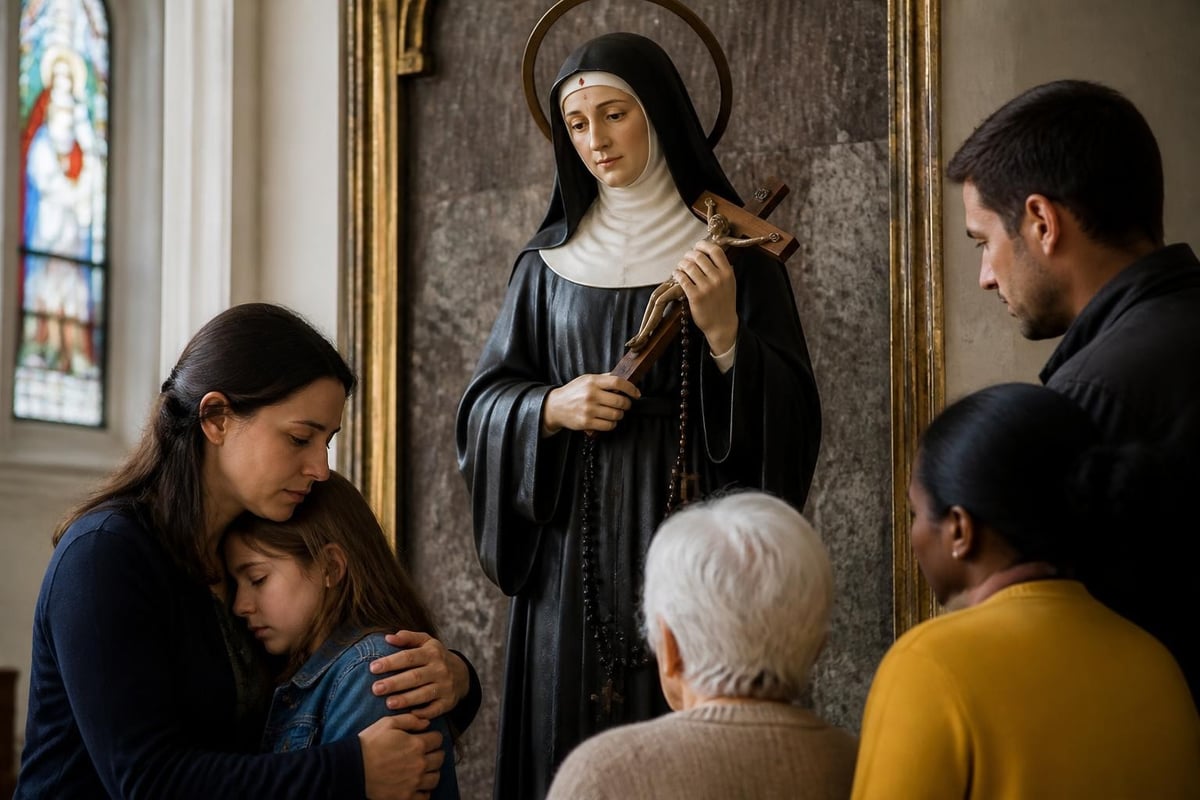
Modern devotees seek St Rita's intercession for:
- Financial impossibilities and debts
- Terminal or chronic illnesses
- Broken family relationships
- Legal battles and injustices
- Addiction and destructive behaviors
- Infertility and pregnancy complications
- Mental health struggles
- Seemingly hopeless conversions
The Diocese of Turin and other Italian dioceses celebrate her feast day with special solemnity, reflecting the deep devotion to St Rita of Cascia throughout Italy. These celebrations often include the blessing of roses, processions, and special Masses attended by thousands seeking her intercession.
Iconography and Visual Representations
Artists have depicted St Rita of Cascia with consistent symbolic elements that make her immediately recognizable in Catholic art and devotional materials. The most common representations show her in the black habit of the Augustinian nuns, with a prominent wound on her forehead and holding roses or a crucifix.
A detailed art-historical analysis of Saint Rita paintings reveals how artists have emphasized different aspects of her spirituality across centuries. Renaissance and Baroque painters focused on the mystical elements, particularly the stigmata and her ecstatic prayer. Later artists emphasized her role as advocate for the suffering and abandoned.
Common iconographic elements include:
- Black Augustinian habit - Identifying her religious order
- Forehead wound - The thorn from Christ's crown
- Roses - Reference to the winter miracle
- Crucifix - Symbol of her deep Passion devotion
- Bees - Legend says bees entered her mouth as an infant without harming her
- Book - Representing prayer and meditation
The visual tradition surrounding St Rita of Cascia helps devotees recognize her in churches, prayer cards, and medals, creating immediate connection to her intercessory power. These images serve not merely as decoration but as windows into her spiritual reality and continued presence among the faithful.
Contemporary Devotion and Shrines
The primary shrine to St Rita of Cascia remains the basilica in Cascia, Italy, which houses her incorrupt body. The official sanctuary website provides information for pilgrims planning visits to this sacred site. The basilica attracts hundreds of thousands of pilgrims annually, particularly around her feast day on May 22.
Beyond Italy, devotion to St Rita of Cascia has spread globally. The National Shrine of Saint Rita in Philadelphia serves as a major center of devotion in the United States, founded by Augustinian friars who brought her cult to America. Similar shrines exist in Spain, Portugal, Latin America, the Philippines, and other countries with strong Catholic populations.
Modern devotional practices include:
- Rose blessings - Roses blessed on her feast day are kept year-round
- Novenas - Nine-day prayer cycles seeking her intercession
- First Fridays - Special devotions on first Fridays in her honor
- Pilgrimage groups - Organized visits to Cascia and other shrines
- Online prayer communities - Digital gathering spaces for shared petitions
The Catholic media resources available through organizations like Journeys of Faith help spread knowledge of St Rita of Cascia and other saints to contemporary audiences. Through books, videos, and digital content, the timeless witness of the saints reaches new generations seeking inspiration and intercession.
St Rita's Message for Modern Catholics
The life of St Rita of Cascia speaks powerfully to contemporary challenges facing Catholic families and individuals. Her experience with domestic abuse, single parenthood, family violence, and social rejection mirrors struggles that many face today. Her response offers a model of faith that neither denies suffering nor succumbs to despair.
St Rita of Cascia never minimized the genuine difficulties she faced. She did not pretend her marriage was easy or that widowhood brought immediate peace. She acknowledged the real pain of her sons' desire for revenge and the genuine hurt of repeated rejection from the monastery. This honest recognition of suffering makes her intercession particularly meaningful for those in desperate situations.
Yet Rita refused to let suffering have the final word. She brought every impossibility to prayer, trusting that God's power exceeded human limitations. When human solutions failed, she persisted in faith. When natural pathways closed, she believed supernatural intervention remained possible. This combination of realism about suffering and faith in divine power defines her spiritual legacy.
Lessons from St Rita of Cascia for today:
- Patience transforms relationships - Persistent love can soften hardened hearts
- Prayer opens closed doors - What humans declare impossible remains possible for God
- Suffering has meaning - United with Christ's Passion, pain becomes redemptive
- Forgiveness breaks cycles - Choosing mercy over revenge liberates future generations
- Hope persists in darkness - Winter cannot prevent God's roses from blooming
The scholarly entry in the Italian Encyclopedia notes that St Rita of Cascia's cult has maintained remarkable vitality precisely because her life circumstances resonate with universal human experiences. Unlike saints whose extraordinary circumstances seem remote from ordinary life, Rita's challenges feel immediately familiar to people across cultures and centuries.
Prayers and Devotions to St Rita of Cascia
Catholics seeking St Rita of Cascia's intercession traditionally employ specific prayers and devotional practices that have developed over centuries. The most common is a simple invocation: "Saint Rita, patron of the impossible, pray for us." This brief prayer can be repeated throughout the day, particularly when facing difficulties that seem insurmountable.
More elaborate devotions include novenas, which involve nine consecutive days of prayer focused on a particular intention. These structured prayers allow devotees to persist in their petitions while meditating on St Rita's life and virtues. Many Catholics report experiencing profound peace during novenas to St Rita of Cascia, even when the specific petition remains unanswered, finding that her intercession brings clarity and strength to endure difficulties.
A traditional prayer to St Rita includes these elements:
Opening invocation: Recognizing Rita's holiness and her proven power as an intercessor for impossible causes.
Meditation on her life: Reflecting on specific aspects of her journey that relate to current needs, such as her patience in marriage, her trust during widowhood, or her perseverance in seeking religious life.
Specific petition: Clearly stating the intention, whether for healing, relationship restoration, financial relief, or other desperate needs.
Act of trust: Expressing confidence in God's providence and willingness to accept whatever outcome serves eternal good, following Rita's example of surrender to divine will.
Closing prayer: Often including the Our Father, Hail Mary, and Glory Be, connecting personal petition to the broader prayer life of the Church.
St Rita of Cascia continues to inspire Catholics facing impossible situations, reminding us that faith, patience, and persistent prayer can transform even the most desperate circumstances. Her life demonstrates that holiness emerges not from avoiding suffering but from trusting God through every trial. Journeys of Faith helps Catholics deepen their knowledge of inspiring saints like St Rita through comprehensive media resources, books, and devotional materials that bring these powerful witnesses to life. Explore the Journeys of Faith collection to discover more about the saints who intercede for us and inspire our faith journey.
Resources:
- Explore Journeys of Faith Online store with thousands of Catholic Items at https://journeysoffaith.com/collections
- Journeys of Faith is blessed to provide Catholic media, including podcasts and inspirational content, free of charge across multiple media platforms for viewers and listeners around the world. While access to this content remains free, there are significant and continually increasing costs associated with producing, hosting, and distributing these programs. Your support helps us continue sharing the beauty of the Catholic faith with souls. Please Make a Donation https://journeysoffaith.com/pages/donate
