Ir directamente a la información del producto
1 de 1

This is My Body,This is My Blood,Miracles of the Eucharist Book 1 & 2

This is My Body,This is My Blood,Miracles of the Eucharist Book 1 & 2

Precio habitual $34.10 USD
Precio habitual Precio de oferta $34.10 USD
Oferta Agotado
Los gastos de envío se calculan en la pantalla de pago.

FREE Shipping for all orders over $50 -- We have graduated discounts automatically  applied up to 67% when you add to cart. --- 20% off orders over $50 --- 25% off orders over $75 --- 30% off orders over $100 --- 35% off orders over $150 --- 5%Cash Back Store Credit on all orders

CHECKOUT TIPS 1. Discounts are applied automatically! 3. Pay with credit card or Express Pay

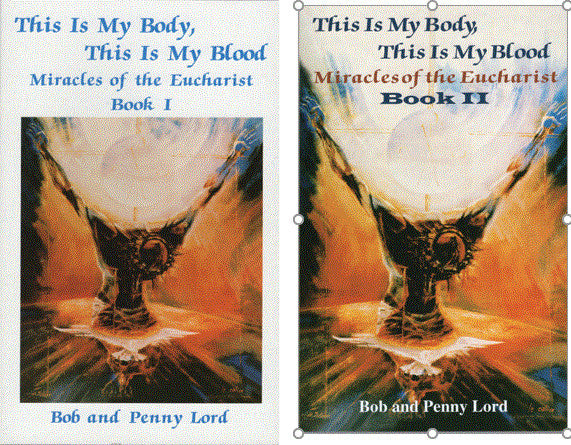
You are purchasing a combo package of both books titled " This is My Body, This is My Blood, Miracles of the Eucharist" Book 1 & II,  written by Bob and Penny Lord. 
*************ONE OF OUR BEST SELLERS!!!!!!****************


 Miracles Miracles of the Eucharist book 1


The Book that Had to Be Written! 300,000+ sold 

Readers' Comments - "I can never consecrate the bread and wine without seeing Our Lord Jesus’ Heart in the Eucharistic Miracle of Lanciano." 
"Until I read your book, I thought the ‘wafer’ was just a symbol."


"During the course of reading this book I felt a profound resurfacing of my own beliefs in this great Sacrament of Love created by our Savior Jesus for humanity"

Contains 22 Miracles of the Eucharist accepted by the Church and proven by science,


PLUS, Saints who lived solely on the Eucharist 
as shown on EWTN.


Lanciano, 700’s AD - The Heart and Blood of Jesus - the oldest documented Miracle of the Eucharist in the History of the Church - The Host turned into Flesh - the Wine turned in Blood


Offida, 1273 - An amazing account of how Jesus combatted Witchcraft through a Miracle of the Eucharist - The Miracle is protected by 14 locks


Bolsena and Orvieto, 1263 - God takes people from Belgium, Prague and Italy to bring about a Miracle of the Eucharist which brought about the Feast of Corpus Christi - Thomas Aquinas wrote the Liturgy for this Feast


Siena, 1730 - God proves beyond doubt that Jesus is truly Present in the Eucharist we receive at every Mass - Consecrated Hosts have not decayed after 276 years


Cascia, 1300's - The faith of a priest is restored after he is part of a Miracle of the Eucharist in which a Consecrated Host bled on two pages of a breviary, and turned into a profile of Christ


Zaragoza, 1427 - the Host turned into the Infant Jesus and remained in that form for three days.
Bois Seigneur Isaac, 1405 - Our Lord appears bleeding and pleading because of irreverence for the Eucharistic Host.

Avignon, 1433 - The waters parted during a flood to protect the Monstrance containing the Consecrated Hosts - reminiscent of Moses parting the Red Sea.
Read about Eucharistic Saints and fasters and many many more!!


190 Pages


Miracles Miracles of the Eucharist book 2


Plus a stirring reality of what really happens during the Mass
Read how Martyrs gave their lives rather than deny the Church and the Eucharist, because the Eucharist is not a piece of bread and a cup of wine, but Our Lord in His Body, Blood, Soul and Divinity!


This new book will bring you closer to Our Lord Jesus in the Eucharist,
as you discover Who your Lord is and how much He loves you.


You will want to live for Christ and His Church
A powerful tool to Defend the Faith. 

 
MIRACLES APPROVED AND DOCUMENTED BY THE CHURCH.  
Miracles that occurred to dispel Heresies Witchcraft and Non-believers.
Réunion, 1902 - Miracle fighting Modernism
Pezille-la-Riviére, 1793 - A double Miracle
Patierno, 1772 -  I will not leave you orphans
Turin, 1640 - Miracle stops a massacre
El Escorial, 1572 - Miracle combats errors of Luther
Morrovalle, 1560 - Host rested intact in scorched Church
Ettiswil, 1447 - The Eucharist fights the prince of darkness
Boxtel-Hoogstraten, 1380 - Miracle and the Black Death
Krakow  1345 A light cuts through the darkness


SAINTS AND LOVERS OF THE EUCHARIST.  
Mother Mary - #1 lover of the Eucharist
Saint Thomas Aquinas - Angelic Doctor
Saint Ignatius of Antioch - Martyred for the Faith
Saint Peter Julian Eymard - Eucharistic Adorer
Mother Angelica - Defender of the Faith
Saint John Vianney - Patron of Parish Priests
Saint Therese of the Child Jesus of the Holy Face
Saint Margaret Mary Alacoque - Consumed in His Presence like a burning taper
Saint Paschal Baylon - Although never a Priest, he is Patron of Eucharistic Congresses and Confraternities of the Blessed Sacrament


THE SACRIFICE OF THE MASS - THE ONGOING SACRIFICE OF THE CROSS
Your heart will burn as you discover what is really happening during the Mass.
Walk with Jesus and Mary to Calvary. 
Trace the Old and New Testament roots of the Mass 
For those who want a deeper relationship with Jesus,
For those who have left the Church,
Read!  Who is Jesus, Who comes to us under the appearance of Bread and Wine?
Read!  The Mass - the ongoing Sacrifice of the Cross.
Read!  How Jesus and the Mass fulfill the Old Law.


317 Pages


 *********************************************************************************

Please visit our other Ebay listing to find more books and DVD written by Bob and Penny Lord.

If you have any questions please let us know.

We will combine shipping if you buy more than 1 item.

God bless you. 


Listed with ExportYourStore.com
Ver todos los detalles

Frequently Asked Questions

Yes. Eucharistic miracle books typically collect Church-recognized accounts in which the Eucharist is reported to have shown extraordinary signs, often alongside historical background, theology, and devotional reflection. This two-book set, This is My Body, This is My Blood, Miracles of the Eucharist Book 1 and 2 by Bob and Penny Lord, is a good example of that category. Book 1 includes 22 Eucharistic miracles accepted by the Church and described as scientifically examined, with well-known cases such as Lanciano, Bolsena and Orvieto, Siena, Cascia, Offida, and Zaragoza. Book 2 expands the topic with additional approved and documented miracles, saints devoted to the Eucharist, and a section on what happens during the Mass. This kind of set is best for Catholics, RCIA participants, Eucharistic adoration groups, and readers who want both miracle stories and doctrinal context. If you want a brief visual overview only, another format may suit you better. If you want a more substantial read that connects miracles with belief in the Real Presence, this set is a stronger fit.
Some of the best-known Eucharistic miracles frequently discussed in Catholic reading include Lanciano, Bolsena and Orvieto, Siena, Cascia, and Zaragoza. These cases are often highlighted because they are historically famous, widely referenced in Catholic teaching, and closely tied to belief in the Real Presence. This two-book set covers many of those major accounts. It includes Lanciano, often described as the oldest documented Eucharistic miracle, where the Host reportedly became flesh and the wine became blood. It also includes Bolsena and Orvieto, connected with the origin of the Feast of Corpus Christi, and Siena, where consecrated Hosts reportedly remained undecayed for centuries. Other cases in the set include Offida, Cascia, Avignon, Turin, El Escorial, and Krakow. These books are most useful for readers who want recognized miracle accounts gathered in one place rather than scattered online. A helpful tradeoff to know is that the books focus on devotional and apologetic value, so readers looking for only academic historical analysis may want to supplement them with additional research.
Yes, this set is well suited for beginners who want an introduction to Eucharistic miracles from a Catholic perspective. It combines narrative miracle accounts with explanations of why the Eucharist matters in Catholic belief, so it does more than simply list events. Book 1 presents 22 Church-accepted miracles and includes famous cases such as Lanciano, Siena, Bolsena and Orvieto, and Cascia. Book 2 goes further by explaining the sacrifice of the Mass, saints devoted to the Eucharist, and how miracle accounts have been used to strengthen faith and answer error or disbelief. Together, the books total 507 pages, which gives a reader a broad foundation without needing to hunt down separate titles. This is especially helpful for Catholics returning to the faith, parish study groups, confirmation candidates with a strong interest in Eucharistic theology, and anyone trying to understand the Real Presence. The main tradeoff is length. A reader wanting a very short summary may prefer a booklet, while someone seeking fuller coverage will likely appreciate this set.
This purchase includes both volumes of This is My Body, This is My Blood, Miracles of the Eucharist by Bob and Penny Lord. Book 1 is 190 pages and Book 2 is 317 pages, for a combined total of 507 pages. Book 1 focuses on 22 Eucharistic miracles accepted by the Church and described as scientifically proven, along with stories of saints who reportedly lived solely on the Eucharist. It includes major miracle locations such as Lanciano, Offida, Bolsena and Orvieto, Siena, Cascia, Zaragoza, Bois Seigneur Isaac, and Avignon. Book 2 adds more approved and documented miracles, saints and lovers of the Eucharist, martyrs who died rather than deny the Eucharist, and a substantial section on the sacrifice of the Mass and its Old and New Testament roots. This set is best for readers who want one resource that combines miracle history, Eucharistic devotion, and apologetics. It is less suited to someone looking for a purely photographic atlas or a short reference pamphlet.
A simple list or PDF usually gives names, places, and short summaries. This book set goes further by providing narrative detail, theological explanation, and devotional context. Instead of only identifying miracles, it explains why Catholics see them as signs pointing to the Real Presence of Jesus in the Eucharist. Book 1 gathers 22 Church-accepted miracles and includes historical accounts such as Lanciano, Siena, and Bolsena and Orvieto. Book 2 adds further miracles, saints devoted to the Eucharist, and an extended reflection on what happens during the Mass and how the Mass fulfills Old Testament worship. That makes the set useful not only for reference, but also for spiritual reading and faith formation. This is a better choice for readers who want to understand the meaning behind the miracles, not just memorize a list. The tradeoff is that it requires more reading time than a quick chart or downloadable summary. For deeper study, discussion groups, or personal devotion, the added depth is often the main advantage.
Yes. In addition to miracle accounts, this set includes saints and other figures known for deep Eucharistic devotion. That matters because many readers want to see not only extraordinary events, but also how belief in the Eucharist shaped holy lives. The product description specifically notes saints who lived solely on the Eucharist in Book 1, and Book 2 includes a section on saints and lovers of the Eucharist. Named examples include Saint Thomas Aquinas, Saint Ignatius of Antioch, Saint Peter Julian Eymard, Saint John Vianney, Saint Therese of the Child Jesus of the Holy Face, Saint Margaret Mary Alacoque, and Saint Paschal Baylon, along with Mother Mary and Mother Angelica. This makes the set especially useful for Catholic readers who want spiritual examples alongside miracle history. It can also help parish groups connect doctrine with lived holiness. If someone wants only a technical catalog of miracles by place and date, the saint material may feel broader than necessary. For most devotional readers, though, it adds valuable context.
Yes. This set is designed not only to recount miracles, but also to strengthen understanding of the Real Presence and the sacrificial meaning of the Mass. That makes it more useful than a miracle collection alone for readers who want doctrinal depth. Book 2 is especially focused on this area. It discusses what really happens during the Mass, presents the Mass as the ongoing sacrifice of the Cross, and traces Old and New Testament roots. The product description also emphasizes that the Eucharist is not treated as a mere symbol, but as Christ in His Body, Blood, Soul, and Divinity. Book 1 supports that teaching through Church-accepted miracle accounts that point back to Eucharistic belief. This set is a strong fit for Catholics seeking faith formation, Eucharistic revival study, adult education, or personal reflection before or after Adoration. The tradeoff is that it approaches the topic devotionally and apologetically. Readers seeking a formal theology textbook may want to pair it with catechetical or academic sources.
These books are most helpful for Catholics who want a stronger understanding of the Eucharist, especially people returning to the Church, those preparing for faith discussions, and readers drawn to miracle accounts as a path to deeper belief. They can also work well for parish study groups, Eucharistic adoration communities, and anyone interested in saints and sacramental theology. The content spans several use cases. Book 1 gathers 22 Church-accepted Eucharistic miracles and introduces famous cases such as Lanciano and Siena. Book 2 continues with additional approved miracles, examples of martyrs and saints devoted to the Eucharist, and a major section on the sacrifice of the Mass. The product description even presents it as a tool to defend the faith. This set is best for readers open to a Catholic devotional approach rather than detached historical criticism. It may be more than a casual reader wants if they only need a quick fact sheet. For someone seeking one substantial resource on Eucharistic miracles and their spiritual meaning, it is a practical choice.
Yes. The product description states that the books contain miracles accepted by the Church, and Book 2 specifically describes its contents as miracles approved and documented by the Church. Book 1 also says it includes 22 miracles of the Eucharist accepted by the Church and proven by science. That distinction is important for Catholic readers, because not every miracle story in circulation has the same level of ecclesial recognition or documentation. This set focuses on cases commonly presented within Catholic devotional and apologetic literature, including Lanciano, Bolsena and Orvieto, Siena, Cascia, Avignon, Turin, and others. The books frame these events as signs that support belief in the Eucharist rather than as substitutes for faith. This is helpful for shoppers who want a curated Catholic resource rather than an unfiltered collection of claims. A reasonable limitation is that Church approval language in devotional books does not replace consulting official diocesan or scholarly sources for deeper investigation. For most readers, though, the set offers a structured and faith-centered starting point.
It works for all three, but it is especially strong for readers who want a blend of devotion and apologetics. The miracle accounts support belief in the Real Presence, while the sections on the Mass and the saints give the reading a spiritual and catechetical dimension. For personal devotion, the stories of Eucharistic miracles and saintly love for the Blessed Sacrament can deepen prayer and reverence. For study, the set gathers many major miracle traditions in one place across 507 pages. For apologetics, Book 2 is particularly relevant because it discusses martyrs who defended the Eucharist, addresses disbelief and heresy, and explains the Mass as the ongoing sacrifice of the Cross. The best fit depends on what the reader wants. Someone looking for a prayer-only book may prefer a shorter devotional title. Someone wanting a dry academic history may want additional sources. But for Catholics who want one resource that informs the mind, supports faith, and encourages Eucharistic devotion, this set is unusually versatile.