Ir directamente a la información del producto
1 de 2

Eucharist Miracles Book II

Eucharist Miracles Book II

Precio habitual $16.95 USD
Precio habitual Precio de oferta $16.95 USD
Oferta Agotado
Los gastos de envío se calculan en la pantalla de pago.

FREE Shipping for all orders over $50 -- We have graduated discounts automatically  applied up to 67% when you add to cart. --- 20% off orders over $50 --- 25% off orders over $75 --- 30% off orders over $100 --- 35% off orders over $150 --- 5%Cash Back Store Credit on all orders

CHECKOUT TIPS 1. Discounts are applied automatically! 3. Pay with credit card or Express Pay

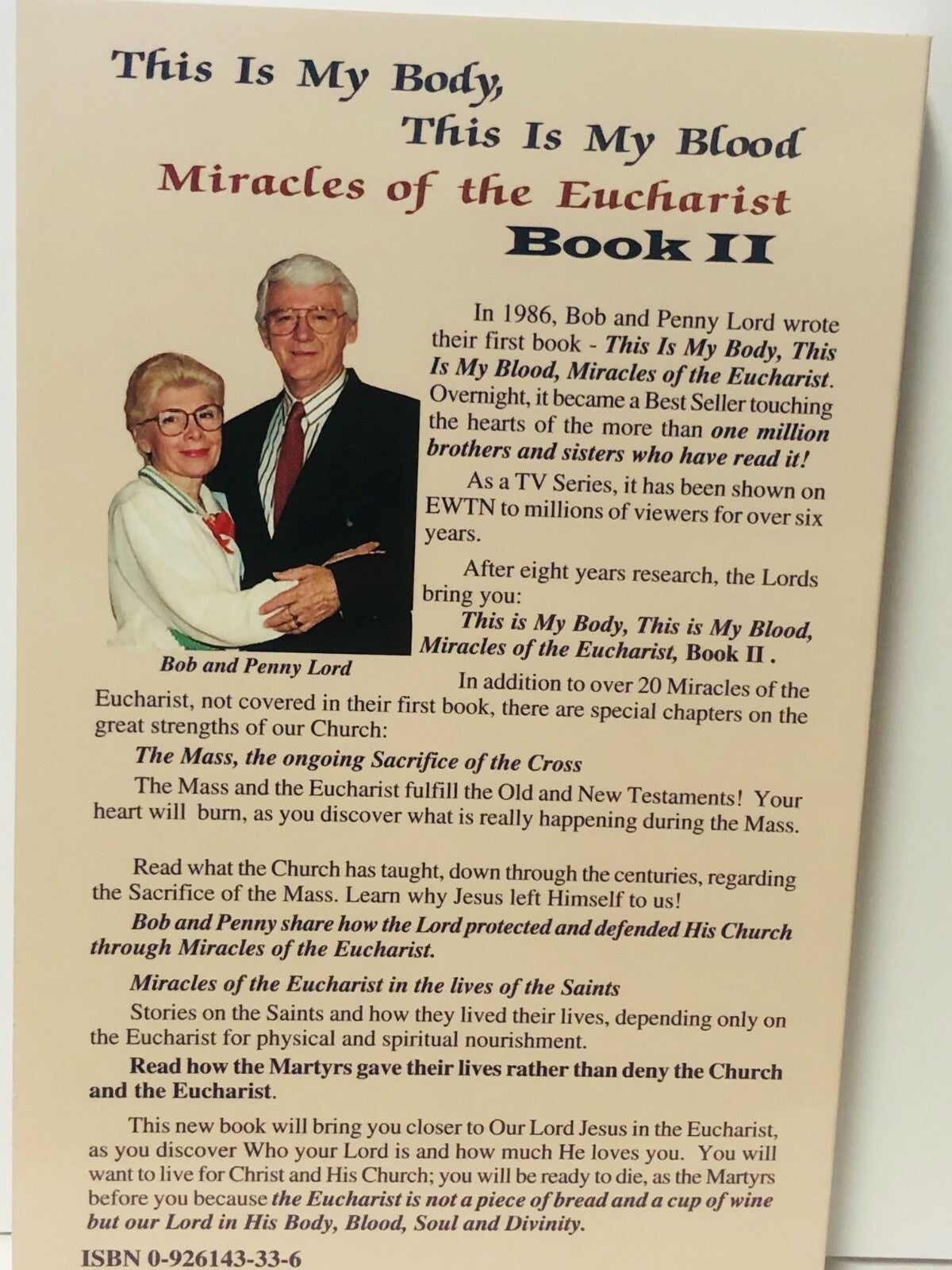
This is My Body, This is My Blood, Miracles of the Eucharist Book II by Bob and Penny Lord is a 317-page Catholic book focused on the Real Presence, the Mass, and 21 additional Eucharistic miracles approved and documented by the Church. Compared to general devotional reading, this volume offers specific miracle accounts, saints connected to Eucharistic devotion, and a structured defense of Catholic teaching.

  • Includes 21 additional Eucharistic miracles presented as Church-documented accounts
  • Explains the Mass as the ongoing Sacrifice of the Cross with Old and New Testament connections
  • Features saints and witnesses of Eucharistic devotion, including St. Thomas Aquinas, St. John Vianney, and St. Peter Julian Eymard
  • Useful for faith formation, RCIA study, parish reading, or personal Eucharistic adoration preparation
  • Written as a companion to Book I for readers seeking deeper study of the Eucharist

A powerful companion to Book I, this volume explores miracles associated with combating heresy, disbelief, and spiritual error, including accounts from Reunion in 1902, Turin in 1640, El Escorial in 1572, and Krakow in 1345. It also reflects on martyrs who gave their lives rather than deny Christ in the Eucharist.

Readers looking for a Catholic prayer book alternative, confirmation saint gift, or study resource on Eucharistic miracles will find this book especially useful for Adoration, catechesis, Lent reading, and returning to the sacraments. Unlike brief pamphlets, this book combines miracle narratives, theology of the Mass, and lives of saints in one reference volume.

Ver todos los detalles

Frequently Asked Questions

A good Eucharistic miracles book should do two things well: explain the Church’s teaching on the Real Presence and provide specific, documented miracle accounts. This is My Body, This is My Blood, Miracles of the Eucharist Book II by Bob and Penny Lord fits that need because it combines both. It includes 21 additional Eucharistic miracles and also explains what the Mass means in Catholic belief, including the teaching that Jesus is truly present in the Eucharist as His Body, Blood, Soul, and Divinity. This type of book is especially helpful for Catholics who want to strengthen their faith, people returning to the Church, and readers who want a clearer understanding of why Eucharistic devotion matters. It also covers saints and lovers of the Eucharist, plus reflections on the Mass as the ongoing Sacrifice of the Cross. The main tradeoff is that this is a faith-focused Catholic book, not a neutral academic survey. Readers looking for purely historical analysis without devotional content may want a different format. For catechesis, personal reading, and Eucharistic devotion, it is a strong choice.
There is no single official Catholic list of only five Eucharistic miracles, but people often ask for a short list of well-known examples as a starting point. In general, the most commonly discussed miracles are those that are widely known, connected to strong Eucharistic devotion, or used in catechesis to explain the Real Presence. A book like This is My Body, This is My Blood, Miracles of the Eucharist Book II is useful because it moves beyond a short popular list and presents 21 additional miracles approved and documented by the Church. The cases in this volume include events such as Turin, 1640; El Escorial, 1572; Ettiswil, 1447; and Krakow, 1345. The book also explains why these miracles matter in Catholic belief, especially in response to heresy, unbelief, and confusion about the Eucharist. This makes it a better fit for readers who want more than a quick internet answer. If you want a broad, faith-based introduction rather than a simple top-five list, this book offers much more depth and context.
Yes, it is a much fuller alternative to a simple list. A list can name miracle locations and dates, but it usually does not explain why the Church preserved those accounts or how they connect to Catholic teaching on the Mass and the Real Presence. This book goes further by presenting 21 additional Eucharistic miracles and placing them within a broader devotional and doctrinal framework. It is especially valuable for readers who want context, not just names. In addition to miracle accounts, the book discusses saints devoted to the Eucharist, the Sacrifice of the Mass, Old and New Testament roots of the Mass, and the meaning of Jesus coming under the appearance of bread and wine. That makes it useful for study groups, adult faith formation, and individual spiritual reading. The tradeoff is that it is not a quick-reference chart or a visual catalog. If you only want a brief list for memorization, a summary source may be faster. If you want explanations that deepen understanding, this book is more helpful.
A helpful Eucharistic miracles book for defending the faith should connect miracle accounts to core Catholic teaching, not just retell unusual events. This is My Body, This is My Blood, Miracles of the Eucharist Book II does that by showing how approved and documented miracles have been understood in the life of the Church, especially in response to doubt, heresy, and disbelief. The book specifically presents miracles that occurred to dispel errors and strengthen belief in the Eucharist. It also explains that the Eucharist is not merely symbolic in Catholic teaching, but truly Christ’s Body, Blood, Soul, and Divinity. Beyond miracle stories, it includes material on martyrs who died rather than deny the Eucharist, saints known for Eucharistic devotion, and teaching on the Mass as the ongoing Sacrifice of the Cross. This makes the book useful for Catholics answering common questions about the Real Presence, especially in parish study, apologetics, and personal formation. It is best for readers open to Catholic teaching, rather than those seeking a detached comparative religion approach.
This book is best for Catholics who want a deeper love for the Eucharist, readers returning to the Church, and anyone trying to understand what the Mass means in Catholic belief. It is also a good fit for people interested in Eucharistic miracles, saints devoted to the Blessed Sacrament, and apologetics related to the Real Presence. Because the book combines miracle accounts with teaching on the Mass, it works well for several types of readers. Someone seeking spiritual reading can use it devotionally. A catechist or parish group can use it as a discussion resource. A reader struggling with belief in the Eucharist may find it helpful because it ties miracles to doctrine rather than presenting them as isolated wonders. It may be less suited to someone who wants a brief children’s introduction or a purely scholarly treatment. At 317 pages, it offers substantial reading. For adults and older teens ready for more serious Catholic reading on Eucharistic miracles and the Sacrifice of the Mass, it is well suited.
Besides miracle stories, this book covers major Catholic teachings about the Eucharist and the Mass. That is one of its strongest features. In addition to 21 Eucharistic miracles, it includes reflections on saints and lovers of the Eucharist, such as Saint Thomas Aquinas, Saint Ignatius of Antioch, Saint Peter Julian Eymard, Saint John Vianney, Saint Therese, Saint Margaret Mary Alacoque, and Saint Paschal Baylon. It also highlights Mary’s role as the foremost lover of the Eucharist. The book further explores the Mass as the ongoing Sacrifice of the Cross and traces Old and New Testament roots of the Mass. This broader approach helps readers see why Eucharistic miracles matter in Catholic theology instead of treating them as isolated historical curiosities. That makes it especially useful for faith formation, prayerful study, and learning how Eucharistic devotion connects to the whole life of the Church. If you want only a short collection of miracle summaries, this book gives more than that. If you want doctrine, devotion, and history together, it is a strong fit.
Yes, this book is especially suitable for someone returning to the Catholic Church, particularly if that person has questions about the Eucharist or the meaning of the Mass. The description explicitly points to readers who have left the Church and encourages them to rediscover who Jesus is in the Eucharist and how the Mass fulfills the Old Law. For a returning Catholic, that matters because confusion about the Real Presence often leads to deeper questions about Catholic worship itself. This book addresses both. It presents approved Eucharistic miracles, explains the Church’s belief that Christ is truly present in the Eucharist, and reflects on the Mass as the ongoing Sacrifice of the Cross. It also includes examples of saints, martyrs, and Eucharistic devotion that can help reconnect faith with lived Catholic tradition. The main limitation is that it assumes a Catholic framework and speaks from within that tradition. For someone open to returning and wanting a faith-deepening resource, it can be very helpful. For someone seeking a neutral overview of all Christian views of Communion, it may feel more devotional and doctrinal than comparative.
Book II is more developed than a basic beginner overview because it expands beyond introductory examples and moves into deeper catechesis. According to the product description, it is a companion to Book I and includes 21 additional miracles. That means it is designed to build on prior interest rather than simply repeat the most familiar stories. What sets it apart is that it does not stop at miracle narratives. It also teaches what happens during the Mass, explores the Eucharist as the true presence of Christ, and discusses the sacrifice of the Mass in relation to Calvary and salvation history. Readers also encounter saints and martyrs whose lives were shaped by Eucharistic faith. This makes Book II especially useful for someone who already knows the topic at a basic level or wants a more serious Catholic reading experience. The tradeoff is that complete beginners looking for a very short introduction may find it more detailed than expected. For readers ready to go deeper, the extra substance is a benefit.
Yes, this book can work well for Catholic study groups, parish faith formation, and adult catechesis. Its structure lends itself to discussion because it combines miracle accounts, doctrinal teaching, and examples from the lives of saints. That gives group leaders several entry points: historical cases, Eucharistic theology, the meaning of the Mass, and practical devotion. The content is especially relevant for groups studying the Real Presence, Eucharistic revival, apologetics, or the connection between the Mass and Christ’s sacrifice on Calvary. Since the book includes 21 miracle accounts plus sections on saints and the Old and New Testament roots of the Mass, it offers enough material for multiple sessions rather than a single meeting. The main consideration is tone and audience. This is best suited to adults, serious teen formation, or parish groups comfortable with Catholic devotional language. It is not a workbook format and may need a discussion leader if used in class settings. For reflective, faith-centered group study, it has strong potential.
Catholics read books about Eucharistic miracles to deepen belief in the Real Presence, strengthen devotion to the Mass, and better understand how the Church has responded to doubt across history. These books are not just about unusual events. They are often used to show that belief in the Eucharist is central to Catholic faith and has inspired saints, martyrs, and generations of worship. This is My Body, This is My Blood, Miracles of the Eucharist Book II reflects that purpose clearly. It presents approved and documented miracles, explains that the Eucharist is truly Christ’s Body, Blood, Soul, and Divinity, and connects those truths to the ongoing Sacrifice of the Mass. It also includes saints known for Eucharistic devotion, helping readers see that this is both a doctrine and a lived spiritual reality. These books are especially helpful for Catholics seeking renewal, people wrestling with belief, and readers wanting to understand why Eucharistic worship matters so much in the Church. If someone wants only historical data, the devotional tone may feel stronger than expected, but for faith formation it is highly relevant.