

The story of a young prince who refused a kingdom to preserve his soul represents one of the most compelling narratives in Catholic hagiography. Saint Casimir, born into Polish royalty in the fifteenth century, demonstrated that authentic nobility stems from virtue rather than political power. His brief life, marked by profound piety, unwavering commitment to chastity, and dedication to the poor, continues to inspire Catholics worldwide as a model of youthful holiness and moral courage.
The Royal Birth and Early Formation of Saint Casimir
Saint Casimir was born on October 5, 1458, in Krakow, Poland, the third of thirteen children born to King Casimir IV of Poland and Queen Elizabeth of Austria. As a member of the Jagiellonian dynasty, he grew up in an atmosphere of political intrigue and royal ambition. Despite the privileges of his station, the young prince exhibited an extraordinary spiritual disposition from his earliest years.
His education was entrusted to Jan Długosz, a renowned Polish historian and canon, who recognized the exceptional character of his student. Under Długosz's guidance, saint casimir studied theology, philosophy, and the liberal arts while developing a deep devotional life centered on the Eucharist and the Blessed Virgin Mary. The comprehensive biography of Saint Casimir reveals how this educational foundation shaped his spiritual development.
The court atmosphere in which he was raised presented constant temptations toward worldly ambition and sensual pleasures. Yet saint casimir demonstrated remarkable self-discipline, choosing prayer and penance over the entertainments typical of royal courts. He developed a particular devotion to the hymn "Omni Die Dic Mariae" (Daily, Daily Sing to Mary), requesting that a copy be buried with him upon his death.
Brought to you by Journeys of Faith, founded by Bob and Penny Lord. We are an Augustinian Secular Institute and Cyber Apostles. Our mission is evangelization through media.
The Hungarian Campaign and Saint Casimir's Stand for Peace
In 1471, when saint casimir was merely thirteen years old, Hungarian nobles approached King Casimir IV with a proposal. They wanted the young prince to lead an army into Hungary and claim the throne, deposing King Matthias Corvinus. The king, seeing political opportunity, agreed to the plan and assembled an army for his son to command.
Saint Casimir reluctantly accepted his father's command, demonstrating filial obedience despite his personal misgivings. He led the Polish forces to the Hungarian border, but what happened next revealed his extraordinary moral character. Upon reaching the frontier and witnessing the potential for bloodshed, the young prince refused to proceed with the invasion.
The Moral Courage to Refuse a Crown
His decision was not based on military considerations or political calculations. Saint Casimir recognized that the proposed war lacked just cause and would result in unnecessary suffering. He refused to shed blood for personal ambition or dynastic expansion, choosing moral integrity over earthly power. The details of his dedication to peace demonstrate this profound commitment to Christian principles.
This decision enraged his father, who viewed it as both disobedience and a missed opportunity for expanding royal influence. As punishment, King Casimir IV confined the young prince to the castle of Dobzki for three months. During this period of forced isolation, saint casimir deepened his prayer life and solidified his commitment to serving God rather than worldly kingdoms.
| Aspect | Saint Casimir's Choice | Expected Royal Behavior |
|---|---|---|
| Military Action | Refused unjust war | Lead conquest for power |
| Motivation | Preserve innocent lives | Expand dynastic influence |
| Consequence | Father's anger, confinement | Royal glory, new territory |
| Spiritual Impact | Deepened prayer life | Worldly advancement |
The Prince Who Chose Perpetual Virginity
Perhaps the most distinctive aspect of saint casimir's holiness was his vow of perpetual chastity. In an era when royal marriages served as essential tools of diplomacy and alliance-building, this decision represented a radical departure from expectations. His father and advisors repeatedly pressured him to marry, presenting various candidates from European nobility.
Saint Casimir firmly but respectfully refused all marriage proposals, explaining that he had consecrated his virginity to God. This commitment was not born from contempt for marriage, which he recognized as a sacred vocation, but from a personal calling to complete dedication to Christ. His devotion to purity extended beyond merely avoiding sin to embracing a life of total self-gift to God.
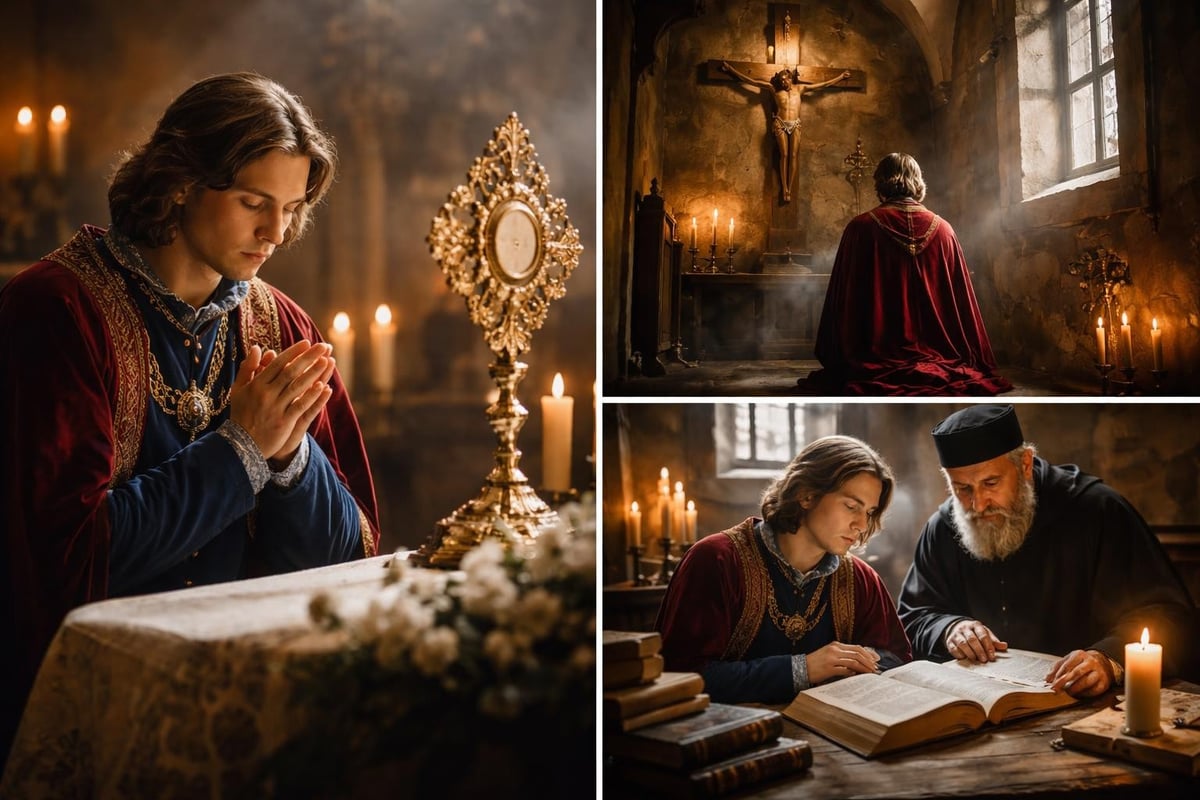
His commitment to celibacy and prayer became legendary throughout the kingdom. Courtiers noted his habit of spending long hours in chapel, often praying through the night before the Blessed Sacrament. He practiced severe penances, including sleeping on the floor and wearing a hair shirt beneath his royal garments.
For those seeking to deepen their understanding of the saints and their extraordinary virtues, the Catholic Saints Books collection offers comprehensive studies of how holy men and women throughout history discovered the path to sanctity.
Daily Life and Devotional Practices of Saint Casimir
The daily routine of saint casimir contrasted sharply with that of typical Renaissance princes. While others pursued hunting, feasting, and courtly entertainment, he structured his days around prayer and works of mercy. He attended Mass daily, often serving as an altar boy despite his royal status, demonstrating profound humility and reverence for the Eucharist.
Generosity to the Poor and Suffering
Saint Casimir's compassion for the poor became one of his defining characteristics. He regularly distributed alms from his personal funds and would slip out of the palace at night to visit the sick and destitute. When questioned about these nocturnal excursions, he explained that he was visiting "his friends," referring to Christ present in the suffering members of His Body.
His generosity extended beyond material assistance. He would sit with the afflicted, listening to their troubles and offering consolation. Witnesses reported that his presence brought comfort and peace, and many attributed healing graces to his prayers and intercession.
Key devotional practices of Saint Casimir:
- Daily Mass attendance and frequent reception of Holy Communion
- Extended periods of Eucharistic adoration
- Nightly prayer vigils before the Blessed Sacrament
- Regular recitation of the Divine Office
- Constant meditation on the Passion of Christ
- Deep devotion to the Blessed Virgin Mary
- Austere fasting and physical penances
- Distribution of alms to the poor
The Final Illness and Holy Death of Saint Casimir
In 1483, saint casimir was sent to Lithuania to serve as viceroy during his father's absence. This assignment placed significant governmental responsibilities on the young prince, who was approximately twenty-four years old. He approached these duties with the same integrity and justice that characterized his entire life, earning the respect and love of the Lithuanian people.
However, his health, weakened by years of rigorous fasting and penance, began to deteriorate. He developed a lung condition, likely tuberculosis, which progressively worsened. Despite his illness, he continued his devotional practices and administrative duties as long as he was physically able. The comprehensive account from EWTN details his final days.
The Death of a Young Saint
Saint Casimir died on March 4, 1484, in Grodno, Lithuania, at the age of twenty-five. His last words reportedly expressed his love for God and the Blessed Virgin Mary. As he had requested, a copy of the hymn "Omni Die Dic Mariae" was placed in his coffin. His body was transported to Vilnius and interred in the Chapel of Saint Casimir at Vilnius Cathedral.
Reports of miracles began immediately after his death. The sick were healed at his tomb, and many testified to receiving favors through his intercession. His incorrupt body, discovered during the canonization process, was viewed as a sign of his sanctity. The Church of St. Casimir in Vilnius became a major pilgrimage site and remains so today.
Canonization and Patronage of Saint Casimir
The process of canonization for saint casimir began remarkably quickly after his death, reflecting the widespread veneration he already enjoyed. Pope Leo X canonized him in 1521, recognizing his heroic virtue and the numerous miracles attributed to his intercession. This formal recognition confirmed what the faithful already believed: that the young Polish prince had achieved extraordinary sanctity.
Saint Casimir was declared the patron saint of Poland and Lithuania, reflecting his royal heritage and the territories he served. He is also invoked as patron of young people, particularly those struggling to maintain purity in challenging circumstances. His example provides powerful encouragement to youth facing pressure to compromise their moral convictions.
Saint Casimir's patronages include:
- Poland and Lithuania (national patron)
- Young people and youth
- Those defending chastity and purity
- Single laypeople committed to celibacy
- Royal families and princes
- Those suffering from lung diseases
| Feast Day | March 4 (date of death) |
|---|---|
| Canonization | 1521 by Pope Leo X |
| Tomb Location | Vilnius Cathedral, Lithuania |
| Symbols | Lily (purity), Crown, Cross |
| Incorrupt Body | Preserved in Vilnius |
Cultural Impact and the Kaziukas Fair Tradition
The veneration of saint casimir profoundly influenced Lithuanian culture, giving rise to unique traditions that continue to this day. The most notable is the Kaziukas Fair, an annual celebration held around his feast day of March 4th. This historic Kaziukas Fair began in the early seventeenth century and has become one of Lithuania's most important cultural events.
The fair originally served as a marketplace where craftsmen could sell their wares, particularly items associated with religious devotion such as rosaries, crosses, and holy cards. Today, it has expanded into a massive celebration of Lithuanian folk arts and crafts, attracting hundreds of thousands of visitors to Vilnius each year. The cultural significance of the Kaziukas Fair demonstrates how the saint's memory has been woven into national identity.
Religious Observances and Pilgrimages
Beyond the commercial aspects, the Kaziukas Fair period includes important religious observances. Special Masses are celebrated at Vilnius Cathedral, where pilgrims venerate the relics of saint casimir. Processions through the city streets recall his charitable works among the poor and his dedication to prayer.
Churches throughout Poland and Lithuania hold special services honoring their patron saint. Many young people make pilgrimages to his tomb, seeking his intercession for purity, vocational discernment, and strength to resist worldly temptations. The profile of Saint Casimir's spiritual legacy emphasizes his continued relevance for contemporary youth.
Lessons from Saint Casimir for Modern Catholics
The life of saint casimir offers profound lessons for Catholics navigating the complexities of twenty-first-century life. His unwavering commitment to moral principles despite intense family pressure resonates with those facing similar challenges today. In an age that often prioritizes personal advancement over ethical considerations, his refusal to pursue power through unjust means provides a powerful counter-witness.
His dedication to purity speaks directly to contemporary struggles with a hypersexualized culture. Saint Casimir demonstrates that chastity is not merely the absence of sin but a positive embrace of total self-gift to God. Young people seeking to live authentic Catholic sexual morality can find in him both a model and a powerful intercessor.
Practical Applications of His Virtues
Modern Catholics can imitate Saint Casimir by:
- Prioritizing prayer over productivity in daily schedules
- Standing firm on moral principles despite social pressure
- Practicing simplicity and detachment from material excess
- Serving the poor and marginalized in concrete ways
- Cultivating devotion to the Eucharist through daily Mass and adoration
- Honoring the Blessed Mother through consistent Marian devotion
- Embracing penance and self-denial as spiritual disciplines
The comprehensive collection of Catholic prayers available through Journeys of Faith provides resources for developing the kind of robust prayer life that characterized saint casimir's spirituality.

Saint Casimir and Eucharistic Devotion
Central to the spirituality of saint casimir was his profound reverence for the Blessed Sacrament. Historical accounts emphasize his practice of spending entire nights in prayer before the tabernacle, finding in the Eucharistic presence of Christ the strength to resist temptation and fulfill his duties. This devotion was not occasional but formed the foundation of his entire spiritual life.
His example challenges modern Catholics to recover a sense of awe and wonder before the Real Presence. In an era when many approach the Eucharist casually or receive Communion without proper preparation, saint casimir's intense reverence serves as a corrective. He understood that the Eucharist is not merely a symbol but the actual Body, Blood, Soul, and Divinity of Jesus Christ.
The educational perspective from Saint Mary's Press highlights how his Eucharistic devotion sustained all other aspects of his spiritual life. His commitment to purity, his generosity to the poor, and his courage in refusing unjust warfare all flowed from his intimate communion with Christ in the Blessed Sacrament.
For those seeking to understand the miraculous nature of the Eucharist and deepen their own devotion, the Miracles of the Eucharist books by Bob and Penny Lord document extraordinary Eucharistic miracles throughout Church history. These accounts of the Eucharist manifesting as actual flesh and blood reinforce the reality that saint casimir grasped so profoundly.
Invoking Saint Casimir's Intercession Today
Catholics facing particular challenges can invoke saint casimir's powerful intercession. His patronage of young people makes him especially relevant for teenagers and young adults navigating the pressures of modern culture. Parents concerned about their children's spiritual welfare often pray to saint casimir for protection and guidance.
Those struggling to maintain purity in thought and deed find in him both a model and an advocate. His own battles against temptation and his ultimate victory through grace demonstrate that heroic chastity is possible with God's help. He understands the difficulty of this path and intercedes powerfully for those who sincerely seek to follow it.
Prayer and Devotional Practices
Ways to honor and invoke Saint Casimir:
- Attend Mass on his feast day (March 4) and receive Communion in his honor
- Pray a novena to saint casimir for specific intentions, especially regarding purity and vocational discernment
- Read his biography to children and young people as an example of youthful sanctity
- Make a pilgrimage to Vilnius Cathedral if possible, or visit a church dedicated to him
- Support charitable works among the poor in his memory
- Practice Eucharistic adoration, following his example of prolonged prayer before the Blessed Sacrament
- Cultivate devotion to the Blessed Virgin Mary, whom he loved so dearly
The resources available at Journeys of Faith include prayer cards, books, and devotional materials that can support a deeper relationship with saint casimir and other holy role models. Understanding the lives of the saints provides inspiration and practical guidance for our own spiritual journeys.
Saint Casimir's Relevance to Contemporary Catholic Life
The witness of saint casimir speaks with particular urgency to the contemporary Church. At a time when Catholics face increasing pressure to conform to secular values, his example of standing firm on moral principles regardless of consequences provides essential encouragement. He demonstrated that authentic freedom comes not from following every desire but from disciplined pursuit of holiness.
His integration of contemplation and action offers a model for laypeople seeking to sanctify ordinary life. Saint Casimir was not a monk or priest but a prince engaged in governmental affairs, yet he maintained an intense spiritual life. This balance challenges the false dichotomy between worldly responsibility and deep prayer, showing that both can and must coexist.
The youthful age at which he died (twenty-five) reminds us that sanctity is not measured by years but by intensity of love. Many Catholics today live decades longer than saint casimir, yet the question remains: are we using our time to grow in holiness and serve God's purposes? His brief but luminous life challenges complacency and spiritual mediocrity.
Resources for Deepening Your Understanding
Explore these valuable resources to learn more about Saint Casimir and Catholic devotional life:
-
Explore Journeys of Faith online store with thousands of Catholic items at https://journeysoffaith.com/collections
-
Our Unique Mega Search Engine at https://journeysoffaith.com/search is linked to hundreds of Catholic shops and stores
-
Get the Journeys of Faith NEW App for iPhone or Android: Search for Journeys of Faith or go to https://journeysoffaith.com/pages/download-our-app
-
We need your help to reach more souls. Please make a donation at https://journeysoffaith.com/pages/donate
The commitment of saint casimir to evangelization through his personal witness mirrors the mission of Journeys of Faith in spreading the Gospel through media. Both recognize that authentic Catholic witness requires not just words but lived holiness that attracts others to Christ.
Those interested in exploring the broader communion of saints can find comprehensive resources through the Catholic shop guide that connects seekers with materials for deepening faith and devotion. Understanding saint casimir within the larger context of Catholic hagiography enriches our appreciation of his unique contributions.
Saint Casimir's brief life of twenty-five years demonstrates that holiness depends not on longevity but on fidelity to grace in each moment. His courage in refusing unjust warfare, his commitment to purity amid a corrupt court, and his profound devotion to the Eucharist and Blessed Mother offer a roadmap for contemporary Catholics seeking to live authentically Christian lives. Whether you're a young person discerning your vocation, a parent seeking role models for your children, or anyone struggling to maintain moral integrity in challenging circumstances, saint casimir's intercession and example provide powerful support. Journeys of Faith offers extensive resources to help you explore the lives of the saints and deepen your own spiritual journey through books, prayer materials, and educational content that brings the faith to life.