

Saint Katharine Drexel stands as one of the most remarkable figures in American Catholic history, a woman who transformed immense personal wealth into a lifetime commitment to serving the marginalized. Born into privilege in 1858, she chose a path of radical service that would establish educational institutions across the United States and ultimately lead to her canonization. Her story demonstrates how faith combined with action can create lasting change in society, making her an essential role model for Catholics seeking to live out their beliefs through service and compassion.
The Early Life of Saint Katharine Drexel
Born on November 26, 1858, in Philadelphia, Pennsylvania, Katharine Mary Drexel entered a world of considerable wealth and social prominence. Her father, Francis Anthony Drexel, was a prosperous investment banker whose family had established one of the most successful financial institutions in America. The Drexel family's fortune provided Katharine with opportunities most could only imagine, yet her parents ensured that privilege came with responsibility.
Her mother, Hannah Langstroth Drexel, died just five weeks after Katharine's birth, leaving a void that would be filled by her stepmother, Emma Bouvier Drexel. Emma proved instrumental in shaping Katharine's spiritual development and social consciousness. The Drexel household practiced what we might today call "faith in action," opening their home three days each week to distribute food, clothing, and assistance to the poor.
This early exposure to charitable work planted seeds that would later flourish into Katharine's life mission. The family's Catholic faith wasn't merely practiced on Sundays but lived daily through concrete acts of mercy and generosity. Katharine received a private education that emphasized not only academic excellence but also moral formation and social responsibility.
Education and Spiritual Formation
The Drexel sisters-Katharine, Elizabeth, and Louise-received instruction from private tutors who provided them with an education that rivaled any available to young women of their era. Beyond academics, their formation included extensive travel throughout the United States and Europe, exposing them to diverse cultures and deepening their understanding of the world beyond their privileged Philadelphia circles.
During these formative years, Katharine developed a deep devotion to the Eucharist and spent considerable time in prayer and contemplation. She maintained a rigorous prayer life that would sustain her through the challenges ahead. Her spiritual practices centered on daily Mass, meditation, and examination of conscience, disciplines that became the foundation of her religious vocation.
Awakening to Social Justice
The turning point in Saint Katharine Drexel's life came during a family trip to the Western United States in 1884 and 1885. There, she witnessed firsthand the devastating conditions faced by Native Americans living on reservations. The poverty, lack of educational opportunities, and systemic injustice shocked her conscience and demanded a response.
Katharine began corresponding with missionaries working among Native American populations, learning about their needs and challenges. She initially responded by providing financial support, funding mission schools and churches. However, she soon realized that money alone, while helpful, couldn't address the depth of need she had witnessed.
The Call to Religious Life
In 1887, during a private audience with Pope Leo XIII in Rome, Katharine asked the Holy Father to send missionaries to help Native Americans. His response changed her life: "Why not, my child, become a missionary yourself?" This challenge struck at the heart of her growing sense of vocation.
After returning to America and her father's death in 1885, Katharine inherited a vast fortune estimated at over $14 million-the equivalent of hundreds of millions in today's currency. Rather than pursuing a life of luxury or even traditional philanthropy, she felt increasingly called to consecrate herself entirely to God and to the service of those the world had forgotten.
| Key Life Events | Year | Significance |
|---|---|---|
| Birth | 1858 | Born into wealthy Drexel family |
| Western Trip | 1884-85 | Witnessed Native American poverty |
| Father's Death | 1885 | Inherited substantial fortune |
| Meeting Pope Leo XIII | 1887 | Received call to missionary work |
| Entered Religious Life | 1889 | Began formation with Sisters of Mercy |
| Founded New Order | 1891 | Established Sisters of the Blessed Sacrament |
Founding the Sisters of the Blessed Sacrament
In 1889, Saint Katharine Drexel entered the novitiate of the Sisters of Mercy in Pittsburgh to begin her religious formation. She spent two years in prayer, study, and preparation for the unique mission she felt called to establish. On February 12, 1891, she took her final vows and simultaneously founded a new religious congregation: the Sisters of the Blessed Sacrament for Indians and Colored People.
This new order combined two essential elements of Katharine's spirituality: devotion to the Blessed Sacrament and service to marginalized communities. The sisters would spend an hour daily in adoration before the Eucharist, drawing strength from Christ's real presence to fuel their demanding ministry. They committed themselves specifically to serving African Americans and Native Americans, populations facing severe discrimination and systemic barriers to education and advancement.
The name itself reflected Katharine's theological understanding. She believed that all people, regardless of race or social status, deserved dignity and opportunity because they were created in God's image and redeemed by Christ in the Eucharist. This sacramental vision drove her educational mission forward with unstoppable momentum.
Building Educational Institutions
Saint Katharine Drexel didn't merely fund schools from a distance. She personally oversaw the establishment of mission schools across the Western and Southwestern United States. By 1894, the Sisters of the Blessed Sacrament were operating schools in Santa Fe, New Mexico, and on reservations throughout the region.
- St. Catherine's Indian School in Santa Fe became a flagship institution
- Boarding schools on reservations provided education and stability for Native American children
- Parish schools in African American communities offered quality education previously unavailable
- Xavier University of Louisiana, founded in 1925, became the first Catholic university specifically for African Americans
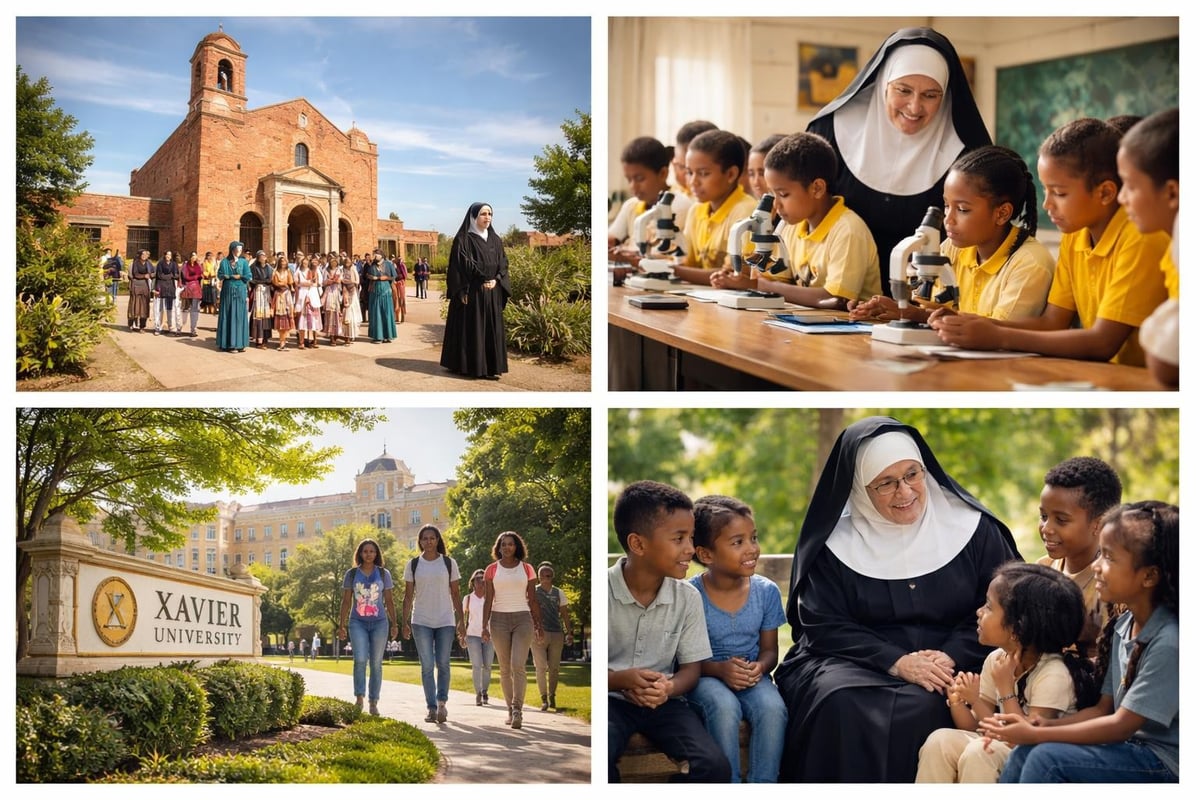
Xavier University represented the culmination of Katharine's educational vision. Located in New Orleans, it provided higher education opportunities to African American students during an era of rigid segregation. The university prepared teachers, pharmacists, nurses, and other professionals who would serve their communities with competence and dignity. The establishment of Xavier demonstrated how education could become a powerful tool for social transformation and justice.
Ministry During Jim Crow and Opposition
Saint Katharine Drexel's work occurred during one of the darkest periods of American racial history. The Jim Crow era enforced strict segregation, denied basic rights to African Americans, and subjected Native Americans to continuing dispossession and cultural destruction. Operating schools for these populations brought significant opposition, threats, and even violence.
In 1913, a mob threatened to burn down a school the sisters had opened in Beaumont, Texas. Community leaders objected to educating African American children, viewing it as a threat to the social order. Katharine responded not with retreat but with determination, working with local authorities and ultimately maintaining the school's operation.
Her approach to these challenges combined prudence with prophetic courage. She understood the dangers her sisters faced but refused to abandon those they served. She worked within legal frameworks when possible, challenged unjust laws when necessary, and maintained focus on the mission regardless of opposition.
Financial Stewardship and Sustainability
Managing her inherited wealth required careful stewardship. Saint Katharine Drexel personally administered her fortune, ensuring funds supported ongoing operations while establishing endowments for long-term sustainability. She lived simply despite her resources, modeling the poverty she professed as a religious sister.
By the time of her death, she had personally contributed over $20 million to her missionary work-nearly her entire inheritance. This wasn't reckless spending but strategic investment in institutions designed to outlast her. Schools built with her funds continued operating long after her passing, educating generations of students.
Spiritual Life and Eucharistic Devotion
The demanding nature of Saint Katharine Drexel's administrative and educational work could have overwhelmed her spiritual life, but she maintained rigorous devotional practices throughout her active years. Daily Eucharistic adoration remained non-negotiable, the source from which all her work flowed.
She wrote extensively about her spiritual experiences, leaving behind journals and letters that reveal a contemplative soul alongside the active missionary. Her writings emphasize themes of:
- Total surrender to God's will in all circumstances
- Trust in Divine Providence despite financial and logistical challenges
- Love for Christ present in the Blessed Sacrament
- Recognition of Christ in the poor and marginalized
Her spirituality integrated action and contemplation seamlessly. The hour before the Blessed Sacrament prepared her for hours of administrative work, teaching, and advocacy. She understood that authentic service required deep roots in prayer and sacramental life.
Those seeking to understand saint katharine drexel's approach to balancing contemplation and action can find inspiration in her commitment to both Eucharistic devotion and practical service. This integration remains her particular gift to the Church and offers a model for contemporary Catholics navigating similar tensions between prayer and ministry.
Journeys of Faith explores the remarkable journey of saint katharine drexel in their book Saints and Other Powerful Women in the Church, offering deeper insights into her spirituality and mission. This comprehensive resource examines how women of faith have shaped Catholic history through courage, determination, and unwavering commitment to the Gospel.
Later Years and Retirement
In 1935, at age 77, Saint Katharine Drexel suffered a severe heart attack that forced her retirement from active administration of her congregation. She spent the next twenty years in prayer and quiet contemplation at the motherhouse in Bensalem, Pennsylvania. These years of forced inactivity proved spiritually fruitful as she deepened her contemplative practices.
Rather than viewing retirement as diminishment, Katharine embraced it as a new phase of her vocation. She prayed for her sisters in the field, for the students in her schools, and for continued progress toward racial justice in America. Her physical limitations didn't end her contribution but shifted its form from active leadership to prayerful intercession.
Legacy and Continuing Mission
By the time of saint katharine drexel's death on March 3, 1955, her congregation had grown to more than 500 sisters operating 60 schools across 21 states. Xavier University had graduated thousands of African American professionals who were transforming their communities. The impact of her work extended far beyond what statistics could measure.
Her sisters continued expanding the mission after her death, adapting to changing educational needs while maintaining the founding charism of Eucharistic devotion and service to marginalized communities. The schools she established became centers of academic excellence and spiritual formation, proving that quality education combined with faith formation could overcome systemic barriers.
Canonization Process and Sainthood
The process toward recognizing Saint Katharine Drexel as a saint began relatively quickly after her death. In 1964, the Archdiocese of Philadelphia opened the cause for her canonization, gathering testimony about her life, virtues, and potential miracles. The investigation process examined her writings, interviewed those who knew her, and evaluated her impact on the Church and society.
Pope John Paul II beatified Katharine on November 20, 1988, recognizing her heroic virtue and declaring her "Blessed." This moved her one step closer to formal canonization as a saint. The beatification required verification of one miracle attributed to her intercession-the healing of a young boy's deafness in 1974.
Canonization as First American Saint Born in USA
On October 1, 2000, Pope John Paul II canonized Blessed Katharine Drexel as Saint Katharine Drexel during a ceremony at the Vatican. She became only the second American-born saint canonized by the Catholic Church and the first born a citizen of the United States. The canonization required verification of a second miracle-the healing of a young girl's nerve deafness in 1994.
| Canonization Milestones | Date | Event |
|---|---|---|
| Death | March 3, 1955 | Died at motherhouse in Bensalem, PA |
| Cause Opened | 1964 | Philadelphia Archdiocese begins investigation |
| Beatification | November 20, 1988 | Declared "Blessed" by John Paul II |
| Canonization | October 1, 2000 | Declared saint by John Paul II |
| Feast Day | March 3 | Celebrated annually on date of death |
The canonization Mass drew thousands of pilgrims, including many descendants of students who had attended schools founded by saint katharine drexel. Representatives from Native American tribes and African American communities participated, honoring a woman who had devoted her life to their advancement and dignity.
Relevance for Contemporary Catholics
Saint Katharine Drexel's example speaks powerfully to Catholics in 2026 facing questions about how to live faith authentically in a complex world. Her life demonstrates several principles that remain urgently relevant:
Integration of faith and action shows that authentic spirituality expresses itself through concrete service to others. Katharine didn't separate prayer from ministry but understood them as mutually reinforcing dimensions of Christian life. Her holistic approach offers a model for contemporary disciples.
Courage in confronting injustice marked her entire ministry. She didn't wait for society to become more accepting before serving marginalized communities. She acted on her convictions despite opposition, trusting that God would provide what was needed. This prophetic witness challenges Catholics today to examine where comfort and conformity may limit their witness.
Stewardship of resources demonstrated how wealth can be transformed into instruments of justice and mercy. Katharine could have lived luxuriously while supporting charitable causes. Instead, she gave everything, living as simply as the poorest sister in her congregation. Her example provokes reflection on how we use our own resources, whatever their extent.
Lessons for Racial Reconciliation
The commitment of saint katharine drexel to serving African American and Native American communities offers particular relevance as the Church continues addressing racism and working toward reconciliation. Her recognition that systemic injustice required systemic responses through education and institutional development provides a blueprint for contemporary efforts.
She understood that charity alone couldn't address structural inequalities. Education empowered individuals and communities to advocate for themselves and claim their rightful place in society. This insight remains crucial for anyone working toward justice in communities still experiencing the effects of historical discrimination.
Prayer and Intercession
Catholics seeking saint katharine drexel's intercession often pray for assistance with:
- Educational endeavors and academic success
- Work toward racial justice and reconciliation
- Financial needs and stewardship decisions
- Vocational discernment, especially to religious life
- Strengthening Eucharistic devotion
Prayer cards, novenas, and devotional materials featuring saint katharine drexel help the faithful connect with her example and seek her heavenly assistance. Many Catholics incorporate prayers to her in their regular devotional practices, particularly those involved in education or social justice ministries.
Her feast day on March 3 provides an annual opportunity to reflect on her life and legacy. Parishes, schools, and religious communities often celebrate with special Masses, educational programs, and service projects that honor her memory through action. These celebrations keep her witness alive and challenge new generations to embrace her vision of faith expressed through service.
The Drexel Fund and Continuing Mission
The Sisters of the Blessed Sacrament continue saint katharine drexel's mission today through the Drexel Fund, which supports educational initiatives serving underserved communities. While the congregation has decreased in numbers, its commitment to the founding charism remains strong through adapted ministries and partnerships.
Xavier University of Louisiana continues operating as a premier historically black Catholic university, maintaining the academic excellence and faith formation that saint katharine drexel envisioned. The university has produced more African American students who go on to medical school than any other institution in the United States, demonstrating the lasting impact of her educational vision.
Many schools founded by the Sisters of the Blessed Sacrament continue serving their communities under new leadership structures, carrying forward the mission while adapting to contemporary educational contexts. The institutions she established have touched hundreds of thousands of lives across multiple generations.
Reflections on Privilege and Service
One of the most striking aspects of saint katharine drexel's story is her willingness to exchange privilege for service. Born into one of America's wealthiest families, she could have enjoyed every luxury while practicing comfortable philanthropy from a distance. Instead, she chose radical identification with those she served.
This choice challenges contemporary Catholics to examine their own relationship to privilege, comfort, and service. Katharine's example suggests that authentic discipleship may require sacrifices that seem unreasonable by worldly standards. She trusted that what she gave up was infinitely less valuable than what she gained-intimate union with Christ and the joy of serving his beloved poor.
Her life also demonstrates that privilege itself isn't sinful but becomes problematic when hoarded or used only for personal benefit. Katharine transformed inherited advantages into opportunities for advancing God's kingdom and serving those whom society marginalized. This redemptive use of privilege offers a model for anyone blessed with resources, talents, or social position.
Educational Philosophy and Methods
Saint Katharine Drexel approached education holistically, recognizing that students needed formation in faith, character, and practical skills. Her schools combined rigorous academics with religious instruction and vocational training, preparing students for productive lives while nurturing their spiritual development.
She insisted on hiring qualified teachers and providing them with adequate resources, understanding that educational quality required investment and professionalism. Schools operated by the Sisters of the Blessed Sacrament maintained high standards while remaining accessible to students whose families couldn't afford tuition at other institutions.
The curriculum emphasized:
- Classical academics adapted to students' needs and contexts
- Catholic religious instruction and sacramental preparation
- Practical skills training for employment and self-sufficiency
- Cultural appreciation and identity formation
- Leadership development and civic responsibility
This comprehensive approach recognized students as whole persons with spiritual, intellectual, emotional, and practical needs. The educational model saint katharine drexel pioneered influenced Catholic education broadly and demonstrated how schools could become instruments of social transformation.
Global Influence and Recognition
While saint katharine drexel's work focused primarily on the United States, her example has inspired Catholics worldwide who work for justice and education in marginalized communities. Her canonization brought international attention to her life and mission, sparking renewed interest in her methods and spirituality.
Catholic educators, social justice advocates, and religious communities across multiple continents study her approach to combining contemplation with action, Eucharistic devotion with practical service. Her writings on spirituality and mission have been translated into multiple languages, extending her influence far beyond the American context where she ministered.
Various institutions worldwide have been named in her honor, including schools, parishes, and charitable organizations. These connections demonstrate how one woman's faithfulness in a particular time and place can generate ripples that extend across generations and geography.
Saint Katharine Drexel's extraordinary journey from wealth to religious life, from privilege to prophetic service, continues inspiring Catholics who seek to live their faith authentically and courageously. Her integration of Eucharistic devotion with practical action, her willingness to confront injustice despite opposition, and her strategic vision for educational transformation offer timeless lessons for disciples in every era. Journeys of Faith provides resources, books, and media that help Catholics discover the saints and deepen their own journeys of faith through the inspiring examples of holy men and women like Saint Katharine Drexel who transformed the world through grace-filled service.