

Saint Walburga stands as one of the most influential female missionaries of the 8th century, whose dedication to evangelization and education transformed the spiritual landscape of medieval Germany. Her remarkable life bridged cultures, combining English monastic traditions with Frankish spirituality to create lasting institutions of faith and learning. As we explore her legacy in 2026, her example continues to inspire Catholics worldwide through her unwavering commitment to spreading the Gospel, her miraculous intercessions, and her pioneering work as an abbess and scholar.
Early Life and Call to Mission
Born around 710 in Wessex, England, Saint Walburga came from a family deeply rooted in religious devotion. Her father, Saint Richard the Pilgrim, was a minor king, while her mother, Wuna, fostered a household centered on Christian values. This noble lineage provided Walburga with educational opportunities rare for women of her era.
Her two brothers, Willibald and Winibald, would also become saints, creating a remarkable family legacy of missionary work. The siblings shared a common vision of bringing Christianity to the Germanic peoples, inspired by the work of their relative, Saint Boniface, the Apostle of the Germans.

Education at Wimborne Abbey
Saint Walburga received her formation at the double monastery of Wimborne in Dorset, under the direction of Abbess Tetta. This institution educated both monks and nuns in separate quarters, providing rigorous training in scripture, liturgy, and the practical arts necessary for monastic life.
At Wimborne, Walburga mastered several essential skills:
- Latin scholarship for reading sacred texts and writing ecclesiastical documents
- Medical knowledge including herbalism and healing practices
- Monastic administration preparing her for future leadership roles
- Scriptural copying contributing to the preservation of sacred manuscripts
The comprehensive education she received at Wimborne positioned her as one of the most learned women of her generation. According to historical records, she became the first female author in England or Germany, though most of her writings have been lost to time.
Brought to you by Journeys of Faith, Founded by Bob and Penny Lord. We are Cyber Apostles and an Augustinian Secular Institute of which we are members; the Evangelization arm of the group of Cloistered Augustinian Nuns in Montefalco, Italy. Our Mission is Evangelization through Media using the tools that God has allowed to be created.
The German Mission
In 748, Saint Boniface summoned Saint Walburga to join the missionary efforts in Germany. This call represented a dangerous undertaking, as the region remained largely pagan with pockets of resistance to Christian evangelization. Walburga responded without hesitation, demonstrating the courage that would define her ministry.
The journey from England to the Continent required crossing the English Channel and traveling through territories where Christian faith was still establishing roots. Walburga's willingness to leave the security of her monastery reflected the same missionary zeal that drove countless saints to spread the Gospel to distant lands.
Establishing Monastic Communities
Upon arrival in Germany, Saint Walburga joined her brother Winibald at the double monastery of Heidenheim in present-day Bavaria. She served there for approximately two years before Winibald's death in 750, after which Bishop Boniface appointed her as abbess of the entire community, giving her authority over both the male and female religious.
This appointment was extraordinary for the 8th century, when women rarely held administrative power over male religious communities. The decision reflected both Boniface's recognition of Walburga's capabilities and the practical needs of the mission field, where qualified leaders were scarce.
Under her leadership, the monastery of Heidenheim flourished:
| Aspect | Achievement |
|---|---|
| Education | Established schools for children in the surrounding region |
| Healthcare | Created infirmaries serving both monastics and local populations |
| Agriculture | Developed productive farms that supported the community |
| Evangelization | Trained missionaries for work throughout Germania |
The monastery became a center of learning and spirituality, drawing visitors from across Europe. Saint Walburga's administrative skills ensured the community's economic sustainability while maintaining strict adherence to the Benedictine Rule.
Missionary Work and Conversion Efforts
Saint Walburga's missionary activities extended far beyond the monastery walls. She actively engaged with the local population, many of whom still practiced pagan customs inherited from their Germanic ancestors. Her approach combined patient catechesis with practical service, particularly in healthcare.
The Germanic peoples of the 8th century faced numerous challenges including disease, crop failures, and political instability. Saint Walburga addressed these needs through both spiritual ministry and temporal assistance, demonstrating how Christian charity could transform communities.
Methods of Evangelization
Saint Walburga employed multiple strategies to bring the Gospel to the German people:
- Direct preaching in public spaces and private homes
- Establishment of schools where children learned Christian doctrine alongside basic literacy
- Medical care that introduced Christian concepts of human dignity and charitable service
- Agricultural instruction that improved local farming techniques while building trust
- Training of local leaders who could continue evangelization after missionaries departed
Her methods emphasized relationship-building rather than coercion, allowing the faith to take root organically within communities. This patient approach, characteristic of the Benedictine tradition, created lasting conversions rather than superficial adherence.
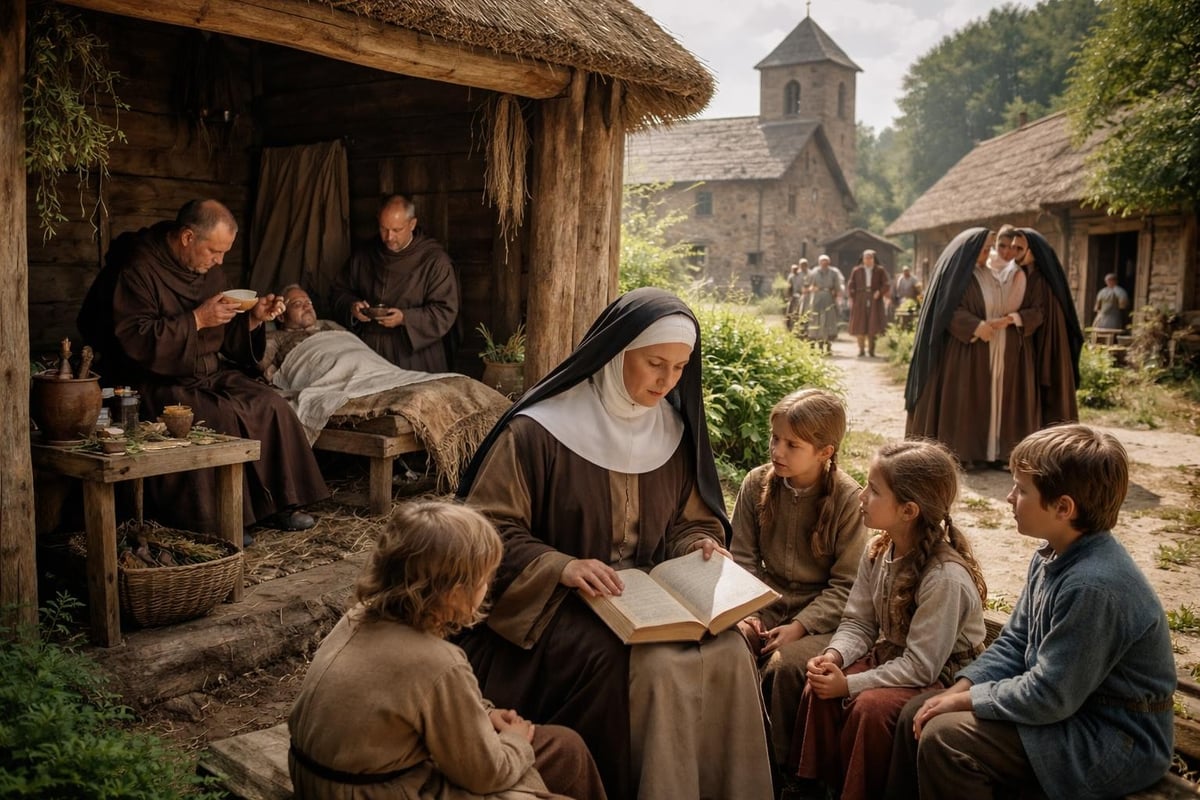
The Catholic Encyclopedia notes that her success in evangelization stemmed partly from her credibility as both an educator and healer, roles that commanded respect in Germanic society.
Miracles and Healing Ministry
Saint Walburga's reputation as a wonderworker grew during her lifetime and expanded dramatically after her death. Numerous accounts describe miraculous healings attributed to her intercession, particularly involving diseases affecting children and agricultural afflictions threatening crops.
The Miraculous Oil
The most famous miracle associated with Saint Walburga is the mysterious oil that flows from the rock near her relics. In 870, Bishop Otgar of Eichstätt translated her remains to the Church of the Holy Cross in Eichstätt, Bavaria. Shortly after this translation, a clear, watery liquid began seeping from the rock surrounding her tomb.
This substance, known as "Walburga oil" or "Walburgis oil," has continued to flow for over 1,100 years. The oil is collected annually on her feast day and distributed to pilgrims worldwide. Countless testimonies attribute healings and other graces to its use, particularly for:
- Diseases of the eyes and vision problems
- Ailments affecting children, especially fevers
- Complications during pregnancy and childbirth
- Agricultural problems, including pest infestations
- Spiritual afflictions and demonic oppression
The Abbey of St. Walburga maintains detailed records of graces attributed to the oil, continuing a tradition of documentation spanning centuries.
Patronage and Intercession
Saint Walburga serves as patron saint of numerous causes:
| Patronage | Reason |
|---|---|
| Farmers | Her prayers protected crops from blight and pests |
| Sailors | Miracles during sea voyages attributed to her intercession |
| Expectant mothers | Assistance during difficult pregnancies and deliveries |
| Those suffering from rabies | Historical accounts of healing this feared disease |
| Against storms | Protection from severe weather through her prayers |
Many Catholic families discover inspiration through studying the lives of saints like Walburga, recognizing that these holy men and women provide authentic role models for living the faith today.
Feast Day and Walpurgis Night
The feast day of Saint Walburga is celebrated on February 25, commemorating the date her relics were translated to Eichstätt. However, another date associated with her has acquired significant cultural meaning: May 1, the anniversary of her death in 779.
The Walpurgis Night Phenomenon
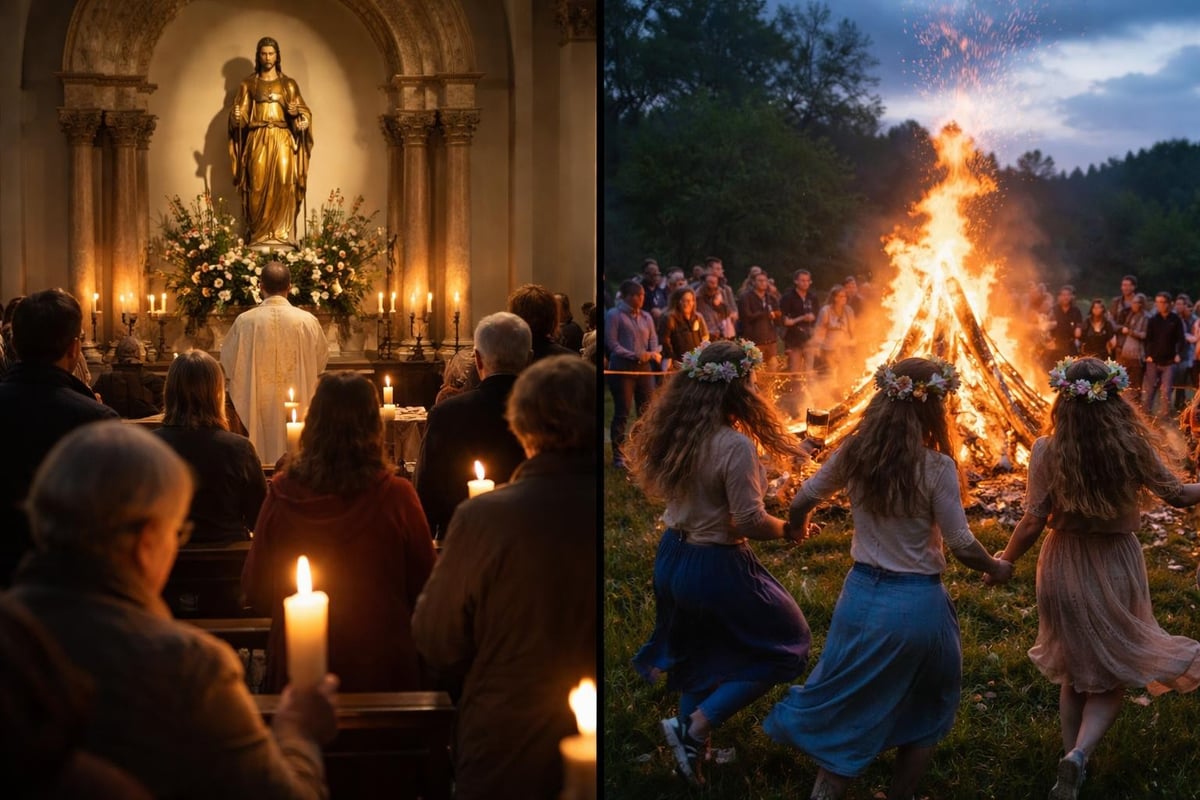
The night of April 30 to May 1, known as Walpurgis Night, developed complex associations in Germanic culture. Originally a Christian vigil before the feast of Saint Walburga's translation, it became intertwined with pre-Christian spring festivals celebrating the end of winter.
This convergence created fascinating cultural dynamics:
- Christian communities held prayer vigils honoring the saint
- Pagan traditions of spring celebrations merged with Christian observances
- Folk beliefs about witches and supernatural activity became associated with the night
- Modern celebrations range from purely secular festivals to devout religious observances
The phenomenon demonstrates how Christian evangelization in medieval Europe often incorporated and transformed existing cultural practices rather than simply eliminating them. Saint Walburga's feast became a focal point for this cultural synthesis.
Legacy in Monastic Life
Saint Walburga's influence on monastic life extends far beyond the communities she personally established. Her example as an abbess governing both male and female religious provided a model for double monasteries throughout medieval Europe.
The Benedictine Tradition
As a faithful follower of the Rule of Saint Benedict, Walburga exemplified the Benedictine motto "Ora et Labora" (Prayer and Work). Her monasteries balanced contemplative prayer with active service to surrounding communities, creating sustainable models of religious life.
The educational emphasis at her monasteries anticipated later developments in Catholic schooling. By teaching children from the surrounding regions, these institutions planted seeds of faith that would grow for generations. This commitment to education reflects the broader Catholic understanding that evangelization requires both proclamation and formation.
Modern Benedictine communities continue to draw inspiration from her example. The Abbey of St. Walburga in Colorado maintains her charism of contemplative prayer combined with productive work, operating a ranch and producing liturgical items while maintaining a rigorous prayer schedule.
Saint Walburga in Art and Devotion
Throughout the centuries, artists have depicted Saint Walburga in various forms, typically showing her as an abbess holding a crozier and sometimes accompanied by symbols of her miraculous powers.
Common iconographic elements include:
- A book representing her scholarship and role as an author
- Three ears of wheat symbolizing her patronage of farmers
- A container of oil referencing the miraculous fluid from her relics
- A church or monastery indicating her role as abbess and founder
- A ship commemorating her sea voyage to Germany
These visual representations help the faithful connect with her story and invoke her intercession. The tradition of sacred art serves as a form of visual catechesis, teaching the faith through images that communicate theological truths and historical realities.
Devotional practices honoring Saint Walburga remain strong in Bavaria and other regions of Germany, where pilgrimages to Eichstätt continue annually. Pilgrims seek her intercession for healing, protection, and spiritual growth, maintaining a living tradition of devotion that spans more than twelve centuries.
Relevance for Modern Catholics
The example of Saint Walburga speaks powerfully to Catholics in 2026, addressing contemporary challenges with timeless spiritual wisdom. Her life demonstrates several principles crucial for modern evangelization.
Evangelization Through Service
Saint Walburga understood that authentic evangelization requires more than verbal proclamation. She served the practical needs of communities while sharing the Gospel, demonstrating Christian love through tangible assistance. This integrated approach remains essential for effective evangelization today.
Modern Catholics can learn from her example by:
- Combining social service with explicit faith witness
- Addressing both material and spiritual poverty
- Building relationships based on mutual respect and genuine care
- Demonstrating Christian charity through concrete actions
- Maintaining credibility through consistent ethical conduct
The methods she employed translate directly to contemporary mission work, whether in traditionally Christian regions experiencing secularization or in areas where Christianity remains a minority faith.
Women in Leadership
Saint Walburga's authority as abbess over both male and female religious challenges simplistic narratives about women's roles in Church history. While the Catholic Church maintains theological distinctions regarding ordained ministry, history reveals numerous examples of women exercising significant spiritual authority and administrative leadership.
Her example encourages modern Catholic women to:
- Pursue excellence in education and professional development
- Serve the Church according to their unique gifts and calling
- Exercise leadership in appropriate contexts with confidence
- Contribute to theological reflection and spiritual writing
- Mentor younger generations in faith and virtue
The Church benefits immensely when women's gifts are fully recognized and utilized within the appropriate structures of ecclesial life.
Perseverance in Mission
The missionary work of Saint Walburga required decades of patient effort. She did not see immediate mass conversions but rather gradually built communities of faith through consistent witness and service. This patience contrasts sharply with contemporary expectations for rapid results.
Modern evangelization efforts require similar long-term commitment:
| Challenge | Saint Walburga's Approach | Modern Application |
|---|---|---|
| Cultural resistance | Patient relationship-building | Authentic friendships before evangelization |
| Limited resources | Sustainable community development | Stewardship and prudent planning |
| Physical dangers | Courage rooted in prayer | Spiritual preparation for mission work |
| Isolation from home | Strong faith community | Supportive networks for missionaries |
Her example reminds us that authentic transformation takes time and that faithful presence matters more than immediate success.
Saint Walburga and Catholic Prayer Life
Incorporating Saint Walburga into personal prayer enriches Catholic devotional life. Her intercession can be sought through traditional prayers or spontaneous petitions addressing her areas of patronage. Those interested in deepening their Catholic prayers often discover that invoking specific saints creates meaningful connections to the communion of saints.
A traditional prayer to Saint Walburga asks for her intercession in times of illness, danger, or spiritual struggle. Many families maintain devotion to her through novenas, especially when facing challenges related to her patronage.
The practice of seeking saintly intercession reflects core Catholic theology about the communion of saints. Those who have gone before us in faith remain active participants in the Church's life, praying for us and supporting our spiritual journey. Saint Walburga's ongoing intercession, evidenced by the continued flow of oil from her relics and the testimonies of those helped through her prayers, confirms this theological truth.
The Benedictine Charism Today
Saint Walburga lived the Benedictine charism with particular excellence, demonstrating how the Rule of Saint Benedict creates balanced, fruitful Christian living. Her life embodied key Benedictine values including stability, conversion of life, obedience, hospitality, and the sanctification of work.
Modern Catholics, whether formally Benedictine or not, can incorporate these values:
- Stability: Commitment to particular communities rather than constant searching for ideal circumstances
- Conversion of life: Ongoing spiritual growth through daily fidelity to prayer and virtue
- Obedience: Listening attentively to God's will and responding generously
- Hospitality: Welcoming others as Christ himself
- Sacred work: Transforming ordinary tasks into acts of worship
These principles offer an antidote to contemporary fragmentation and restlessness. By following Saint Walburga's example of stable, committed service, Catholics can build sustainable spiritual lives that bear lasting fruit.
The Benedictine emphasis on balance between prayer and work, solitude and community, tradition and adaptation provides wisdom for navigating modern complexity. Saint Walburga's successful integration of contemplative depth with active ministry demonstrates this balance in practice.
Continuing Her Mission in 2026
The evangelization work begun by Saint Walburga continues today through various means. Catholic media organizations play crucial roles in spreading the Gospel using contemporary tools, much as Walburga used the available means of her era-personal presence, education, and service-to bring others to Christ.
Organizations like Journeys of Faith carry forward this mission by making Catholic resources accessible to wider audiences. Through books, media, and digital platforms, modern evangelizers reach people who might never encounter the faith through traditional parish structures alone.
The principles that guided Saint Walburga's mission remain constant even as methods evolve:
- Authentic witness grounded in personal holiness
- Integration of faith with practical service
- Patient, relationship-based evangelization
- Excellence in education and formation
- Commitment to the long-term transformation of cultures
These timeless principles guide effective evangelization whether in 8th-century Germany or 21st-century America. By studying the lives of saints like Walburga, contemporary Catholics gain both inspiration and practical wisdom for their own missionary efforts.
Saint Walburga's extraordinary life as missionary, abbess, educator, and healer demonstrates the transformative power of faithful witness across cultures and centuries. Her example challenges modern Catholics to embrace evangelization with courage, patience, and creativity, adapting methods while maintaining the unchanging truth of the Gospel. Journeys of Faith supports your spiritual journey through comprehensive Catholic resources, helping you discover and share the treasures of our faith just as Saint Walburga did centuries ago.
- Explore Journeys of Faith Online store with thousands of Catholic Items at https://journeysoffaith.com/collections
- Our Unique Mega Search Engine https://journeysoffaith.com/search is linked to hundreds of Catholic Shops and Stores.
- Get the Journeys of Faith NEW App for IPhone or Android Search for Journeys of Faith or go to https://journeysoffaith.com/pages/download-our-app
- We need your help to reach more souls. Please Make a Donation https://journeysoffaith.com/pages/donate