

Roman Catholicism is the Christian tradition led by the Pope and the bishops in communion with him, rooted in the teaching of Jesus Christ and handed down through the apostles. Catholics believe in one God in three Persons, in Christ's real presence in the Eucharist, and in a Church that carries the fullness of the faith through Scripture, Tradition, and the sacraments.
This article walks through what Catholics hold to be true, how the faith is lived and prayed, and why its devotions to Mary and the saints matter. It is written for those who pray the rosary and novenas and want to understand the teaching behind their devotion.
Brought to by Journeys of Faith Founded and Bob and Penny Lord - We are an Augustinian Secular Institute - Cyber Apostles - Our Mission is Evangelization through Media.
What Is the Catholic Religion?
The Catholic religion is the faith of the Catholic Church, which holds that Jesus Christ founded one Church on the apostles, with Peter as its visible head, and that this Church has continued without interruption to the present day. The word "Roman" points to the Bishop of Rome, the Pope, who is regarded as Peter's successor and the visible sign of unity among Catholics worldwide.
At its center is a person, not a system of rules. Catholics believe God entered human history in Jesus, who died and rose again to reconcile humanity with the Father. The Church exists to make that saving work present in every age through teaching, worship, and charity.
The faith is summarized in the Creed, recited at Sunday Mass. It affirms belief in God the Father, the Son, and the Holy Spirit, in the forgiveness of sins, the resurrection of the body, and life everlasting. The Catechism of the Catholic Church organizes these teachings into four parts: the Creed, the liturgy and sacraments, the moral life, and Christian prayer.
Core Beliefs of Roman Catholicism
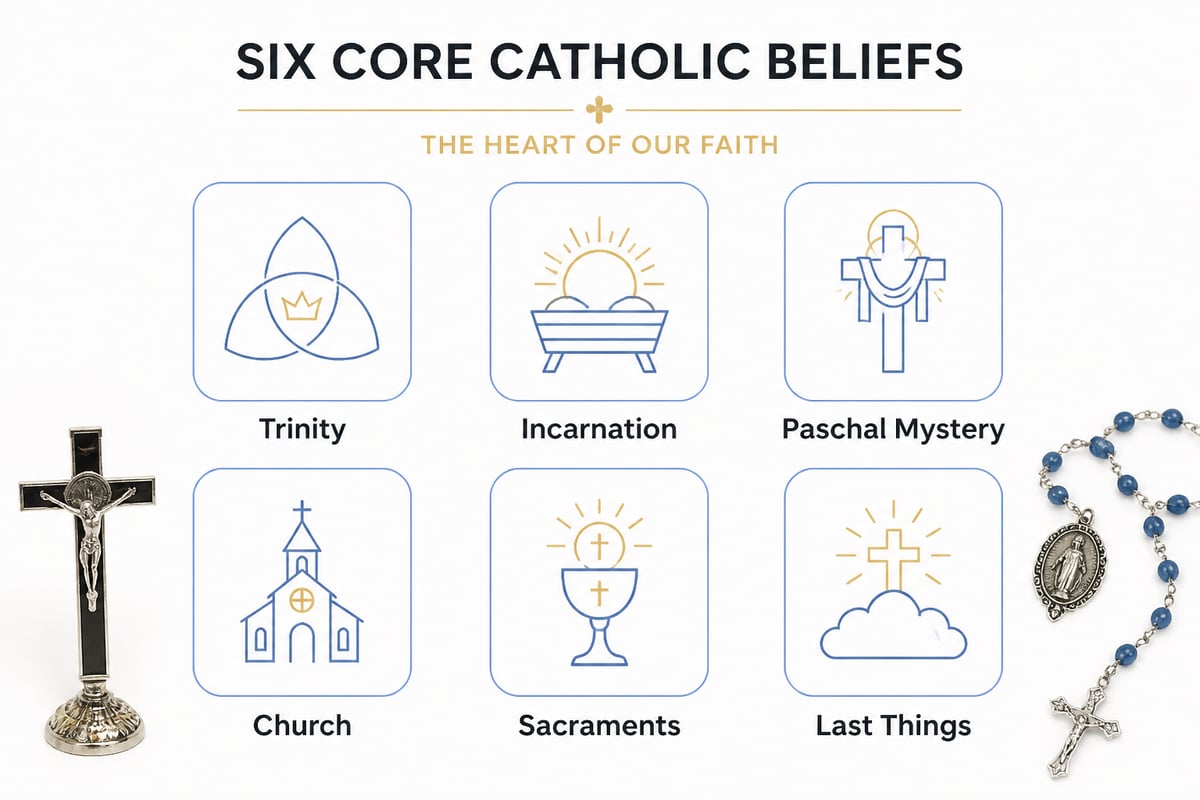
The core beliefs of roman catholicism center on the Trinity, the Incarnation, the Church, the sacraments, and eternal life. Each rests on divine revelation, which Catholics receive through both Scripture and Tradition.
- The Trinity: One God in three divine Persons, Father, Son, and Holy Spirit, equal and eternal.
- The Incarnation: The Son of God became man in Jesus, fully divine and fully human.
- The Paschal Mystery: Christ's passion, death, and resurrection win salvation for all who accept it.
- The Church: One, holy, catholic, and apostolic, guided by the Holy Spirit and the teaching office of the Pope and bishops.
- The Sacraments: Visible signs instituted by Christ that give grace.
- Last Things: Death, judgment, heaven, hell, and purgatory, followed by the resurrection of the body.
Catholics also hold that grace and human cooperation work together. Faith is a gift, yet it is expressed through works of mercy, prayer, and obedience to God's commandments.
Scripture and Sacred Tradition
Catholics believe God's revelation comes through two connected sources: Sacred Scripture and Sacred Tradition, both interpreted authentically by the Church's teaching office, called the Magisterium. Scripture is the written Word of God, containing the books of the Catholic canon. Tradition is the living transmission of the apostles' teaching through worship, creeds, and the writings of the Church Fathers.
This is why Catholics do not treat the Bible as standing apart from the community that compiled and preserved it. The Church, guided by the Holy Spirit, recognized which writings belong in the canon, and it continues to explain how they apply to new questions.
Doctrine develops without changing in substance. A teaching such as the divinity of Christ was defined clearly at the early ecumenical councils in response to confusion, yet it expressed what the apostles already believed. Councils and papal definitions clarify; they do not invent.
The Seven Sacraments
The Catholic Church recognizes seven sacraments: Baptism, Confirmation, Eucharist, Penance, Anointing of the Sick, Holy Orders, and Matrimony, as set out in the Catechism of the Catholic Church. Catholics understand these as encounters with Christ, who acts through visible signs to give invisible grace.
| Category | Sacraments |
|---|---|
| Initiation | Baptism, Confirmation, Eucharist |
| Healing | Penance, Anointing of the Sick |
| Service of communion | Holy Orders, Matrimony |
The Catechism calls the Eucharist the "Sacrament of sacraments," to which all the others are ordered. Baptism, Confirmation, and Holy Orders also confer an indelible spiritual character, which is why they cannot be repeated.
The Eucharist and the Mass
The Eucharist is the sacrament in which Catholics believe bread and wine become the Body and Blood of Christ, a change the Church calls transubstantiation. The Mass has two main parts: the Liturgy of the Word, with readings and a homily, and the Liturgy of the Eucharist, which makes Christ's sacrifice present on the altar.
Belief in the Real Presence has been strengthened for many Catholics by accounts of Eucharistic miracles recorded in various places over the centuries. Journeys of Faith has produced materials on these events, including a Lanciano Eucharistic miracle minibook and the Miracles of the Eucharist book series.
Confession and Reconciliation
Catholics confess serious sins to a priest because they believe Christ gave the apostles authority to forgive sins in his name. The sacrament, also called Penance or Reconciliation, includes contrition, confession, absolution, and satisfaction. The Church explains the names and meaning of the sacrament in the Catechism section on Penance and Reconciliation.
Mary in Catholic Teaching
Catholics honor Mary as the Mother of God, because the child she bore is truly God, and as the first and model disciple. The Church teaches that she was conceived without original sin, remained a virgin, and was assumed body and soul into heaven at the end of her earthly life.
Catholic devotion to Mary is not worship. The Church distinguishes between adoration, which belongs to God alone, and veneration, which honors those closest to Christ. Marian prayer always leads to her Son, as in the rosary, which meditates on the mysteries of Jesus's life through Mary's eyes.
Approved Marian apparitions, including Guadalupe, Lourdes, and Fatima, have shaped Catholic devotion for centuries. Readers wishing to study them can turn to The Many Faces of Mary or the Fatima Family Handbook.
Saints and the Communion of Saints
Catholics ask the saints to pray for them for the same reason they ask a friend to pray: the Church believes death does not sever the bond among believers in Christ. This is the communion of saints, the union of the faithful on earth, those being purified, and those in heaven.
Praying to saints is not praying to statues. Images remind the faithful of real people whose lives show what grace can do. Canonization is the Church's declaration that a person lived heroic virtue and is in heaven, and it follows a rigorous investigation that includes evidence of miracles.
Many Catholics choose patron saints for particular needs, such as Saint Peregrine for cancer or Saint Michael for protection. A fuller overview can be found in this guide to saints in the Roman Catholic Church.
Catholic Prayer and Devotional Life
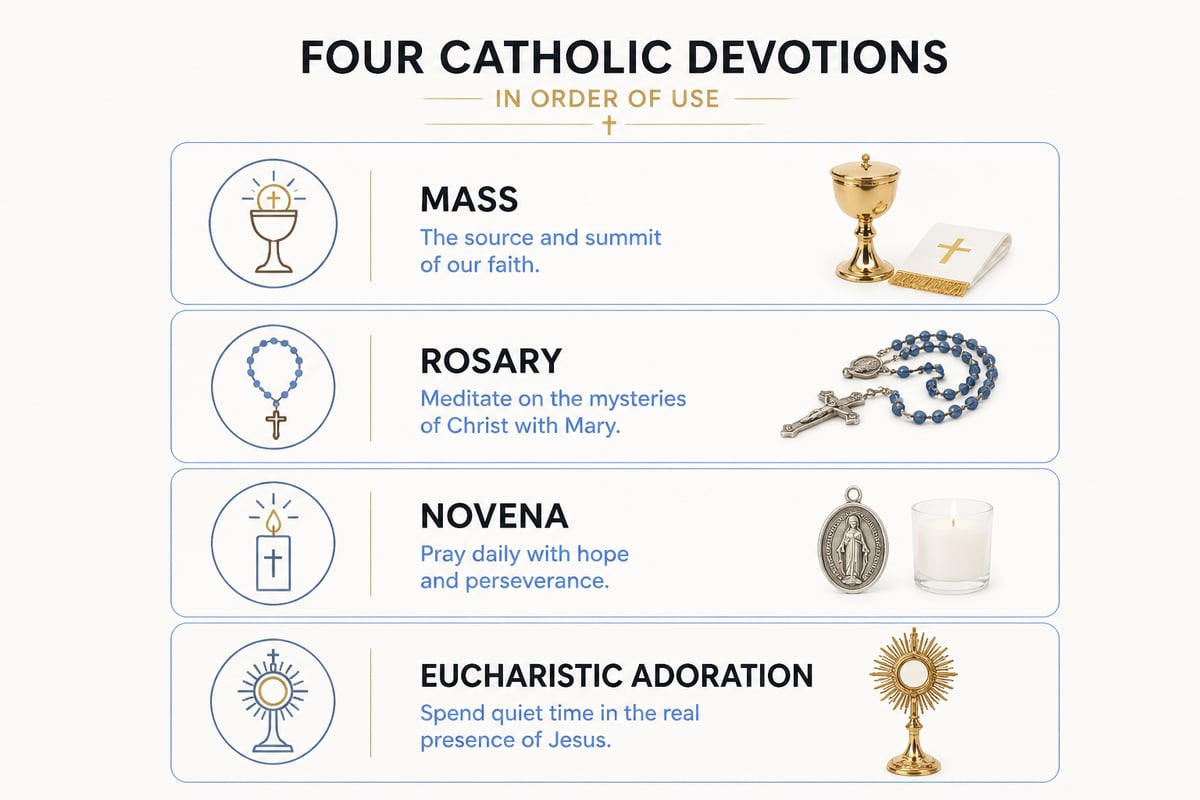
Catholic prayer ranges from the Mass, the Church's highest prayer, to personal devotions such as the rosary, novenas, and the Liturgy of the Hours. The Catechism describes prayer as the raising of the mind and heart to God, and the tradition offers structure for those who want to pray daily.
Common devotions include:
- The rosary: The rosary guides meditation on the joyful, sorrowful, glorious, and luminous mysteries.
- Novenas: Nine days of prayer, recalling the apostles' prayerful waiting with Mary between the Ascension and Pentecost.
- The Our Father: The prayer Jesus taught, central to every Mass and rosary.
- Eucharistic adoration: Silent prayer before the Blessed Sacrament.
Sacramentals, such as crucifixes, medals, holy cards, and rosaries, support prayer by reminding Catholics of Christ, Mary, and the saints. They carry no power in themselves; they dispose the heart to pray and to trust in God.
Journeys of Faith offers crucifixes, rosaries, and medals, including Miraculous Medals and saints' medals, that many Catholics carry or keep in the home as aids to daily prayer.
How the Catholic Church Gained Its Influence
The Church grew from a small community in Jerusalem into a worldwide institution through martyrdom, missionary work, and the conversion of the Roman Empire. Christians faced persecution for several centuries, yet the faith spread. Emperor Constantine's legalization of Christianity opened a new era, and later the empire made it its official religion.
After Rome's fall in the West, bishops and monasteries preserved learning, founded schools and hospitals, and mediated between rival rulers. Benedictine monasteries, for example, became centers of agriculture, copying of manuscripts, and prayer. The papacy gained moral and political weight as the one institution that endured.
Influence also brought failures, which the Church has acknowledged: corruption in some periods, entanglement with political power, and the divisions of the Reformation. Catholic renewal followed, notably through the Council of Trent and the founding of new orders such as the Jesuits. The Second Vatican Council (1962 to 1965) later addressed the Church's relationship with the modern world.
Roman Catholicism Around the World
Catholicism is the largest Christian communion, with roughly 1.39 billion Catholics at the end of 2022, according to Agenzia Fides. Latin America remains home to the largest share of Catholics.
Brazil, Mexico, and the Philippines have long been among the countries with the largest Catholic populations. Devotion looks different across cultures: Our Lady of Guadalupe in Mexico, the Santo Niño in the Philippines, and Eucharistic processions in Europe all express one faith in varied ways.
Was G. K. Chesterton a Roman Catholic?
Yes. G. K. Chesterton, the English writer known for his Father Brown mysteries and for Orthodoxy, converted to the Catholic Church. His later books defended Catholic teaching with wit and clarity.
Learning More and Growing in the Faith
Understanding roman catholicism is a lifelong project, and the Church offers many entry points. Reading the Gospels, attending Mass, and praying the rosary build a foundation. Biographies of the saints show doctrine lived out, and books on Eucharistic miracles and Marian apparitions help many Catholics deepen devotion.
For a practical starting path, this overview on learning about Catholicism is a useful companion. Those drawn to novenas can begin with the Surrender Novena collection, which pairs a short, focused prayer with daily trust in God's providence.
FAQ
Do Catholics worship Mary and the saints?
No. Catholics worship God alone, offering Mary and the saints veneration, which is honor and a request for prayer. The saints are understood as friends in Christ who intercede, never as sources of divine power.
Who started the Catholic Church?
Catholics believe Jesus Christ founded the Church on the apostles, with Peter as its first leader, as described in Matthew 16:18. The Pope is regarded as Peter's successor in an unbroken line of bishops of Rome.
What is the difference between Catholic and Roman Catholic?
The terms refer to the same Church. "Roman Catholic" is often used to distinguish the Church in communion with the Pope from other Christian bodies that use the word "catholic," while Catholics usually simply say "Catholic."
A good next step is to choose one devotion, such as a daily decade of the rosary or a nine-day novena, and pray it consistently for a month. Journeys of Faith, founded by Bob and Penny Lord, is a Catholic media company dedicated to evangelization through books, DVDs, and religious items on the Eucharist, Mary, and the saints. You can start with its crucifixes, rosaries, and medals, then explore the full range at the Journeys of Faith online store, which carries thousands of Catholic items, and Shop now to find the resources that will support your prayer life. Journeys of Faith is blessed to provide Catholic media, including podcasts and inspirational content, free of charge across multiple media platforms for viewers and listeners around the world. While access to this content remains free, there are significant and continually increasing costs associated with producing, hosting, and distributing these programs. Your support helps us continue sharing the beauty of the Catholic faith with souls. Please make a donation.
