

The Catholic Church has preserved and venerated sacred objects, spiritual gifts, and divine graces for over two millennia. These treasures of the church encompass far more than material artifacts displayed in museums or cathedrals. They represent a profound theological reality that connects believers across time and space, offering channels of grace, inspiration for faith, and tangible links to the saints who have gone before us. Understanding these treasures requires exploring both their physical manifestations and their deeper spiritual significance within Catholic tradition.
The Dual Nature of Church Treasures
The treasures of the church exist on two interconnected planes: the material and the spiritual. Physical treasures include relics of saints, sacred art, liturgical vessels, ancient manuscripts, and architectural wonders that have inspired generations of faithful. These tangible items serve as sacramentals, directing our hearts and minds toward the divine. The spiritual treasures, however, represent the infinite merits of Christ, the prayers and sacrifices of Mary, and the good works of all the saints, forming what theology calls the "treasury of the Church."
This distinction matters because both categories work together. A beautiful monstrance used for Eucharistic adoration is valuable not merely for its gold and jewels, but because it holds the greatest treasure of all: the Body of Christ. Similarly, a first-class relic of a saint connects us to that holy person's prayers and intercession, drawing us into the communion of saints.
Material Treasures Through History
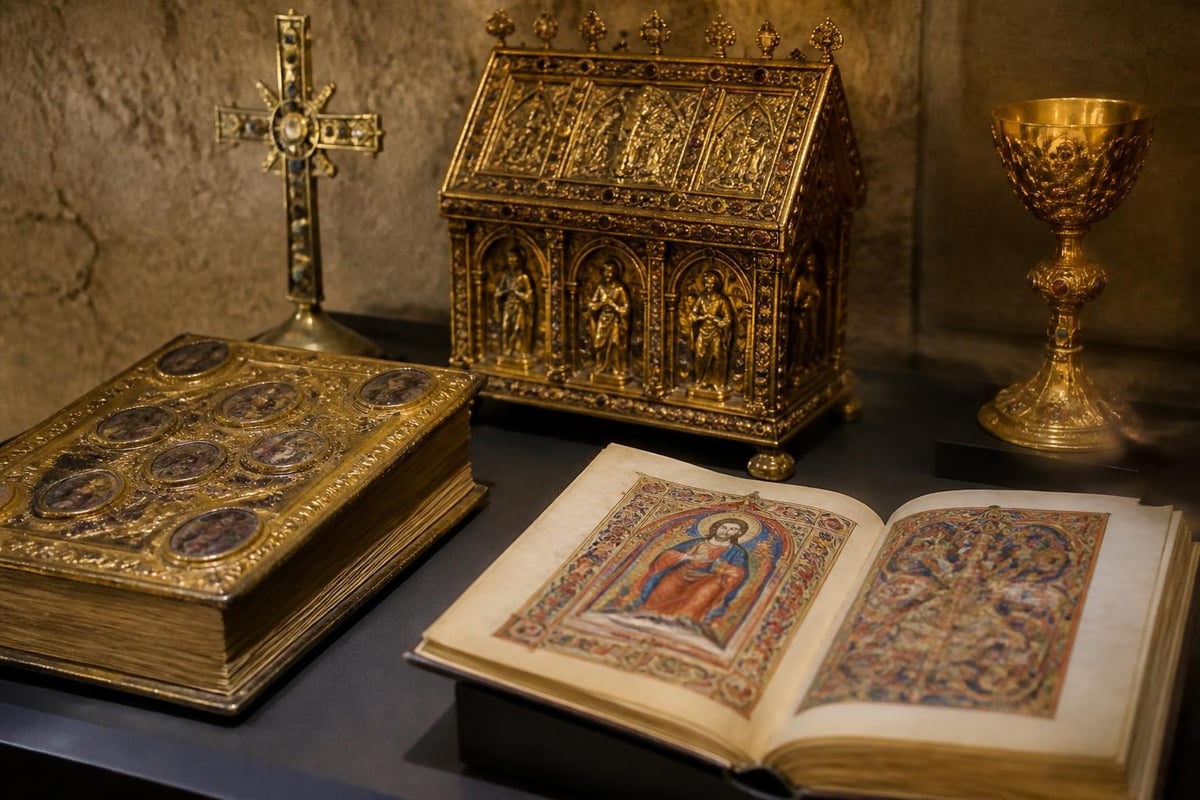
Throughout the centuries, the Church has carefully preserved objects of profound religious significance. Medieval church treasuries housed reliquaries, chalices, Gospel books adorned with precious metals and gems, and vestments embroidered with gold thread. These items were not displays of wealth for its own sake but expressions of the medieval understanding that the most beautiful objects should serve God's worship.
The Metropolitan Museum of Art's examination of medieval church treasuries reveals how these collections reflected theological priorities. Reliquaries shaped like body parts contained the remains of martyrs and saints, while ornate crosses and chalices transformed the Mass into a foretaste of heavenly liturgy.
Brought to you by Journeys of Faith, founded by Bob and Penny Lord. We are an Augustinian Secular Institute, Cyber Apostles. Our Mission is Evangelization through Media.
Relics as Sacred Connections
First-class relics, which are physical remains of saints, represent some of the most treasured possessions of Catholic parishes and institutions worldwide. The veneration of relics dates to the earliest Christian centuries when believers gathered at the tombs of martyrs to celebrate Mass. This practice emphasized the communion of saints and the belief that holy persons remain spiritually present and active after death.
Second-class relics include items the saint wore or used regularly, while third-class relics are objects touched to a first-class relic. Each category carries significance because of its connection to someone who lived heroic virtue. The practice of venerating relics is not worship, which belongs to God alone, but rather veneration, honoring the saint and asking for their intercession.
| Relic Classification | Definition | Examples |
|---|---|---|
| First-Class | Physical remains of a saint | Bones, hair, tissue |
| Second-Class | Items owned or used by saint | Clothing, books, tools |
| Third-Class | Objects touched to first-class relic | Medals, prayer cards, cloth |
The Role of Relics Today
Modern Catholics continue this ancient practice. Churches display relics in beautiful reliquaries, often processing them through streets during feast days. The Vatican's Apostolic Penitentiary regularly grants plenary indulgences for venerating relics during special exhibitions, recognizing how these sacred objects draw believers closer to Christ through the saints.
Many faithful keep small relics in their homes or carry third-class relics as reminders of particular saints' protection. This practice connects contemporary believers with centuries of tradition, making the treasures of the church accessible in daily life.
The Spiritual Treasury and Indulgences
Beyond physical objects, the Church teaches about a spiritual treasury composed of the infinite merits of Christ's passion, the prayers of Mary, and the surplus good works of all the saints. This concept underpins the Catholic understanding of indulgences, which draw from this treasury to remit temporal punishment due to sin.
The Apostolic Constitution on indulgences from Pope Paul VI explains this doctrine clearly. When the Church grants an indulgence, she applies graces from this spiritual treasury to help souls either on earth or in purgatory. The treasury grows continually as the faithful perform good works in union with Christ.
Understanding Indulgences Properly
The Council of Trent's decree on indulgences addressed abuses while reaffirming the legitimate practice. An indulgence is not a permission to sin or a purchase of forgiveness, but rather the Church's application of spiritual treasures to remove the temporal consequences of already-forgiven sins.
- Partial indulgences reduce some temporal punishment
- Plenary indulgences remove all temporal punishment when specific conditions are met
- Conditions typically include sacramental confession, Communion, prayer for the Pope's intentions, and detachment from all sin
The faithful can gain indulgences for themselves or offer them for souls in purgatory, exercising the communion of saints through the Church's spiritual treasures.
Sacred Art and Architecture
The treasures of the church include masterpieces of art and architecture that have shaped Western civilization. From the mosaics of Ravenna to Michelangelo's Sistine Chapel ceiling, from Romanesque basilicas to soaring Gothic cathedrals, Catholic artistic heritage inspires believers and nonbelievers alike.
These works were created as acts of devotion, using the best materials and techniques available. Artists understood their work as prayer made visible, offering beauty to God and instructing the faithful. Medieval cathedrals served as "books in stone," teaching biblical narratives and theological truths to illiterate populations through sculpture, stained glass, and architectural symbolism.
The Educational Function of Sacred Art
Icons, particularly in Eastern Catholic traditions, are considered "windows to heaven" that make spiritual realities present. The strict iconographic rules ensure theological accuracy, as these images are meant to teach doctrine as much as inspire devotion.
Stations of the Cross installed in churches worldwide guide believers through Christ's passion, turning buildings into pilgrimage sites. This artistic devotion transforms architecture into a treasure that facilitates prayer.
Liturgical music, from Gregorian chant to polyphonic masses by Renaissance composers, represents another artistic treasure. These compositions were created for divine worship, elevating minds and hearts toward God through beauty.
Eucharistic Treasures
The greatest of all treasures of the church is the Eucharist itself, the Real Presence of Jesus Christ in the consecrated bread and wine. All other treasures pale in comparison to this sacrament, which contains not merely grace but the Author of grace himself.
Bob and Penny Lord's work documenting Eucharistic miracles has helped countless Catholics appreciate this central treasure. Their comprehensive research into miraculous hosts that have turned to flesh and blood demonstrates God's desire to strengthen our faith in the Real Presence. The Miracles of the Eucharist books provide detailed accounts of these extraordinary events throughout history.

Eucharistic adoration allows the faithful to spend time before this supreme treasure. Monstrances, often ornate works of sacred art, display the consecrated Host for veneration, combining material and spiritual treasures in a single devotional practice.
Safeguarding Eucharistic Reverence
Churches maintain tabernacles of precious materials to house the Blessed Sacrament, recognizing that the container should reflect the value of what it holds. The sanctuary lamp burns constantly before the tabernacle, signaling Christ's presence and representing our continual prayer.
Corpus Christi processions carry the Eucharist through streets, publicly honoring this treasure and inviting communities to worship Christ present among them. These traditions maintain the Church's understanding that her greatest treasure deserves the highest honor.
| Eucharistic Element | Purpose | Significance |
|---|---|---|
| Tabernacle | Reserving the Blessed Sacrament | Christ's dwelling among us |
| Monstrance | Exposing Host for adoration | Making the invisible visible |
| Sanctuary Lamp | Indicating Real Presence | Symbol of eternal vigilance |
| Ciborium | Holding consecrated hosts | Vessel of sacred dignity |
Marian Treasures and Devotions
The Church's treasures include profound devotion to Mary, the Mother of God, whose unique role in salvation history places her above all other saints. Marian shrines around the world preserve memories of her apparitions, house miraculous images, and serve as pilgrimage destinations for millions annually.
Our Lady of Guadalupe's tilma in Mexico City, bearing the miraculous image that converted millions of indigenous peoples, represents a treasure both artistic and spiritual. Scientific examination has found no explanation for the image's creation or preservation, pointing to divine origin.
The Rosary itself is a spiritual treasure, a meditation on the mysteries of Christ's life through Mary's eyes. This prayer combines Scripture, traditional prayers, and contemplation into a powerful devotional practice that has sustained Catholics through persecution, war, and personal trials. Those interested in exploring Marian apparitions throughout history will find rich resources documenting these encounters.
Miraculous Images and Icons
Our Lady of Czestochowa, the Black Madonna of Poland, has weathered wars and invasions while remaining a symbol of Polish Catholic identity. The painting's history intertwines with the nation's survival, making it both an artistic and patriotic treasure.
Our Lady of Perpetual Help, an ancient Byzantine icon, inspires devotion worldwide. The image's theological richness, showing Mary presenting Christ while angels display instruments of the Passion, teaches profound truths about redemption and Mary's role in salvation.
Saints as Living Treasures
The communion of saints represents an inexhaustible treasury of inspiration, intercession, and example. Each canonized saint offers unique gifts to the Church: spiritual writings, charitable works, theological insights, or simple holiness lived in ordinary circumstances.
Doctor of the Church saints like Teresa of Ávila, Thomas Aquinas, and Catherine of Siena left theological treasures in their writings. These works continue guiding believers toward deeper understanding of God and spiritual growth.
Martyrs throughout the centuries demonstrated that faith is worth dying for, their blood becoming, in Tertullian's phrase, "the seed of the Church." Their courage in persecution strengthens believers facing contemporary challenges to faith.
- Confessor saints showed holiness in daily life
- Virgin saints witnessed to consecrated celibacy
- Married saints demonstrated sanctity in family life
- Religious founders established orders serving specific needs
Accessing Saintly Wisdom
The lives of the saints offer practical wisdom for modern challenges. Reading their biographies, studying their writings, and imitating their virtues allows contemporary Catholics to draw from these treasures. Resources that compile information about Catholic saints make this wisdom accessible to believers seeking guidance.
Prayer cards depicting saints serve as portable reminders of these holy intercessors. Carrying an image of a particular saint keeps their example fresh in mind throughout daily activities, turning the treasures of the church into practical spiritual tools.
Liturgical and Devotional Objects
The Church's treasury includes countless objects designed for worship and devotion. These range from simple wooden rosaries to elaborate chalices encrusted with gems, from printed prayer cards to illuminated medieval manuscripts.
Vestments worn by clergy during Mass follow specific liturgical colors and designs, each element carrying symbolic meaning. The chasuble, stole, and other garments transform the priest into a visible representation of Christ, the Great High Priest.
Sacred vessels used in the Mass, including the chalice for wine and paten for bread, must meet specific requirements regarding materials and construction. These standards reflect the Church's recognition that objects touching the Eucharist deserve special reverence.
Personal Devotional Items
Crucifixes make the central mystery of faith visible in homes, churches, and public spaces. The variety of crucifixes, from simple wooden crosses to elaborate corpus designs, allows individuals to choose representations that speak to their devotional needs.
Holy water fonts in homes remind families of their baptismal covenant. The practice of blessing oneself with holy water connects daily life to the sacramental grace received at baptism.
Medals, scapulars, and holy cards serve as sacramentals, objects blessed by the Church to prepare believers for grace and dispose them toward cooperation with divine action. These small items make the treasures of the church portable and accessible.
Preserving and Sharing Church Treasures
The responsibility to preserve these treasures falls on each generation of believers. Physical conservation requires expertise in art restoration, climate control, and security. Museums and church archives employ specialists to ensure these objects survive for future generations.
Digital preservation now allows unprecedented access to manuscript collections, sacred art, and architectural treasures. Online databases catalog relics, making it possible to learn about saints and locate their remains for veneration.
Education about the treasures of the church ensures their continued relevance. When believers understand the theology, history, and devotional practices associated with these treasures, they can participate more fully in the Church's rich tradition.
Making Treasures Accessible
Pilgrimages to sites housing important treasures allow personal encounter with these sacred objects. Visiting the relics of favorite saints, praying before miraculous images, or celebrating Mass in historic basilicas deepens faith through embodied experience.
Traveling exhibitions bring treasures to wider audiences. When relics tour parishes or sacred art exhibits visit local museums, they democratize access to objects usually housed in distant locations.
Publications and media about church treasures fulfill an important educational mission. Books, documentaries, and online resources help believers appreciate what they might never see in person. Organizations dedicated to Catholic media and evangelization play a crucial role in this educational work.
The Treasury of Merits in Practice
Understanding the spiritual treasury helps Catholics appreciate practices that might otherwise seem confusing. The doctrine of the communion of saints means that no good deed is wasted. Every prayer, sacrifice, and act of charity performed in grace contributes to the Church's spiritual wealth.
Vicarious suffering, when united with Christ's passion, holds redemptive value. Saints who offered their sufferings for souls in purgatory or for sinners exercised this understanding of the spiritual treasury, knowing their pain could draw on and contribute to the Church's store of merit.
Indulgenced prayers and practices allow believers to access these spiritual riches systematically. The Church designates certain prayers, devotions, and good works as particularly meritorious, attaching specific indulgences to their performance under the right conditions.
This theological framework transforms individual spiritual efforts into participation in the Church's corporate life. Personal holiness enriches the whole Body of Christ, while struggling believers can draw strength from the treasury accumulated by more advanced saints.
The treasures of the church, both material and spiritual, connect contemporary believers with two millennia of faith, devotion, and grace. These sacred objects, spiritual practices, and theological realities provide channels through which God's grace flows to His people, enriching the Church's mission and strengthening individual faith. Whether you seek to deepen your understanding of Eucharistic miracles, explore the lives of the saints, or access resources for spiritual growth, Journeys of Faith offers books, prayer cards, and media that bring these treasures within reach. Explore the Journeys of Faith online store with thousands of Catholic items to discover resources that will enrich your faith journey. Journeys of Faith is blessed to provide Catholic media, including podcasts and inspirational content, free of charge across multiple media platforms for viewers and listeners around the world. While access to this content remains free, there are significant and continually increasing costs associated with producing, hosting, and distributing these programs. Your support helps us continue sharing the beauty of the Catholic faith with souls. Please make a donation to support this vital work of evangelization through media.
Journeys of Faith
Explore the Church's Greatest Treasures
Deepen your faith with books, minibooks, and media from Bob and Penny Lord — documenting Eucharistic miracles, Marian apparitions, the lives of the saints, and the sacred heritage of the Catholic Church.
Founded by Bob and Penny Lord · Augustinian Secular Institute · Cyber Apostles
Evangelization through Media — serving the Church since 1981
