Skip to product information
1 of 5

Eucharistic Miracles Minibook

Eucharistic Miracles Minibook

Regular price $14.00 USD
Regular price Sale price $14.00 USD
Sale Sold out
Shipping calculated at checkout.

FREE Shipping for all orders over $50 -- We have graduated discounts automatically  applied up to 67% when you add to cart. --- 20% off orders over $50 --- 25% off orders over $75 --- 30% off orders over $100 --- 35% off orders over $150 --- 5%Cash Back Store Credit on all orders

CHECKOUT TIPS 1. Discounts are applied automatically! 3. Pay with credit card or Express Pay

Four Miracles of the Eucharist is a printed 64-page Catholic minibook by Bob and Penny Lord, published by Journeys of Faith. It presents four well-known Eucharistic miracles in a concise format designed for personal study, parish groups, Eucharistic Revival reading, and classroom use.

  • Covers four documented miracle accounts: Lanciano, Bolsena-Orvieto, Cascia, and Siena
  • Printed minibook pamphlet format for easy reading, travel, and group discussion
  • Explains the connection between Bolsena-Orvieto and the Feast of Corpus Christi
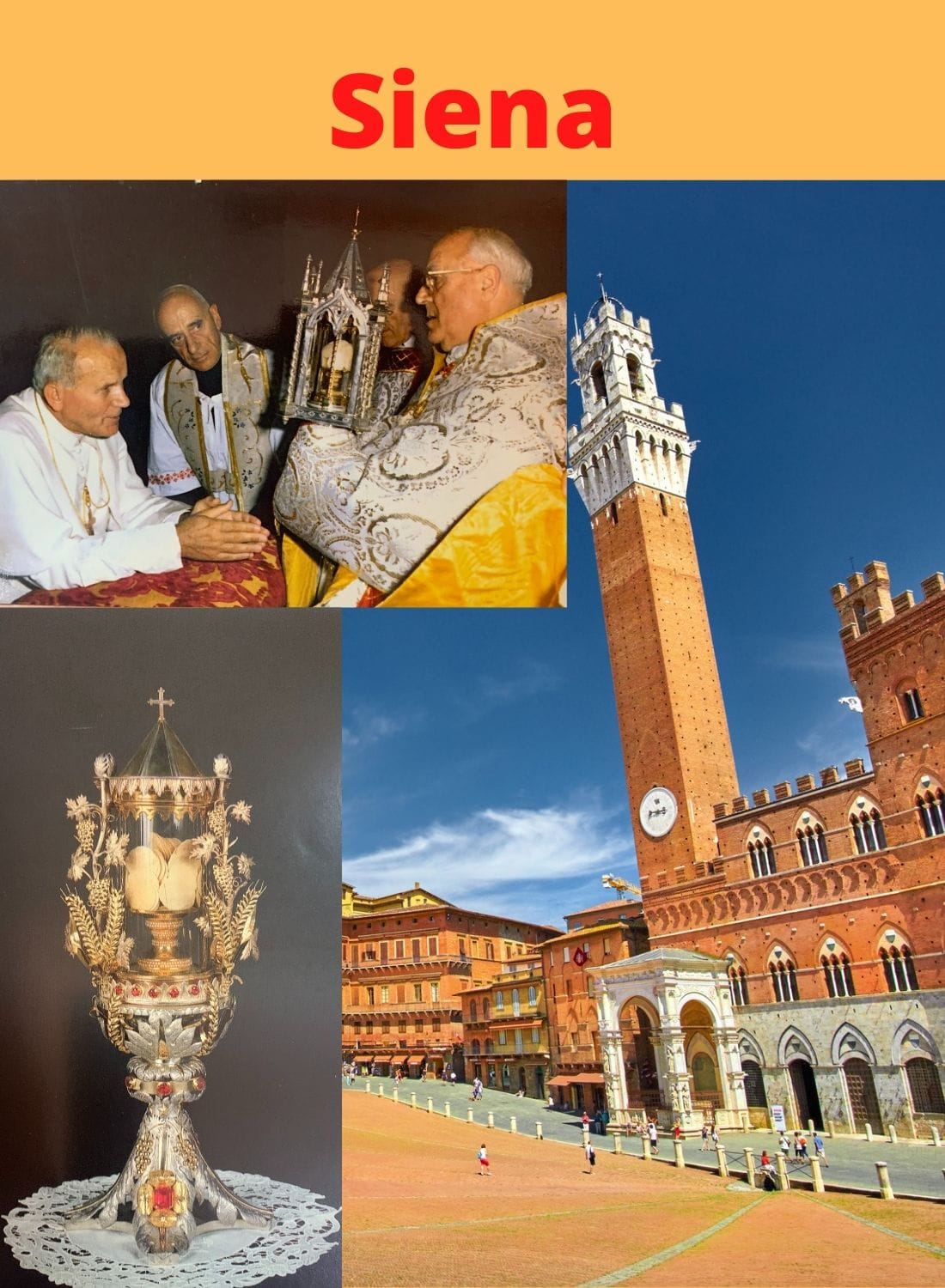
  • Includes the Siena miracle noted for incorrupt Hosts preserved over centuries
  • Useful for CCD classes, retreats, prayer groups, and Eucharistic Adoration formation

Unlike a full-length theological text, this minibook gives a focused introduction to Eucharistic miracles and the Catholic teaching on the Real Presence. Readers can use it for confirmation preparation, adult faith formation, sacramental study, or as a Catholic gift for someone seeking a clearer understanding of Eucharistic devotion.

The booklet highlights the Miracle of Lanciano, often cited as the oldest recorded Eucharistic miracle still preserved; the Miracle of Bolsena-Orvieto, associated with the origin of the Feast of Corpus Christi; the Miracle of Cascia; and the Miracle of Siena, where the Hosts remained incorrupt in their original state after 276 years. This makes it a practical resource for Catholics looking for a compact, citable overview of major Eucharistic miracle traditions.

View full details

Frequently Asked Questions

The best Eucharistic miracles books depend on how much detail you want and how you plan to use them. If you want a short, approachable introduction, a printed booklet or minibook is often better than a large reference volume because it highlights key miracles without overwhelming the reader. Four Miracles of the Eucharist Minibook is designed for that purpose. It is a 64 page printed minibook by Bob and Penny Lord that focuses on four well known Eucharistic miracles: Lanciano, Bolsena-Orvieto, Cascia, and Siena. This format is especially useful for parish study groups, Eucharistic Revival reading, personal prayer, and readers who want a starting point before moving into larger collections. It works well for Catholics interested in the Real Presence and for those looking for a compact teaching resource. The main tradeoff is scope. Because it covers four miracles rather than a large global list, it is better for focused learning than for someone seeking an encyclopedic survey of every reported Eucharistic miracle.
A good beginner resource on Eucharistic miracles should be clear, faithful, and easy to finish. A short printed minibook is often ideal because it gives enough historical and devotional context to start meaningful study without requiring a major time commitment. Four Miracles of the Eucharist Minibook fits that need well. It presents four major Eucharistic miracles in a 64 page printed format, making it manageable for individual reading, prayer groups, CCD discussion, and parish Eucharistic Adoration preparation. It is especially helpful for readers who want to understand how specific miracles have supported Catholic belief in the Real Presence. The miracles included are Lanciano, Bolsena-Orvieto, Cascia, and Siena, each of which is well known in Catholic devotional life. This resource is best for beginners, adult faith formation, and those returning to the faith. If you need a scholarly study with extensive documentation of many cases, a larger academic or reference work may be a better next step after reading a concise introduction like this.
The Eucharistic miracles most commonly featured in Catholic books and study materials are usually the best documented and most widely recognized in Catholic tradition. Four of the most frequently discussed are Lanciano, Bolsena-Orvieto, Cascia, and Siena. Four Miracles of the Eucharist Minibook centers on those exact cases, which makes it a useful snapshot of the miracles many Catholics first encounter when studying the Real Presence. Lanciano is often highlighted as one of the oldest recorded Eucharistic miracles still present today. Bolsena-Orvieto is closely connected with the origin of the Feast of Corpus Christi and the Eucharistic hymns associated with St. Thomas Aquinas. Cascia is remembered for the bleeding Host and the image formed on the pages of a breviary. Siena is known for the incorrupt Hosts preserved over centuries. This kind of focused selection benefits readers who want the foundational stories most often referenced in Catholic teaching and devotion. The limitation is that it does not attempt to cover every Eucharistic miracle from every country or century.
Yes, this minibook can be a good alternative if you want a focused introduction rather than a large catalog. A book covering 100 Eucharistic miracles offers broad scope and can be helpful for deep research or long term study. Four Miracles of the Eucharist Minibook takes the opposite approach. It concentrates on four major miracles that are especially important in Catholic devotion and Eucharistic teaching: Lanciano, Bolsena-Orvieto, Cascia, and Siena. That makes it a strong choice for readers who prefer a shorter format, for parish handouts, or for those beginning Eucharistic study during personal prayer or adoration. Because it is 64 pages, it is easier to complete and discuss than a much larger reference work. It is also practical for group settings where participants need a concise text. The tradeoff is breadth. If your goal is to survey many miracles from different countries and eras, a larger compilation may serve you better. If your goal is to understand a few major miracles clearly and devotionally, this minibook is a better fit.
Eucharistic miracles are not all presented in the same way, and not every case centers on scientific testing. Some miracles are discussed through historical records, eyewitness testimony, preservation of sacred objects, and their long standing place in Catholic tradition. Others are known partly because later examinations drew attention to unusual physical details. Four Miracles of the Eucharist Minibook is best understood as a Catholic devotional and educational resource rather than a scientific report. It focuses on four famous miracles that support belief in the Real Presence: Lanciano, Bolsena-Orvieto, Cascia, and Siena. Readers looking for faith formation, Eucharistic devotion, and historical introduction will benefit most from this booklet. It is especially suitable for parish study, personal reflection, and discussion during Eucharistic Revival efforts. If your main goal is laboratory analysis, medical documentation, or comparative scientific review of many miracles, you may want an additional specialized source. This minibook is stronger as a concise introduction to the spiritual and historical significance of major Eucharistic miracles.
A printed Eucharistic miracles minibook and an online Eucharistic miracles website serve different needs. Websites are useful for browsing many cases quickly, searching by country or saint, and viewing material on demand. A printed minibook is often better for focused reading, prayerful study, classroom use, and discussion without digital distraction. Four Miracles of the Eucharist Minibook is a 64 page printed pamphlet that presents four major miracles in a curated, manageable format. Its main advantage is clarity and concentration. Instead of sorting through a large database, the reader receives a guided introduction to Lanciano, Bolsena-Orvieto, Cascia, and Siena. That makes it especially helpful for Catholic adults, prayer groups, CCD classes, and parish leaders who want a compact teaching tool. The tradeoff is coverage. A website may include many more miracles and multimedia materials, while this minibook focuses only on four. For many readers, the best approach is to use a concise printed resource first, then explore broader online materials if they want a wider survey.
Four Miracles of the Eucharist Minibook covers four major Eucharistic miracles: Lanciano, Bolsena-Orvieto, Cascia, and Siena. These are among the most recognized miracles connected with Catholic belief in the Real Presence of Jesus in the Eucharist. Lanciano is presented as the oldest recorded Miracle of the Eucharist still present today. Bolsena-Orvieto is especially important because it is linked to the Feast of Corpus Christi and the Eucharistic hymns associated with St. Thomas Aquinas, including O Salutaris and Tantum Ergo. Cascia recounts the miracle involving a priest who had lost his love for the Eucharist and the bleeding Host that marked the pages of a breviary. Siena is known for the incorrupt Hosts that remained in their original state over many years. This selection makes the minibook most useful for readers who want a solid introduction to some of the best known Eucharistic miracles rather than a broad catalog of many lesser known cases.
This Eucharistic miracles minibook is best for Catholics who want a concise, readable introduction to major Eucharistic miracles. It is especially suitable for personal devotional reading, Eucharistic Adoration preparation, adult faith formation, CCD support, prayer groups, and parish study during Eucharistic Revival efforts. Because it is a 64 page printed minibook, it is accessible for readers who may not want to begin with a large or highly academic volume. It is also a good fit for those seeking a resource centered on belief in the Real Presence. The four miracles included, Lanciano, Bolsena-Orvieto, Cascia, and Siena, are among the most meaningful and frequently discussed in Catholic teaching and devotion. This minibook may be less ideal for someone looking for a full global directory of Eucharistic miracles, advanced scholarly analysis, or a heavily illustrated coffee table style book. Its strength is focused, practical formation. For many readers, that makes it a very effective first step before exploring more extensive books, documentaries, or research collections.
A printed Eucharistic miracles minibook is often better for slow reading, group discussion, note taking, and prayerful reflection, while a DVD or video can be stronger for visual presentation and shared viewing. The best choice depends on how you plan to use it. Four Miracles of the Eucharist Minibook is a printed 64 page resource, so it works well for readers who want to study at their own pace or use the material in a parish, school, or small group setting. Printed material is especially helpful when participants need something easy to carry, revisit, highlight, or discuss section by section. It also works well in quiet devotional settings such as before or after Adoration. A video format can be more engaging for audiences who learn visually or for event based presentations. If your goal is structured reading and conversation, this minibook is the better fit. If your goal is showing a group a visual presentation, a video may be more effective. Many ministries use both formats together for complementary learning.
Catholics read about Eucharistic miracles to deepen faith in the Real Presence, learn how the Church has remembered extraordinary signs, and strengthen devotion to the Eucharist. For many people, these stories are not a substitute for faith or Church teaching, but a way to reflect more seriously on what happens at Mass. A booklet like Four Miracles of the Eucharist Minibook helps by presenting a focused set of major miracles in a short, approachable format. This minibook covers Lanciano, Bolsena-Orvieto, Cascia, and Siena, four cases often discussed in Catholic devotional life and Eucharistic formation. Because it is printed and concise at 64 pages, it is practical for individual reading, parish study, and prayer group discussion. It gives readers a manageable way to engage with important Eucharistic miracle traditions without starting with a very large reference work. It is most helpful for Catholics seeking spiritual reflection and foundational learning. Readers who want exhaustive historical research on many miracles may eventually want to supplement it with larger studies.