Skip to product information
1 of 4

St. Augustine Confessions

St. Augustine Confessions

Regular price $23.95 USD
Regular price Sale price $23.95 USD
Sale Sold out
Shipping calculated at checkout.

FREE Shipping for all orders over $50 -- We have graduated discounts automatically  applied up to 67% when you add to cart. --- 20% off orders over $50 --- 25% off orders over $75 --- 30% off orders over $100 --- 35% off orders over $150 --- 5%Cash Back Store Credit on all orders

CHECKOUT TIPS 1. Discounts are applied automatically! 3. Pay with credit card or Express Pay

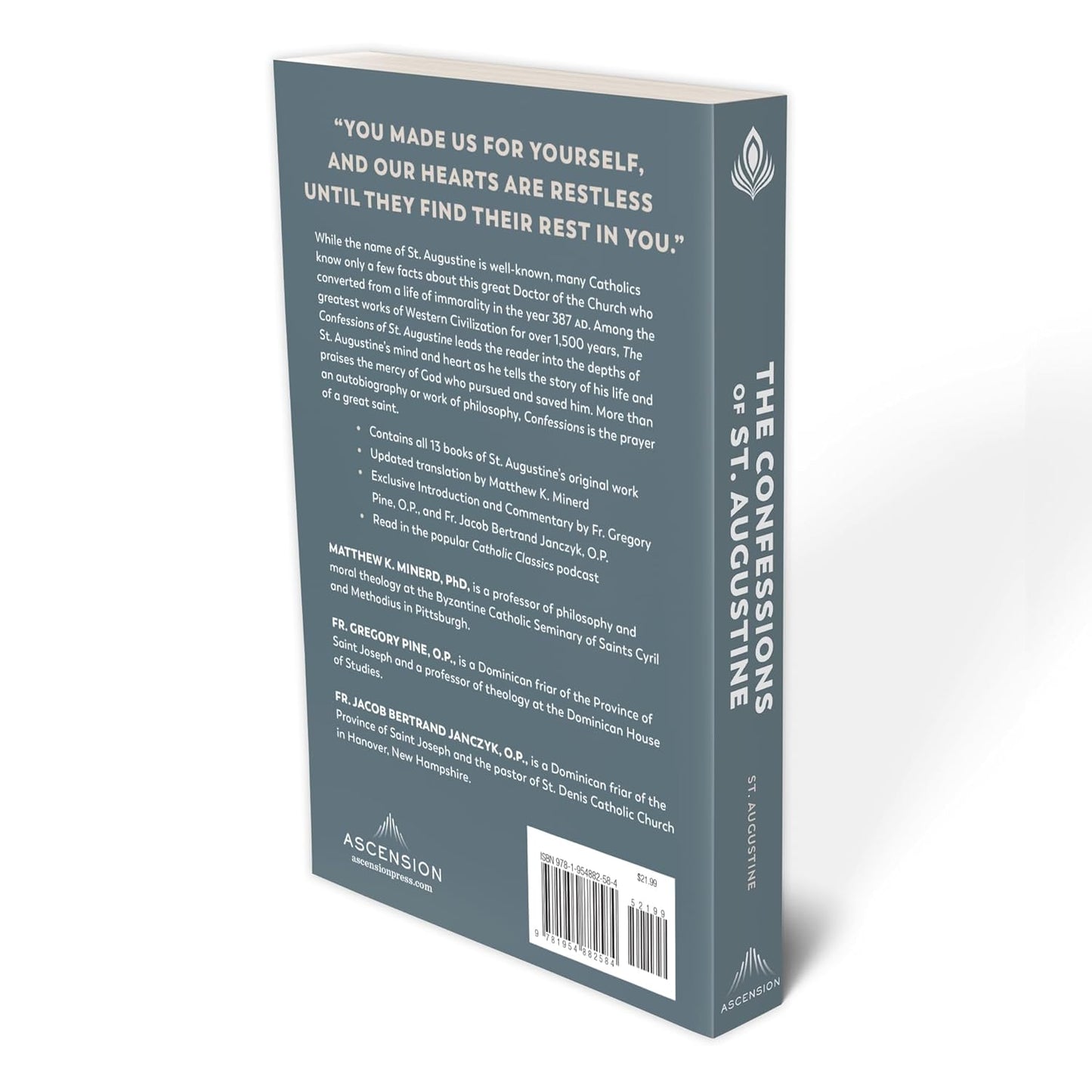
The Confessions of St. Augustine is a 432-page Catholic Classics paperback from Ascension, published February 20, 2024. This English edition features a new translation by Dr. Matthew K. Minerd and introductions to all 13 books by Fr. Gregory Pine, O.P., and Fr. Jacob Bertrand Janczyk, O.P. For Catholics seeking a reliable edition of this foundational spiritual work, it offers accessible language for modern readers while preserving the depth of Augustine’s prayerful autobiography.

  • Updated English translation by Dr. Matthew K. Minerd for clear modern reading
  • Includes introductions and expert commentary for each of the 13 books
  • Paperback format with 432 pages, ISBN-13: 978-1954882584
  • Explores conversion, Sacred Scripture, sin, grace, and the spiritual life
  • Useful for personal prayer, Catholic book study, RCIA enrichment, and spiritual direction reading

Unlike abridged or heavily academic editions, this version is designed for everyday Catholic readers who want both fidelity to the text and practical guidance for understanding it. St. Augustine’s account of repentance, mercy, and transformation remains one of the most cited classics of Christian spirituality and a trusted resource for those pursuing holiness.

Readers may turn to this volume during Lent, Eucharistic adoration, confession preparation, men’s and women’s studies, or year-round devotional reading. It also makes a thoughtful Catholic gift for converts, students, and anyone building a home library of saints books and Catholic books.

View full details

Frequently Asked Questions

Some of the best Catholic books for beginners are works that combine clear teaching with a personal witness of conversion, and The Confessions of St. Augustine is one of the strongest choices in that category. It is not a simple how-to prayer manual, but it helps readers understand sin, grace, Scripture, memory, desire, and God’s action in a human life through Augustine’s direct prayer to God. This edition is especially helpful for modern readers because it uses an updated English translation by Dr. Matthew Minerd and includes introductions to each of the 13 books by Fr. Gregory Pine, O.P., and Fr. Jacob Bertrand Janczyk, O.P. That added guidance makes a classic text easier to approach than many older editions. It is best for readers who want a serious but accessible spiritual classic rather than a short devotional. If someone is completely new to Catholic reading and prefers very brief daily reflections, this may feel denser than a beginner booklet. But for readers who want a foundational Catholic classic that still feels personal and relevant, this is an excellent starting point.
Yes, The Confessions of St. Augustine is widely considered one of the essential Catholic books every Catholic should read. It is often included on core reading lists because it is both autobiographical and theological, showing how grace transforms a restless heart. It remains one of the Church’s most enduring works on conversion, prayer, and the spiritual life. A balanced list of seven often includes Scripture, a catechetical text, and major spiritual classics. Confessions usually belongs in the spiritual classics category because it helps readers reflect on their own weaknesses, habits, desires, and relationship with God. Unlike purely academic theology, Augustine writes as a man addressing God directly, which gives the book unusual spiritual depth and personal immediacy. This specific paperback edition is especially suitable for readers building that essential Catholic library because it presents the text in updated language and adds expert commentary before each section. That makes it a strong choice for Catholics who want a classic that is historically important, spiritually rich, and still readable today.
The Confessions of St. Augustine is considered a major Catholic spiritual classic because it unites personal testimony, theology, and prayer in one work. Augustine does not simply tell his life story. He examines how God pursued him through confusion, ambition, moral failure, and eventual conversion, all while speaking directly to the Lord. Its importance comes from both its influence and its content. For centuries, Catholics and other Christians have read it for insight into grace, sin, Scripture, memory, desire, and the human search for truth. Augustine’s honesty about weakness makes the book timeless, while his reflections on God’s mercy make it deeply hopeful. This edition is especially useful for today’s readers because it presents an updated translation and includes introductions to each of the 13 books by Dominican priests Fr. Gregory Pine and Fr. Jacob Bertrand Janczyk. That helps bridge an ancient text to modern spiritual reading. It is best for readers who want a substantial classic, though those looking for a light devotional may prefer something shorter first.
Yes, this is a very strong choice for someone going through conversion or returning to the Catholic faith. The heart of The Confessions of St. Augustine is the story of a man who struggled with pride, misplaced desire, and spiritual confusion before surrendering more fully to God. Because Augustine speaks candidly about his past and God’s mercy, many readers find the book especially meaningful during seasons of repentance and renewal. This edition is helpful because it is not just a historical text. It uses an updated translation that is more approachable for modern readers, and it includes commentary introducing each of the 13 books. That can make a serious classic feel less intimidating for someone re-entering Catholic life. It is best for readers who are ready for reflective, prayerful reading rather than quick answers alone. The tradeoff is that it is still a substantial 432-page spiritual classic, so it rewards slow reading. For someone seeking a deep companion in conversion rather than a short guide, it is a fitting and worthwhile choice.
Yes, this edition is designed to be more accessible for modern Catholics than many older versions. It features a new translation by Dr. Matthew Minerd, which aims to preserve Augustine’s depth while making the language easier for contemporary readers to follow. That matters because some classic editions can feel formal or difficult, especially for readers new to patristic writing. Another practical advantage is the added structure. The book includes commentary and introductions to each of Augustine’s 13 books from Fr. Gregory Pine, O.P., and Fr. Jacob Bertrand Janczyk, O.P. Those introductions help readers understand what they are about to read and why it still matters spiritually today. This edition is best for readers who want a faithful Catholic classic without feeling lost in archaic wording. The limitation is that Confessions is still an intellectually and spiritually rich text, so it requires attention and reflection. It is more approachable than many traditional editions, but it is not meant to read like a simple devotional pamphlet or modern self-help book.
This edition stands out mainly because it combines a new translation with guided commentary for modern Catholic readers. The translation is by Dr. Matthew Minerd, and it is presented as an updated rendering of one of the key works of Catholic tradition. That can make a meaningful difference for readers who have found older translations harder to follow. It also includes introductions and expert commentary from Fr. Gregory Pine, O.P., and Fr. Jacob Bertrand Janczyk, O.P., who introduce each of the 13 books and explain the text’s relevance for Catholics today. Many editions provide the raw text alone, so this added framework is useful for study, book clubs, or personal spiritual reading. This version is best for readers who want both the classic work itself and help understanding its themes, such as Scripture, the weakness of the human heart, and conversion through grace. If a reader wants a bare academic text with no interpretive guidance, another edition may suit that preference better. For most Catholic readers, though, this format offers a helpful balance of fidelity and readability.
The Confessions of St. Augustine is best for Catholics and Christian readers who want to grow in self-knowledge, prayer, and understanding of grace. It is especially well suited to people wrestling with conversion, repentance, desire, vocation, or the problem of spiritual inconsistency. Augustine’s honesty about his past makes the book relatable, while his theological depth makes it enduring. This edition is particularly helpful for adult readers who want a classic with guidance. It includes commentary before each of the 13 books, which can support those reading Augustine for the first time. It also works well for parish reading groups, adult faith formation, college students, and serious personal devotional study. It may be less ideal for very young readers or for people looking only for brief daily inspiration. Although the updated translation improves accessibility, this is still a full-length spiritual classic at 432 pages. Readers who benefit most are those willing to move slowly, reflect deeply, and let the text challenge their understanding of sin, mercy, and the call to holiness.
Yes, this edition is well suited for Catholic book clubs, adult faith formation, and spiritual study groups. One reason is its built-in structure. Augustine’s work is divided into 13 books, and this edition includes an introduction and commentary for each one from Fr. Gregory Pine, O.P., and Fr. Jacob Bertrand Janczyk, O.P. That makes it easier for groups to assign sections, summarize themes, and discuss spiritual applications. The content also lends itself naturally to discussion. Topics such as conversion, sin, Scripture, memory, grace, and the search for truth are deeply personal yet broadly relevant. Readers can talk about Augustine’s life while also examining their own spiritual struggles and growth. This is best for groups that want more depth than a short devotional study offers. The tradeoff is that Confessions is substantial and reflective, so it works best when a group is willing to read thoughtfully and not rush. For a parish or study group seeking a serious Catholic classic with helpful modern guidance, this edition is a strong fit.
It is best described as a spiritual autobiography written as a prayer, with strong theological depth. The Confessions of St. Augustine includes elements of memoir because Augustine recounts his life, mistakes, intellectual journey, and conversion. It also reads like theology because he reflects on Scripture, the human heart, evil, memory, and grace. Most importantly, the entire work is addressed to God, which gives it the tone of an extended prayer. That blend is exactly why the book has remained so influential. Readers do not just learn facts about Augustine. They encounter a soul speaking honestly before God and trying to understand how divine mercy works in a real life. This edition helps modern readers appreciate all three dimensions. The updated translation makes the text more readable, while the commentary from Fr. Gregory Pine and Fr. Jacob Bertrand Janczyk helps frame Augustine’s ideas. It is ideal for readers who want a book that nourishes prayer and thought together. Those looking for a simple prayer collection or straightforward biography should know it is more layered and demanding than either of those formats.
This paperback edition is a 432-page English-language book published by Ascension on February 20, 2024. Its ISBN-13 is 978-1954882584. The listed dimensions are 6 x 9 x 1 inches, and it weighs about 1.1 pounds. Those details make it a standard trade paperback size rather than a pocket edition. For regular reading, that format is practical for home use, study, and carrying in a bag, though it is not as compact as a small devotional booklet. The 6 x 9 trim size usually gives readers a more comfortable page layout than smaller formats, which can help with a dense classic text. Because Confessions is a book many readers will underline, annotate, and revisit, the paperback format can also be convenient for study purposes. This edition is best for readers who want a readable, full-length spiritual classic they can use over time. The only tradeoff is portability. If someone wants a highly compact travel book, a smaller edition might be easier to carry, but for sustained reading and study, this format is a solid choice.