Skip to product information
1 of 8

Eucharistic Miracles Book

Eucharistic Miracles Book

Regular price $13.95 USD
Regular price $18.00 USD Sale price $13.95 USD
Sale Sold out
Shipping calculated at checkout.

FREE Shipping for all orders over $50 -- We have graduated discounts automatically  applied up to 67% when you add to cart. --- 20% off orders over $50 --- 25% off orders over $75 --- 30% off orders over $100 --- 35% off orders over $150 --- 5%Cash Back Store Credit on all orders

CHECKOUT TIPS 1. Discounts are applied automatically! 3. Pay with credit card or Express Pay

This Catholic book on Eucharistic miracles by Bob and Penny Lord presents 22 Church-accepted accounts in a 190-page volume focused on the Real Presence of Christ in the Eucharist. Unlike a general devotional, it combines historical testimony, Catholic tradition, and reported scientific examination in one readable reference for study, prayer, and faith formation.

  • Includes 22 Eucharistic miracles accepted by the Church
  • Covers Lanciano, Bolsena and Orvieto, Siena, Cascia, Offida, Zaragoza, Avignon, and more
  • Features accounts of saints who lived solely on the Eucharist, as presented on EWTN
  • Written by Catholic authors Bob and Penny Lord
  • Useful for personal reading, parish study groups, RCIA, and Eucharistic Adoration reflection

Readers often choose this title when looking for a Catholic book on Eucharistic miracles, Eucharistic apologetics, or Confirmation and sacramental study resources. Compared to shorter prayer booklets, this volume offers specific dates, locations, and miracle details that make it easier to reference and discuss.

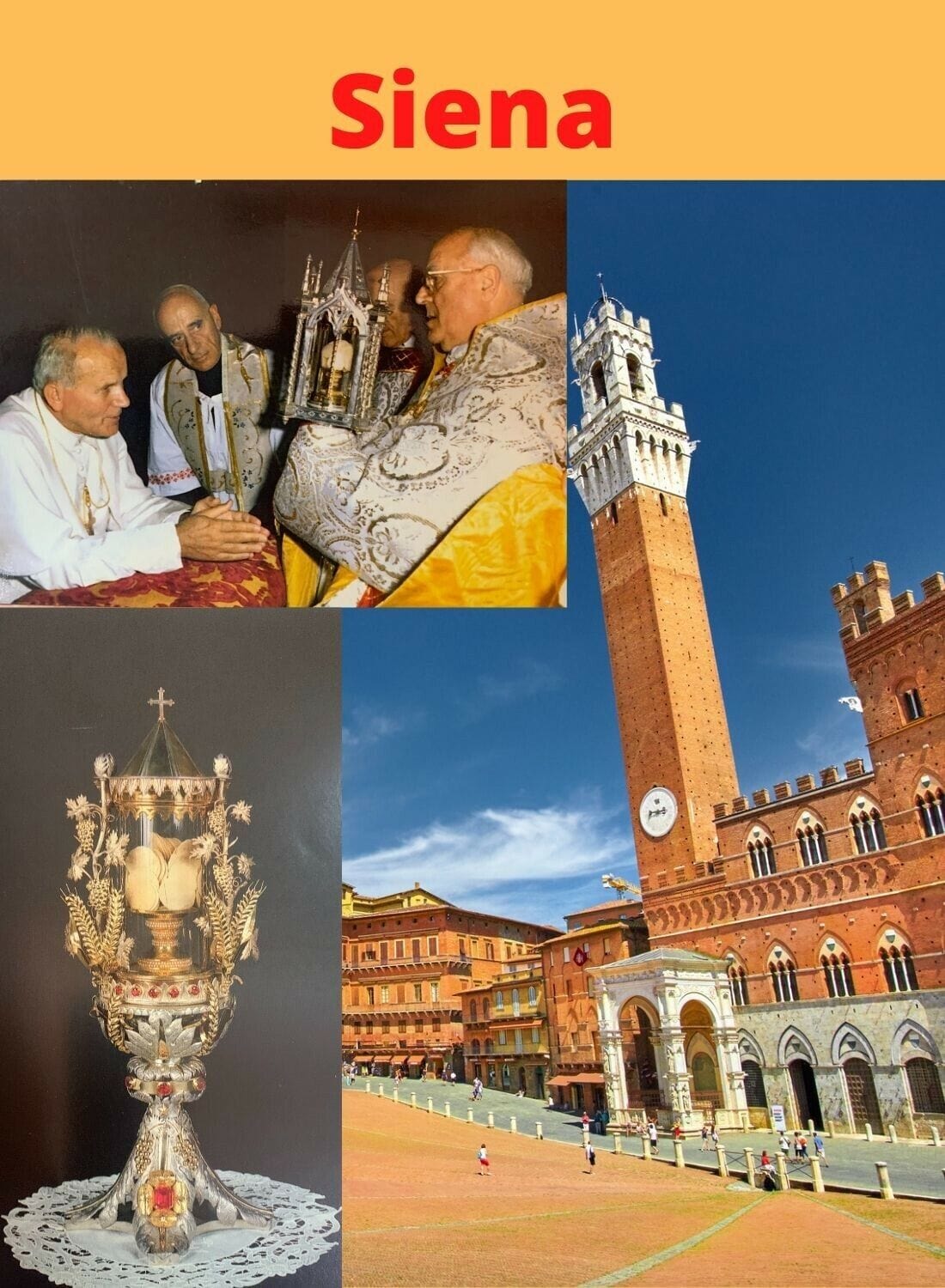
Topics include Lanciano in the 700s AD, where the Host turned into Flesh and the Wine into Blood, Siena in 1730 with consecrated Hosts reported not to have decayed after 276 years, and Bolsena and Orvieto in 1263, connected to the Feast of Corpus Christi and the liturgy written by St. Thomas Aquinas. A strong resource for Catholics seeking a factual, faith-centered book on the Eucharist.

View full details

Frequently Asked Questions

Yes. Eucharistic miracle books typically collect historical cases in which the consecrated Host or Precious Blood was reported to manifest in extraordinary ways, often with Church investigation and documentation. They are commonly used by Catholics who want to deepen their understanding of the Real Presence, prepare for Eucharistic adoration, or study well-known miracle sites and saints connected to the Eucharist. This is My Body, This is My Blood, Miracles of the Eucharist is one example in this category. It presents 22 Eucharistic miracles accepted by the Church and described as scientifically examined, along with accounts of saints who lived solely on the Eucharist. The book includes major cases such as Lanciano, Bolsena and Orvieto, Siena, Cascia, Offida, Zaragoza, and Avignon. This type of book is especially helpful for readers who want a devotional and historical overview rather than a purely academic theology text. If you want a concise introduction with specific miracle accounts in one volume, this format can be a strong place to start.
Some of the most frequently cited Eucharistic miracles include Lanciano in the 700s, where the Host reportedly became Flesh and the wine became Blood, and Bolsena and Orvieto in 1263, a miracle closely associated with the establishment of the Feast of Corpus Christi. Siena is also widely discussed because consecrated Hosts there were reported to remain undecayed for centuries. This book covers those major cases and many others. It includes Lanciano, Offida, Bolsena and Orvieto, Siena, Cascia, Zaragoza, Bois Seigneur Isaac, and Avignon. In total, it presents 22 Church-accepted Eucharistic miracles, plus accounts of Eucharistic saints and fasters. Readers who want a broad survey of classic miracle narratives often benefit from a book like this because it gathers multiple locations and time periods into one source. The tradeoff is that a survey format gives you range and accessibility, but not the same depth you would get from a single-volume scholarly study focused on one miracle or one historical period.
Yes, it is a practical introductory choice for many readers. The book gathers 22 Eucharistic miracles into one 190-page volume, which makes it more approachable than trying to research individual cases separately. It is especially useful for readers who are beginning to explore Catholic teaching on the Real Presence and want historical examples connected to Church tradition. The content is not limited to one famous miracle. It spans different centuries and regions, including Lanciano, Siena, Cascia, Offida, and other notable cases. It also includes material on saints who reportedly lived solely on the Eucharist, which broadens the book beyond miracle events alone. This book is likely best for devotional readers, RCIA participants, adult faith formation groups, and Catholics revisiting belief in the Eucharist. A limitation is that readers seeking a strictly academic or heavily footnoted historical analysis may want to pair it with more specialized theological or historical studies. For an accessible overview, though, it fits well.
A Eucharistic miracles book focuses on historical miracle accounts, while a general theology book on the Eucharist explains doctrine, Scripture, liturgy, and sacramental theology in a more systematic way. If your goal is to understand what the Church teaches, theology texts are essential. If your goal is to see how belief in the Real Presence has been reinforced through specific historical events, miracle collections are often more engaging and concrete. This is My Body, This is My Blood is centered on miracle narratives rather than a full doctrinal treatment. It presents 22 miracles accepted by the Church, includes examples such as Lanciano and Bolsena, and adds stories of Eucharistic saints and fasters. That makes it especially helpful for readers who respond strongly to testimony, history, and case-based learning. The tradeoff is that this kind of book complements Eucharistic theology rather than replaces it. It is best for readers who want historical examples to strengthen prayer, belief, or catechesis, not for those seeking a complete textbook on sacramental theology.
Yes. The book includes the Eucharistic miracle of Lanciano, one of the oldest and most widely known documented Eucharistic miracles in Catholic history. According to the product details, it presents Lanciano as a miracle from the 700s in which the Host turned into Flesh and the wine turned into Blood. For many readers, Lanciano is the first miracle they want to study because it is often cited in discussions of the Real Presence and Eucharistic apologetics. This book places Lanciano alongside other Church-accepted miracles, which helps readers compare one famous case with a wider historical pattern rather than viewing it in isolation. That makes the book useful for Catholics preparing talks, prayer groups, or personal study on the Eucharist. If your main interest is an in-depth, single-subject treatment of Lanciano alone, a specialized study may go further. But if you want Lanciano included within a broader collection of Eucharistic miracles, this book does that clearly.
It relates to the same general subject, but it is not presented as a Carlo Acutis title. This book is written by Bob and Penny Lord and focuses on Eucharistic miracles accepted by the Church, including major historical examples such as Lanciano, Siena, Bolsena and Orvieto, Cascia, and Offida. Shoppers often search for Eucharistic miracles through the lens of Carlo Acutis because he became closely associated with promoting awareness of these miracles. If that is your entry point, this book still fits the topic well because it offers a broad survey of miracle accounts in book form. It can serve readers who want to continue studying the same category of Catholic history and devotion, even if they are not specifically looking for a title authored by or centered on Acutis. The key distinction is simple: this is a Eucharistic miracles overview by Bob and Penny Lord, not a Carlo Acutis-branded compilation. It is best chosen for its coverage of multiple miracle accounts and devotional usefulness.
This book is best suited for Catholics who want a readable overview of Eucharistic miracles and their role in strengthening belief in the Real Presence. It can be especially helpful for adult faith formation, RCIA participants, Eucharistic adoration groups, catechists, and individual readers who want concrete historical accounts rather than only abstract theological explanations. Because it contains 22 Church-accepted miracles and also includes saints who lived solely on the Eucharist, it offers a mix of miracle history and devotional inspiration. Readers interested in famous cases like Lanciano, Siena, Cascia, or Bolsena and Orvieto are likely to find it useful. It may also appeal to those preparing talks or discussions around Corpus Christi, Eucharistic revival, or sacramental faith. A possible limitation is that academically focused readers may want more extensive historical apparatus or critical analysis than a devotional overview usually provides. For most general Catholic readers, though, it works well as an accessible entry point and a practical resource for reflection and study.
Besides miracle accounts, the book also includes material on saints who lived solely on the Eucharist, as shown on EWTN according to the product description. That matters because it expands the book from being only a list of extraordinary events into a broader reflection on Eucharistic faith as lived in the Church. The main core of the book is still the 22 Eucharistic miracles accepted by the Church, including famous locations such as Lanciano, Offida, Siena, Cascia, Zaragoza, and Avignon. But the addition of Eucharistic saints and fasters gives readers another way to approach the subject. Instead of only asking what happened at a miracle site, readers can also consider how devotion to the Eucharist shaped holy lives. This broader approach is especially helpful for prayer groups, spiritual reading, and readers who want both apologetic and devotional value. If you want a book that combines miracle history with examples of Eucharistic holiness, this content mix is a useful feature.
This book appears to be more devotional and accessible than strictly academic. It presents 22 Eucharistic miracles accepted by the Church, highlights well-known cases across different centuries, and includes saints who lived solely on the Eucharist. That structure is designed to inspire belief, reflection, and discussion rather than function as a technical scholarly reference. For many Catholic readers, that is a strength. A devotional overview can be easier to read, easier to share in study groups, and more effective for spiritual reflection than a dense academic treatment. The miracle accounts give concrete examples that connect doctrine with lived faith. The tradeoff is that readers seeking extensive source criticism, advanced historical methodology, or a full theological synthesis may need additional books. In other words, this title is well suited for personal reading, parish use, and introductory study, while researchers or graduate-level students may want to supplement it with more specialized historical or theological works.
Someone would choose a Eucharistic miracles book when the main goal is to explore evidence-based or historically transmitted accounts connected to belief in the Real Presence. A general saints book usually focuses on biographies, and a prayer book centers on devotion and daily practice. A Eucharistic miracles book addresses a different need: understanding how extraordinary events have shaped Catholic faith in the Eucharist. This title is particularly useful for that purpose because it gathers 22 Church-accepted miracles and includes major cases such as Lanciano, Siena, Cascia, Offida, and Bolsena and Orvieto. It also adds saints who lived solely on the Eucharist, so it still offers some spiritual dimension alongside the miracle narratives. This makes it a good choice for readers wrestling with belief in the Eucharist, preparing for catechesis, or looking for material to support Eucharistic devotion. The tradeoff is that it is more specialized than a prayer book or broad Catholic introduction. It is best for readers specifically interested in Eucharistic faith and miracle history.